Category: States

  • U.S. Virgin Islands: America’s Paradise In The Caribbean

    In the northeastern Caribbean Sea, where the Atlantic Ocean meets warm tropical waters and the trade winds blow steadily from the east, lies a small constellation of islands that has captivated sailors, explorers, and travelers for centuries. The United States Virgin Islands, an unincorporated territory of the United States consisting of three main islands and dozens of smaller cays and islets, offer one of the most complete and varied Caribbean experiences available anywhere in the region. Here, within a chain of islands spanning roughly 50 miles, visitors find world-class sailing waters, beaches of breathtaking beauty, some of the best snorkeling and diving in the Western Hemisphere, the ruins of a sugar plantation economy built on the labor of enslaved Africans, vibrant towns with a strong West Indian character, and a national park that protects more than half of one of the islands in near-pristine condition.

    The three main islands, St. Thomas, St. John, and St. Croix, each have a distinct personality. St. Thomas is the commercial and tourist hub, a lively, hilly island with a busy cruise ship port, duty-free shopping that draws shoppers from around the world, a sophisticated restaurant and nightlife scene, and access to some beautiful beaches on its more sheltered coasts. St. John is the most natural and serene of the three, where the Virgin Islands National Park covers nearly two-thirds of the island and where the pace of life is slow, the beaches are legendary, and the waters of Trunk Bay and Cinnamon Bay are among the most beautiful in the Caribbean. St. Croix, the largest of the three but the least visited, is in many ways the most authentically West Indian, with a rich African heritage, a charming historic capital in Christiansted, the best agricultural land in the territory, a growing farm-to-table food scene, and diving off the dramatic underwater wall along its northern coast that is among the most spectacular in the entire Caribbean.

    For American citizens, the U.S. Virgin Islands offer a particular combination of convenience and tropical escape. No passport is required. The currency is the U.S. dollar. English is the primary language. American cell phone plans typically work without international charges. And yet the islands feel genuinely foreign, genuinely Caribbean, with a culture shaped by African, Danish, and West Indian traditions that gives them a character entirely their own. The food is different. The music is different. The colors of the water and the architecture and the flowers are different from anything on the mainland. The U.S. Virgin Islands are, for American travelers, among the most accessible yet most transporting international-feeling destinations in the world.

    A BRIEF HISTORY
    The islands that are now the U.S. Virgin Islands have been inhabited for thousands of years. Archaeological evidence indicates that indigenous peoples settled the islands as early as 2000 BCE, and the Ciboney, Arawak, and Taino peoples all had communities in the islands before European contact. The Kalinago, also known as the Caribs, were the dominant people in the region when Europeans arrived, and their reputation as fierce warriors who resisted colonization with great tenacity gave the entire region its name: the Caribbean.

    Christopher Columbus encountered the islands during his second voyage in 1493, naming the archipelago Las Once Mil Vírgenes, meaning the Eleven Thousand Virgins, in honor of Saint Ursula and her legendary martyred companions. Columbus landed on St. Croix, where his party had a violent confrontation with Kalinago inhabitants, the first recorded armed conflict between Europeans and indigenous peoples of the Americas. Spain claimed the islands but did not develop them significantly, and the indigenous population was decimated by disease, violence, and enslavement within decades of European contact.

    The Danish West India Company established the first permanent European colony on St. Thomas in 1672, and Denmark went on to colonize St. John in 1718 and to purchase St. Croix from France in 1733. Under Danish rule, the islands were developed primarily as sugar-producing colonies, an enterprise that depended entirely on the labor of enslaved Africans brought across the Atlantic in the horrific conditions of the Middle Passage. By the 18th century, the sugar plantations of St. Croix in particular had made the Danish West Indies among the most productive colonial possessions in the Caribbean, and the enslaved population vastly outnumbered the European colonists.

    The resistance of enslaved people to their bondage took many forms, from day-to-day acts of defiance to organized uprisings. The most significant rebellion occurred on St. John in 1733 and 1734, when enslaved Akwamu people from present-day Ghana seized control of most of the island and held it for six months before Danish and French forces suppressed the uprising. It was one of the earliest and longest slave revolts in the Americas and is remembered with pride in the Virgin Islands today. Denmark abolished the slave trade in its colonies in 1792, the first European colonial power to do so, though slavery itself continued until full emancipation in 1848, which came after an uprising led by a man named Moses Gottlieb, known as General Buddhoe, who led hundreds of enslaved people to demand freedom. The Danish governor, fearing a broader revolt, declared emancipation on July 3, 1848, a date still celebrated as Emancipation Day in the U.S. Virgin Islands.

    The United States purchased the islands from Denmark in 1917 for 25 million dollars in gold, motivated primarily by strategic concerns during World War I about the possibility of Germany seizing the territory and using its harbors to threaten the Panama Canal. The residents of the islands, who were not consulted about the sale, were granted American citizenship in 1927. The islands became an unincorporated organized territory of the United States, a status that, as in Guam and Puerto Rico, gives residents American citizenship but denies them the right to vote in presidential elections unless they establish residency on the mainland.

    The sugar industry, already declining by the time of the American purchase, collapsed entirely during the early and mid-20th century. Tourism began to emerge as an economic driver in the 1950s and 1960s, and the establishment of the Virgin Islands National Park on St. John in 1956, largely through the efforts and funding of Laurance Rockefeller, transformed that island and helped establish the territory’s reputation as a premier Caribbean destination. Today tourism is by far the dominant economic activity across all three islands, supplemented by the Hovensa oil refinery complex on St. Croix, which was one of the largest oil refineries in the Western Hemisphere before its closure in 2012, and by a small but growing agricultural and artisan economy.

    Hurricane Irma and Hurricane Maria, which struck the islands in September 2017 within two weeks of each other, caused catastrophic damage across the territory. Irma, one of the most powerful Atlantic hurricanes ever recorded, devastated St. Thomas and St. John in particular, destroying infrastructure, homes, hotels, and boats, and stripping vegetation from the hillsides. The recovery has been substantial and ongoing, and the islands have largely rebuilt and reopened, though some scars and some ongoing projects remain visible to attentive observers.

    GEOGRAPHY AND CLIMATE
    The U.S. Virgin Islands sit about 40 miles east of Puerto Rico and about 1,100 miles southeast of Miami, at a latitude of approximately 18 degrees north. They form the western end of the Lesser Antilles island chain, with the British Virgin Islands beginning immediately to the east across the Sir Francis Drake Channel.

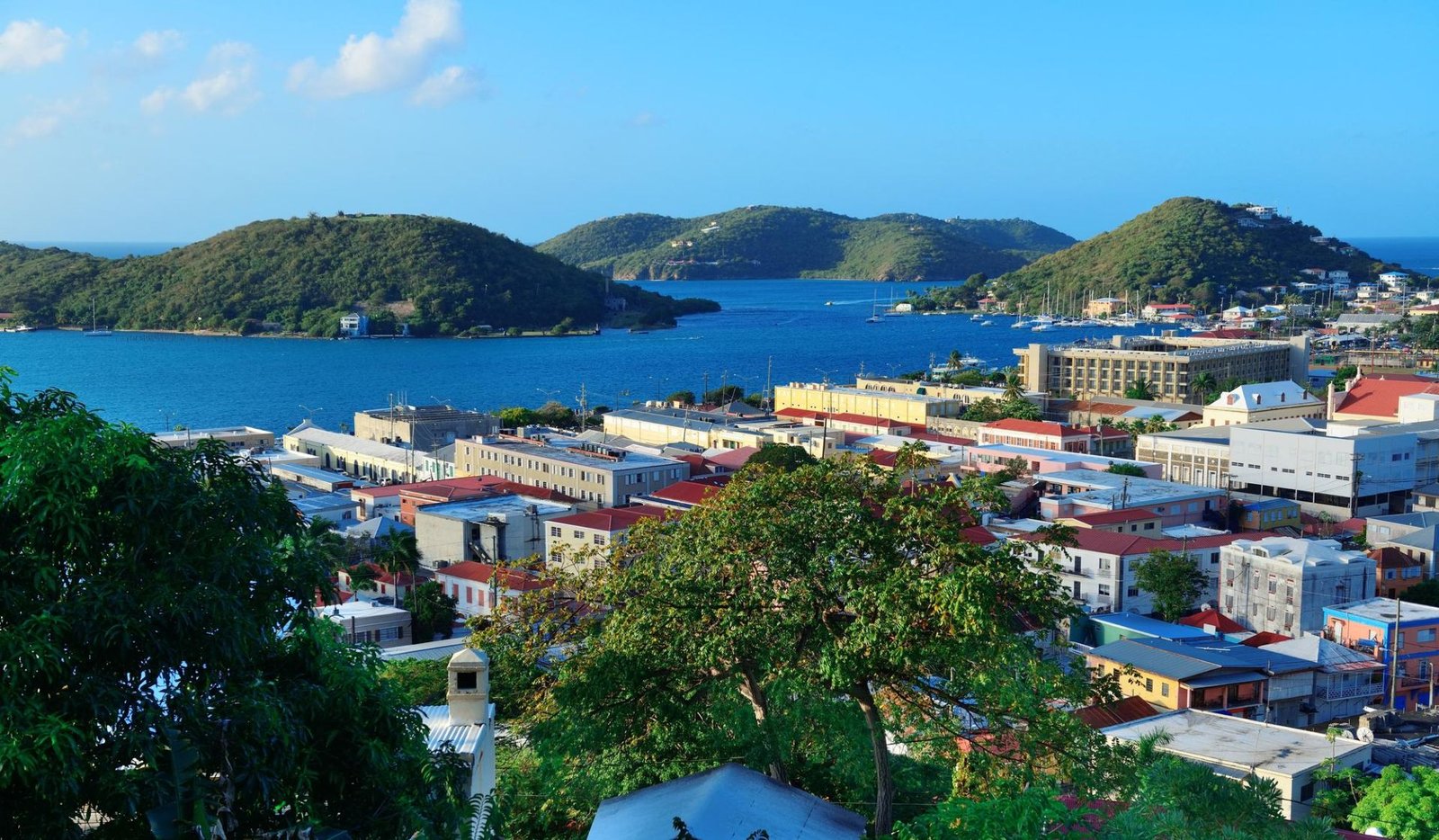
    St. Thomas is the second largest of the three main islands, covering about 32 square miles. It is dramatically hilly, with a central ridge running east to west that reaches its highest point at Crown Mountain at 1,556 feet. The island’s topography creates a distinction between the calmer, more protected waters of the southern and western coasts and the more exposed northern and eastern coasts, which face the Atlantic trade winds and swell. The capital and main port, Charlotte Amalie, sits on the island’s southern coast around a deep, well-protected natural harbor.

    St. John is the smallest of the three main islands, covering about 19 square miles, and the most rugged, with steep, heavily forested hills dropping to turquoise bays. The Virgin Islands National Park covers approximately 60 percent of the island’s land area and extends underwater to protect the surrounding coral reefs. The island has no airport; visitors arrive by ferry from St. Thomas or from the British Virgin Islands. The main settlement is Cruz Bay on the western tip, which has restaurants, shops, a ferry dock, and the park visitor center.

    St. Croix is the largest of the three main islands, covering about 84 square miles, and it lies about 40 miles south of St. Thomas and St. John, separated from them by a deep ocean channel. Its topography is more varied than the other two islands, with a range of hills in the northwest, a flat coastal plain in the center and east, and dramatic cliffs along parts of the northern coast. This varied geography, combined with its position slightly south and west of the other islands, gives St. Croix a somewhat different ecological character, with drier conditions in the east and more lush tropical vegetation in the northwest. The two main towns are Christiansted on the northern coast and Frederiksted on the western coast. St. Croix is also home to the territory’s airport, Henry Rohlsen Airport, which receives commercial flights from the mainland.

    The climate across all three islands is tropical, moderated by the consistent easterly trade winds that keep conditions more comfortable than the temperature alone would suggest. Average temperatures hover around 80 degrees Fahrenheit year-round, rarely dropping below 70 or rising above 90. The dry season runs roughly from December through April, with lower humidity, less rainfall, and the clearest water conditions. The wet season from May through November brings heavier but usually brief tropical rain showers and the risk of tropical storms and hurricanes, with the peak hurricane season running from August through October.

    The water temperature is warm year-round, typically ranging from about 78 degrees in winter to about 84 degrees in summer, making it comfortable for extended snorkeling and diving in all seasons without a wetsuit, though a thin rash guard provides useful protection from sunburn and the occasional jellyfish.

    ST. THOMAS: THE COMMERCIAL HUB
    St. Thomas is the entry point for most visitors to the U.S. Virgin Islands, home to the territory’s main international airport, Cyril E. King Airport, and the busiest cruise ship port in the Caribbean. On any given day during high season, two, three, or four massive cruise ships may be docked in Charlotte Amalie harbor, disgorging thousands of passengers for the day’s shopping and sightseeing. Despite, or perhaps because of, this commercial intensity, St. Thomas has developed a full-service tourist infrastructure that is sophisticated, varied, and generally impressive.

    Charlotte Amalie, the capital and commercial center, is a working town as well as a tourist destination, with a waterfront that handles both cruise ship passengers and serious commerce. The downtown shopping district, concentrated along Main Street and the parallel streets and alleyways running up the hillside behind it, is one of the premier duty-free shopping destinations in the Caribbean. Jewelry, watches, perfumes, liquors, electronics, clothing, and luxury goods are available at prices that, for certain categories, are genuinely competitive with or lower than mainland prices and far lower than comparable items in some visitors’ home countries. Shopping in Charlotte Amalie is an experience in itself: the stores are housed in old Danish colonial warehouses and counting houses, painted in the warm pastels that characterize historic Caribbean architecture, and the alleyways between them have names that recall the mercantile history of the port.

    Beyond shopping, Charlotte Amalie has genuine historic and architectural interest. Fort Christian, a rust-red Danish fortification completed in 1680 and one of the oldest buildings in the territory, is a landmark at the edge of the waterfront and houses a museum of Virgin Islands history. The 99 Steps, one of several stairways built by the Danes from ship’s ballast brick that climb the steep hillside above the town, lead up to Blackbeard’s Castle, an 18th-century watchtower with panoramic views of the harbor and the surrounding islands. The Frederick Lutheran Church, dating from 1793, is the second oldest Lutheran congregation in the Western Hemisphere and a beautiful example of Danish colonial ecclesiastical architecture.

    Hassel Island, in the middle of Charlotte Amalie harbor, is a unit of the Virgin Islands National Park and contains the ruins of a 19th-century British fortification and a marine railway. The island is accessible by water taxi from the waterfront and offers hiking, birding, and a peaceful contrast to the busy mainland shore.

    The beaches of St. Thomas are among its greatest assets, though reaching the best ones requires a short drive or a water taxi ride from the main tourist areas. Magens Bay, on the northern coast, is one of the most celebrated beaches in the entire Caribbean, a mile-long arc of white sand sheltered by wooded hills on either side and fronted by calm, clear, flat water that is perfect for swimming and kayaking. It is justifiably famous and can be crowded during cruise ship days, but its beauty is undeniable at any time of day.

    Coki Beach, also on the northern coast near Coral World Ocean Park, is a smaller beach with excellent snorkeling directly from shore and a lively, local-feeling atmosphere with vendors selling food, drinks, and beach rentals. Coral World itself is an ocean park with underwater observation areas, a sea turtle sanctuary, reef tanks, and various marine encounters that make it particularly popular with families.

    Hull Bay, also on the north coast, is a local favorite with a relaxed surf shack atmosphere and the best surf conditions on the island when the north swell runs. Brewers Bay, near the airport on the western coast, is a quiet, shallow bay with good snorkeling and a more local feel. Sapphire Beach and Secret Harbour on the eastern end of the island are resort beaches with calm water, water sports rentals, and good dining nearby.

    Drake’s Passage and the surrounding waters off St. Thomas’s eastern end are some of the finest sailing waters in the Caribbean, and the charter boat industry is a major part of the island’s economy. Day sails to the neighboring British Virgin Islands, sunset cruises, snorkeling charters, and full-crewed private yacht charters departing from Red Hook Marina on the eastern tip of St. Thomas are all popular and widely available.

    The view from Paradise Point, reached by cable car from the waterfront near the cruise ship dock, offers spectacular panoramic views of Charlotte Amalie, the harbor, and the surrounding islands, including St. John and several of the British Virgin Islands on clear days. It is a tourist attraction but a genuine one, and the view at sunset is memorable.

    ST. JOHN: THE JEWEL OF THE CARIBBEAN
    If St. Thomas is the commercial heart of the U.S. Virgin Islands, St. John is its soul. Small, hilly, and largely protected by the national park that covers most of its area, St. John is the island that visitors most often describe as life-changing, the one they cannot stop thinking about when they return home, the one that brings them back year after year.

    The ferry ride from Red Hook on St. Thomas to Cruz Bay on St. John takes about 20 minutes and crosses waters of extraordinary clarity. Cruz Bay itself is a small, colorful, walkable village with a handful of restaurants, bars, boutiques, and galleries clustered around the ferry dock and the adjacent streets. It has a genuine community feeling; unlike the aggressively commercial atmosphere of Charlotte Amalie, Cruz Bay has the character of a place where people actually live rather than merely sell.

    The Virgin Islands National Park visitor center at Cruz Bay is an excellent starting point for understanding the island. The park was established in 1956 on land donated by Laurance Rockefeller, who had quietly purchased much of the island over several years before donating it to the National Park Service. The park encompasses not only the terrestrial forests, hills, and beaches but also the surrounding coral reef ecosystems, making it one of the first parks to include underwater protection as part of its mandate.

    The beaches of St. John are, quite simply, among the most beautiful in the world. Trunk Bay is the most famous, a long crescent of brilliant white sand sheltered by forested hills, with an underwater snorkeling trail marked with plaques identifying coral formations and marine life. It is the most photographed beach in the Caribbean and lives up entirely to its reputation on a calm morning before the day-trippers arrive from St. Thomas. Cinnamon Bay, a few minutes further east along North Shore Road, is longer and more wild-feeling, with a campground and historic sugar mill ruins at its western end and excellent snorkeling at both ends of the beach. Hawksnest Bay, closest to Cruz Bay, is a local favorite with several separate sections of beach, good snorkeling, and a slightly quieter atmosphere than Trunk Bay. Maho Bay is one of the best places in the Caribbean to spot sea turtles feeding on seagrass in the shallows, and patient visitors sitting quietly at the water’s edge in the early morning or late afternoon are frequently rewarded with close encounters with these ancient, beautiful animals.

    Watermelon Bay, Leinster Bay, and Francis Bay on the northern coast are more remote and require a short hike from the road, a quality that reduces the crowds substantially and rewards the effort with even greater tranquility. The trail around the Leinster Bay area also passes the ruins of the Annaberg Sugar Plantation, one of the best-preserved plantation complexes in the territory and an important site for understanding the island’s history. The National Park Service offers ranger-led programs at Annaberg that provide context for the lives of the enslaved people who worked the plantation, and the ruins of the windmill tower, boiling house, and other structures speak eloquently of an economy built on brutality.

    Hiking in the national park is one of St. John’s great pleasures. The park maintains more than 20 trails covering about 800 different miles of territory across the island’s hills and coast. The Ram Head Trail, in the remote southern part of the island, leads through dry scrub forest and cactus to a dramatic rocky headland 200 feet above the sea, with views in every direction that are among the finest in the Caribbean. The Reef Bay Trail is the island’s most popular hike, descending from the center of the island through various ecological zones to a beautiful bay on the southern coast, passing ancient Taino petroglyphs carved into rocks near a freshwater pool along the way. The National Park Service offers guided hikes to Reef Bay that include a boat return to Cruz Bay, sparing hikers the uphill return journey.

    The waters around St. John provide outstanding snorkeling and diving. The healthy coral reefs, protected by their national park status, support an abundance of marine life including sea turtles, eagle rays, nurse sharks, barracuda, parrotfish, angelfish, trumpet fish, and hundreds of other species. The coral formations themselves are complex and beautiful, with brain corals, elkhorn corals, sea fans, and sponges of vivid color. Salt Pond Bay on the southern coast, Waterlemon Cay off the northeastern coast, and the reefs at the eastern end of Trunk Bay are among the top snorkeling locations.

    Accommodations on St. John range from the legendary Caneel Bay resort, originally developed by Laurance Rockefeller and long considered one of the premier luxury resorts in the Caribbean, to the Cinnamon Bay Campground, operated by the National Park Service and offering the experience of sleeping in tents or cottages within the park at an affordable price. A range of villas, small inns, and vacation rentals fill the middle ground. The island has no large chain hotels, which is part of what preserves its character.

    The restaurant scene in Cruz Bay has grown steadily in quality over the years. Several restaurants offer genuinely excellent food in settings ranging from open-air waterfront tables to hillside terraces overlooking the harbor. The combination of fresh local fish, Caribbean produce, and the culinary ambitions of chefs who have chosen island life makes dining on St. John a genuine pleasure rather than merely a necessity.

    ST. CROIX: THE FORGOTTEN GEM
    Of the three main islands, St. Croix is the least visited and in many ways the most rewarding for the traveler willing to make the extra effort to reach it. It lies 40 miles south of St. Thomas and St. John, a separation that keeps it off the itinerary of visitors who ferry between the northern islands and consider themselves to have seen the U.S. Virgin Islands. Those who do make the journey to St. Croix, by small plane from St. Thomas or directly from the mainland, discover an island with a stronger West Indian cultural identity, a richer agricultural landscape, a more complex and layered history, and diving along its northern wall that ranks among the best in the Caribbean.

    Christiansted, the island’s main town, is one of the best-preserved examples of Danish colonial urban architecture in the Caribbean. The historic district, a national historic site maintained by the National Park Service, consists of a compact waterfront area of 18th and early 19th-century buildings in yellow, pink, ochre, and white, many of them with the arcaded sidewalks called galleries that protected pedestrians from sun and rain. The scale of the town is human and walkable, and the harbor, with its small boats, pelicans, and the small yellow Fort Christiansvaern on the point, has a beauty and an authenticity that rewards slow exploration on foot.

    Fort Christiansvaern, completed by the Danes in 1749 and the best-preserved Danish colonial fort in the Caribbean, is managed by the National Park Service and open for tours. The fort’s ramparts offer views over the harbor and the surrounding townscape, and the interior, with its cannons, powder magazine, dungeon, and officers’ quarters, provides a vivid sense of the colonial military world. The nearby Steeple Building, a former Lutheran church completed in 1753 and now a museum, houses exhibits on the island’s Amerindian, African, and Danish heritage.

    The Christiansted boardwalk along the harbor is a pleasant place to walk, eat, and watch the activity of the small harbor, from which boats depart for snorkeling and diving trips, for day trips to Buck Island, and for sailing excursions. The restaurants and bars along the waterfront and the adjacent streets offer a range of cuisines and price points, with fresh fish and lobster prominent on many menus.

    Frederiksted, on the western coast, is a smaller and quieter town with its own Danish colonial architecture and Fort Frederik, where emancipation was proclaimed on July 3, 1848. The fort and the adjacent Victorian-era pier are the main attractions, and the town has a handful of restaurants and a different, more subdued character from the busier eastern coast. The pier at Frederiksted is one of the few places in the Caribbean where night diving directly from a pier is possible, and the marine life that congregates around the pier’s pilings after dark, including seahorses, frogfish, flamingo tongues, and various other nocturnal creatures, makes it a favorite among divers.

    The north shore of St. Croix, between Christiansted and the northwestern end of the island, is where the island’s most dramatic natural feature lies: the St. Croix Wall, also known as the north drop. The island’s coral shelf drops abruptly from about 35 feet to depths exceeding 3,000 feet just off the northern coast, and the wall dive along this dramatic underwater cliff is one of the great dive experiences in the Caribbean. The wall is festooned with black corals, deep-sea sponges in colors ranging from orange to purple to yellow, sea fans, and a diversity of fish life including large pelagics that cruise past in the blue water beyond the wall’s edge. Several dive operators based in Christiansted run regular trips to the wall, and the combination of the wall diving with the shallower reef diving in the same area makes St. Croix a destination that serious divers regard as unmissable.

    Buck Island Reef National Monument, a small island and surrounding reef about a mile and a half off the northeastern coast of St. Croix, is one of the great snorkeling destinations in the United States. The underwater trail through the elkhorn coral gardens along the island’s eastern shore, in water that ranges from three to twelve feet in depth and visibility that can exceed 100 feet on good days, is an experience of almost overwhelming beauty. The reef here is some of the healthiest in the territory, and the fish life, including large schools of blue tangs, sergeant majors, parrotfish, and the ever-present sea turtles, is abundant. Boat tours to Buck Island depart from Christiansted harbor throughout the day.

    The interior of St. Croix, with its gentle hills, pastures, and historic sugar estate ruins scattered across the landscape, is worth exploring by rental car. The northwestern highlands, known as the Rain Forest, receive more moisture than the rest of the island and support dense, lush tropical vegetation. The Estate Whim Museum, a beautifully preserved 18th-century sugar plantation near Frederiksted, is the most complete plantation museum in the territory and offers a thoughtful and unflinching interpretation of the plantation system and the lives of the enslaved people who made it run. The great house, cookhouse, windmill, and other structures are well-preserved, and the museum’s programming engages seriously with the African heritage that is central to Crucian identity.

    The food scene on St. Croix has been developing rapidly, driven in part by a local agricultural revival that has brought small farms producing tropical fruits, vegetables, herbs, and livestock back to life on land that was fallow for decades after the sugar industry’s collapse. The St. Croix Food and Wine Experience, held annually in April, celebrates this local food culture with dinners, tastings, and events held at plantation estates and other beautiful settings around the island. The Farmer’s Market held in various locations around the island on weekends is an excellent place to sample local produce, prepared foods, and artisan products.

    St. Croix also has a growing craft spirits scene. Cruzan Rum, produced at a distillery near Frederiksted that has been making rum on the island since 1760, is the most established producer and offers tours and tastings. The rum production tradition is deeply connected to the sugar history of the island, and Cruzan Rum remains one of the most respected names in Caribbean rum.

    The culture of St. Croix, shaped by its African, Danish, and West Indian heritage, has a distinct character from the other islands. The Crucian accent and dialect are different from those of St. Thomas and St. John. The music, food, and customs have their own local flavor. The Crucian Christmas Festival, held from late December through early January, is one of the great Caribbean Carnival celebrations, with parades, music, food, and the crowning of the Festival Queen. The J’ouvert celebration on the morning of January 6, with its mud, paint, and revelry, is one of the most exuberant street parties in the Caribbean.

    SAILING AND THE WATER
    The U.S. Virgin Islands are situated at one of the finest sailing locations in the world. The consistent easterly trade winds, the protected anchorages, the short distances between beautiful islands, and the clarity and warmth of the water make these islands a sailor’s paradise. The charter boat industry is enormous; hundreds of bareboat and crewed charter yachts operate out of marinas in St. Thomas and St. John, and spending a week sailing between the U.S. and British Virgin Islands is one of the defining Caribbean travel experiences.

    The Sir Francis Drake Channel, separating the British Virgin Islands from the U.S. side to the south, is one of the great sailing passages in the world, with steady winds, manageable seas, and an extraordinary parade of islands and anchorages. From St. Thomas or St. John, a charter can reach the Baths on Virgin Gorda, the beautiful harbor at Jost Van Dyke, Anegada’s flamingo ponds, and dozens of other British Virgin Islands destinations within a day’s sail.

    For non-sailors, day sail charters, sunset cruises, snorkeling excursions, fishing charters, and power boat rentals all provide ways to experience the water that surrounds these islands in varying degrees of independence and comfort. Kayaking and paddleboarding in the protected bays of St. John are excellent, and the water is calm and clear enough for beginners to paddle safely and enjoyably.

    WILDLIFE AND NATURE
    The natural environment of the U.S. Virgin Islands is rich and diverse, both above and below the water, and nature-focused visitors will find much to reward careful attention.

    The coral reefs, already discussed in the context of snorkeling and diving, are among the most biodiverse ecosystems on the planet and are home to hundreds of species of fish, crustaceans, mollusks, echinoderms, and corals. Sea turtles, particularly hawksbill and leatherback turtles, nest on several beaches in the territory, and conservation programs monitor and protect nesting sites. Seeing a sea turtle in the wild, whether gliding past on a snorkel, surfacing to breathe just offshore, or laboriously hauling itself up a beach in the darkness to lay eggs, is one of the most moving wildlife experiences available to visitors.

    The terrestrial wildlife of the islands includes numerous species of birds, including resident species and migratory birds that use the islands as a stopover. Brown pelicans, magnificent frigatebirds, red-billed tropicbirds, bananaquits, pearly-eyed thrashers, and various herons and egrets are among the species commonly seen. The tropical forests of St. John’s national park provide habitat for a range of bird species, and early morning walks on the park’s trails offer excellent birdwatching.

    Mongooses, introduced to the islands in the 19th century to control snakes in the sugar plantations, are now ubiquitous and an invasive presence that has had negative impacts on ground-nesting birds and other native species. Iguanas, both the native green iguana and an introduced population that has grown to enormous numbers, are visible everywhere on St. Thomas and St. Croix. Deer were introduced to St. John by the Danes and are now widespread in the national park, where they browse in forest clearings and on the edges of beaches.

    The Salt Pond at Salt Pond Bay on St. John, the mangrove ecosystems at various locations around all three islands, and the freshwater pools along the Reef Bay Trail on St. John are all important habitats that support distinct communities of birds, fish, crustaceans, and other wildlife.

    The Virgin Islands Environmental Resource Station, known as VIERS, on St. John has for many years operated as a marine science research station, and its work on coral reef ecology and restoration is important for the long-term health of the reefs that are so central to the territory’s natural heritage and its tourism economy.

    FOOD, DRINK, AND LOCAL CULTURE
    The cuisine of the U.S. Virgin Islands reflects the complex cultural heritage of the islands, drawing most deeply from African and West Indian traditions while incorporating Danish, American, and other influences.

    The foundational elements of local cooking are fresh fish and seafood, tropical root vegetables including sweet potato, yams, and cassava, plantains, rice, and the complex seasoning traditions brought by enslaved Africans whose culinary knowledge has shaped Caribbean cooking throughout the region. Callaloo, a thick soup or stew made from leafy greens (usually dasheen leaves or spinach) combined with okra, crab, and various seasonings, is one of the most characteristic dishes of the islands and is found at local restaurants and home kitchens across the territory. Fungi, a cornmeal-based dish similar to polenta or grits, is the traditional starch accompaniment and is often served with stewed fish or chicken. Pates, the local version of the filled pastry found throughout the Caribbean under various names, are a beloved street food; the dough is fried and filled with combinations of seasoned beef, chicken, conch, or saltfish.

    Fresh lobster and conch are featured prominently in local menus and are excellent when simply prepared by cooks who understand their quality. Whelks, also called Turban shells, are another local seafood delicacy. Johnny cakes, fried or baked cornmeal breads, are eaten at all times of day. Maubi, a bitter-sweet fermented beverage made from the bark of the maubi tree, is a traditional drink that visitors either love or find challenging; it is worth trying. Coconut water, fresh sugarcane juice, and various tropical fruit juices are also widely available.

    Rum is the iconic spirit of the Caribbean, and the Virgin Islands take their rum seriously. Cruzan Rum from St. Croix is the most famous local producer, available in numerous varieties from light white rum to aged expressions of considerable complexity. Rum punch, painkiller cocktails (popularized at the Soggy Dollar Bar in the British Virgin Islands but made throughout the territory), and simple rum and coconut water are the social lubricants of island life and tourism.

    The restaurant scene varies considerably across the three islands. St. Thomas has the greatest variety and the highest concentration of high-end dining, reflecting its role as the primary tourist hub and the tastes of the cruise ship clientele. St. John has developed a surprisingly sophisticated restaurant scene given its small size, with several establishments offering genuinely excellent farm-and-sea-to-table cuisine in beautiful open-air settings. St. Croix’s food scene has been improving steadily, driven by the agricultural revival and the arrival of talented chefs who are working with local ingredients to create menus that celebrate the island’s heritage.

    The music of the Virgin Islands is reggae, calypso, soca, and the uniquely local genre of quelbe, also known as scratch band music, a lively, syncopated style played on instruments that historically included recycled items like bottles, washboards, and flutes, alongside guitars and bass. Quelbe is the official music of the U.S. Virgin Islands and is recognized as a living cultural heritage. It is heard at festivals, cultural events, and certain bars and restaurants, and experiencing a live quelbe performance is a memorable cultural encounter.

    Carnival, held on St. Thomas in late April and early May, is the biggest cultural celebration in the territory, with two weeks of events including parades, competitions for steel pan bands and mocko jumbies (stilt dancers), calypso and soca concerts, food fairs, and the elaborate Children’s Parade and Grand Parade that are the culminating events. St. Croix’s Christmas Festival and St. John’s Carnival, held around July 4th, are the corresponding celebrations on those islands, each with their own character and traditions.

    PRACTICAL INFORMATION FOR VISITORS
    United States citizens do not need a passport to travel to the U.S. Virgin Islands, though a passport is strongly recommended as useful identification and is required for any side trips to the British Virgin Islands. Non-U.S. citizens should carry their passports and check visa requirements, as the territory applies U.S. immigration rules.

    The currency is the U.S. dollar, and credit cards are widely accepted throughout the tourist areas of all three islands. Cash is useful for smaller purchases, local markets, beach vendors, and tips.

    The territory operates on Atlantic Standard Time year-round, which is the same as Eastern Daylight Time during the summer months and one hour ahead of Eastern Standard Time in winter. This means that in winter, when much of the mainland is on Eastern Standard Time, the Virgin Islands are one hour ahead.

    Electricity uses the standard American system of 110 volts with flat-pin outlets, so no adapters are needed for American travelers.

    Getting around St. Thomas requires a rental car or reliance on taxis, which are plentiful but operate at fixed rates rather than meters; confirming the price before getting in is advisable. Open-air safari buses, a distinctly local form of transportation using modified flatbed trucks with bench seating and canvas covers, operate on several routes and are a fun and inexpensive way to travel if you are not in a hurry. St. John has limited car access on its interior roads, and many visitors rent a Jeep or small SUV to manage the steep, sometimes unpaved tracks leading to remote beaches and trailheads. St. Croix has the most spread-out geography and a rental car is essentially necessary for anything beyond the Christiansted waterfront.

    Ferries connect St. Thomas and St. John frequently throughout the day and into the evening from both the Charlotte Amalie waterfront and the Red Hook ferry dock on the eastern end of St. Thomas. The crossing from Red Hook takes about 20 minutes and costs a few dollars each way. Regular scheduled flights connect St. Thomas and St. Croix, and seaplanes historically offered scenic inter-island flights though service has varied over the years; checking current availability is recommended.

    Medical facilities in the territory include the Schneider Regional Medical Center on St. Thomas and the Juan F. Luis Hospital on St. Croix. For serious medical emergencies, evacuation to Puerto Rico or the mainland may be necessary, and comprehensive travel insurance including medical evacuation coverage is strongly recommended.

    The sun in the Caribbean is intense at this latitude, and sunburn is one of the most common ailments affecting visitors. Reef-safe, high-SPF sunscreen applied generously and frequently, protective clothing, wide-brimmed hats, and seeking shade during the midday hours are all important precautions. The combination of sun, saltwater, and wind can also cause dehydration more rapidly than expected; drinking plenty of water throughout the day is essential.

    Marine life safety deserves attention from anyone entering the water. Fire coral, which resembles regular coral but causes an intense burning rash on contact, is present on the reefs; not touching any coral, both for your own protection and for the reef’s, is important. Sea urchins inhabit rocky areas and reef bottoms; wearing water shoes in areas where you might step is advisable. The Portuguese man-of-war, a colonial organism related to the jellyfish, occasionally appears in the waters, particularly after certain wind conditions; their distinctive blue floating bubble is the warning sign to avoid.

    Mosquitoes and no-see-ums, tiny biting midges, can be present particularly during the wet season and in mangrove areas; insect repellent provides good protection. The tap water is generally safe to drink, though many residents and visitors prefer bottled water; the territory collects rainwater as its primary fresh water source, supplemented by reverse osmosis desalination.

    The social culture of the islands reflects West Indian traditions of warmth, formality of greeting, and a pace of life that differs from mainland American norms. Greeting shopkeepers, restaurant servers, and other local people with a “good morning” or “good afternoon” before launching into a request is considered basic courtesy and is genuinely appreciated. The pace of service may be slower than some visitors expect; this is not inefficiency but a cultural preference for human interaction over transactional speed, and relaxing into that pace makes for a more pleasant experience for everyone. Haggling is not customary in shops. Tipping follows American norms of 15 to 20 percent in restaurants.

    Hurricane season, running from June through November with peak activity in August through October, requires planning consideration. Travel insurance that covers hurricane-related cancellations and delays is strongly recommended for anyone traveling during this period. The islands are well-experienced with hurricanes and have invested heavily in resilient infrastructure, but a major storm can disrupt travel plans significantly.

    WHEN TO VISIT
    The dry season from mid-December through April is the peak tourist season, offering the most reliably pleasant weather, the clearest water for snorkeling and diving, and the calmest sailing conditions. This is also the most expensive time to visit, when hotels and villas book up well in advance and prices are at their highest. The Christmas and New Year period is the absolute peak, with prices and bookings reflecting that demand.

    January through April offers excellent weather with somewhat less extreme pricing than the holiday peak, and this period, particularly February and March, represents perhaps the best overall value of the dry season. The trade winds are consistent, temperatures are comfortable, and the water clarity is typically at its best.

    May and June offer good weather at reduced prices as the peak season winds down, though the humidity begins to increase and the risk of tropical weather starts to build toward the end of June. This can be an excellent time to visit for travelers with flexibility who want to see the islands without the high-season crowds and costs.

    July through November requires the most careful planning due to hurricane risk, but many weeks in this period pass with beautiful weather and the islands largely to themselves. September and October are the highest-risk months and are best approached with maximum flexibility and comprehensive insurance. Avid divers sometimes favor this period for the calmer water conditions that can develop between weather systems, and the deals on accommodations can be extraordinary.

    CONCLUSION
    The U.S. Virgin Islands offer something for almost every kind of traveler, but they offer it most completely to those who come with curiosity as well as a desire for tropical beauty. The beaches are extraordinary, the water is among the clearest in the world, the sailing is second to none in the Caribbean, and the diving and snorkeling rank among the best experiences available anywhere on earth. These alone would make the islands worth the journey.

    But the U.S. Virgin Islands are also a place with a deep and complicated human story. The ancient Taino people left their mark on the rocks at Reef Bay. The Akwamu freedom fighters held St. John for six months against the full force of colonial power. General Buddhoe’s brave confrontation at Frederiksted changed the lives of thousands. The Danish colonists left their architecture and their surnames and their church spires behind in the warm Caribbean air. African culture survived the Middle Passage and slavery and colonization and transformed itself into the quelbe music, the callaloo, the Carnival, the warmth and resilience of Virgin Islands culture today.

    Walking through the ruins of the Annaberg plantation on St. John with an understanding of what happened there, or standing on the ramparts of Fort Christiansvaern in Christiansted and thinking about the layers of history those yellow walls have witnessed, or listening to a quelbe band play as the sun sets over the harbor in Charlotte Amalie: these are experiences that add a dimension of meaning to the blue water and the white sand that no beach alone, however beautiful, can provide.

    Come for the paradise. Stay for the people and the history and the culture. Leave with something more than a tan.

  • Rhode Island: Small Wonder

    Rhode Island is the smallest state in the United States by area – a fact that its residents will acknowledge with a mixture of pride and mild defensiveness, as though daring you to make something of it. At just 1,214 square miles, it is smaller than many individual counties in the western states, smaller than some municipal parks, smaller, as locals are fond of pointing out, than some of the ranches in Montana or Texas that were featured in the previous installments of this series. And yet Rhode Island contains within its modest borders a density of history, culture, architectural beauty, culinary distinction, and coastal splendor that would do credit to a state ten times its size. This is a place where the Revolutionary War was fought in living rooms and taverns, where the Industrial Revolution began in a mill on a river, where the Gilded Age built its most extravagant monuments to wealth, and where the ocean has shaped every aspect of life for four centuries. Rhode Island rewards the traveler who comes with attention and curiosity in ways that its diminutive dimensions would not lead you to expect.

    The state’s official name — Rhode Island and Providence Plantations, the longest official state name in the United States, recently simplified to Rhode Island by referendum — reflects its colonial origins as a confederation of distinct settlements rather than a unified colony. Roger Williams, banished from Massachusetts Bay Colony for his radical views on religious tolerance and the separation of church and state, founded Providence in 1636 on land purchased from the Narragansett people. Anne Hutchinson and her followers established Portsmouth in 1638. Newport was settled in 1639. Each community brought its own character and its own interpretation of the radical idea at the heart of Rhode Island’s founding — that civil government had no business dictating religious belief, and that people of different faiths could live together in civic peace. This founding principle, radical in the 17th century and still not universally accepted in the 21st, gave Rhode Island its character of independence and its tradition of religious pluralism that persists to the present day.

    Geography and the Shape of the State
    Rhode Island divides naturally into two distinct landscapes separated by Narragansett Bay, the great estuary that cuts into the state from the south and constitutes its defining geographical feature. The western mainland — roughly two-thirds of the state’s land area — is a rolling, wooded landscape of hills, ponds, and river valleys, historically agricultural and industrial, currently a mixture of suburban communities, small cities, and rural countryside. The eastern shore of the bay and the various islands within it — Aquidneck Island, Conanicut Island, Prudence Island, Jamestown Island — constitute the coastal Rhode Island most visitors know and most love, culminating in Newport at Aquidneck’s southern tip.
    Narragansett Bay itself is one of the great estuaries of the northeastern coast — a complex, biologically rich body of water covering about 150 square miles with more than 30 islands, tidal rivers, salt marshes, and sheltered coves that have supported human habitation for thousands of years. The bay’s influence on Rhode Island’s climate, economy, culture, and identity is total — this is, in every meaningful sense, a maritime state, and the water is never more than a short drive from anywhere within its borders.
    The Block Island Sound opens to the south, beyond Point Judith and the mainland shore, and Block Island itself — 12 miles offshore and connected to the mainland by ferry — constitutes Rhode Island’s most remote and most purely beautiful destination, an island of rolling moors, dramatic clay cliffs, pristine ponds, and exceptional bird life that has been drawing visitors and inspiring painters for well over a century.

    The climate is temperate maritime — moderated by the bay and the ocean, with milder winters and cooler summers than the continental interior. Summers are warm, occasionally hot, and generally pleasant on the coast, where sea breezes provide relief from heat and humidity. Winters are cold but rarely brutal, with snow common but the most severe continental weather softened by the moderating influence of the water. Spring and fall are beautiful, with the latter bringing excellent foliage to the wooded western portions of the state and a quality of golden coastal light in October that is among the finest anywhere in New England.

    Newport: America’s First Resort
    Newport occupies a position in American cultural history that is entirely disproportionate to the size of the city — a place of fewer than 25,000 permanent residents that has been, at various points in its history, one of the most important ports in colonial North America, the summer capital of American high society, the center of the country’s most important yachting tradition, and a repository of architectural history spanning from the 17th century to the Gilded Age that is without parallel in the United States. It is the most visited city in Rhode Island and one of the most historically rich small cities in America, capable of absorbing multiple days of serious exploration without exhausting its rewards.
    The Gilded Age mansions of Newport’s Bellevue Avenue are the city’s most famous attraction and deserve every superlative lavished upon them. Between roughly 1880 and 1914, the wealthiest families in America — Vanderbilts, Astors, Belmonts, Belmonts again, Oelrichs, and others whose fortunes had accumulated beyond the capacity of mere wealth to describe — built summer “cottages” along Newport’s ocean-facing cliffs that were, by any reasonable definition, palaces. These were not summer homes in any sense that the word normally implies but rather statements of social position and architectural ambition on a scale that the old aristocracies of Europe would have recognized with approval and perhaps slight envy.
    The Breakers, built for Cornelius Vanderbilt II and completed in 1895, is the grandest of the cottages and one of the most spectacular houses in the United States. The 70-room Italian Renaissance palazzo, designed by Richard Morris Hunt, stands on 13 acres above the Atlantic and contains interiors of overwhelming opulence — marble columns, gilded ceilings, mosaic floors, and a Great Hall of such theatrical grandeur that the mind initially refuses to accept it as a private residence. The Preservation Society of Newport County, which operates the Breakers and nine other historic properties, offers tours that provide access to the principal rooms and their extraordinary contents. Standing in the loggia of the Breakers on a clear afternoon, looking out over the ocean from an elevation of 40 feet, it becomes briefly possible to understand the particular intoxication that this combination of wealth, beauty, and sea air produced in the people who built this world.

    Marble House, also designed by Richard Morris Hunt for William Kissam Vanderbilt and completed in 1892, is in some respects even more impressive as a pure architectural statement — its exterior of white Westchester marble and its interior of yellow Siena marble, pink Numidian marble, and red Skyros marble constitute a sustained exercise in classical architecture of extraordinary quality. The Gold Ballroom, sheathed in gilded bronze, is among the most spectacular interior spaces in America. The Chinese Tea House, constructed in the garden in 1913 by Alva Vanderbilt Belmont after her suffragist conversion, is a wonderfully incongruous addition and a reminder that even in Newport’s most opulent milieu, the currents of history were flowing.

    The Elms, modeled on the Château d’Asnières near Paris and built for coal magnate Edward Julius Berwind, offers perhaps the most satisfying overall experience of the cottage tour — its house, gardens, and support buildings restored to a completeness that gives visitors a genuine sense of how the whole operation functioned, from the service tunnels beneath the property through which deliveries were made invisibly to the restored ballroom where Newport society gathered on summer evenings. Rosecliff, modeled on the Grand Trianon at Versailles and built for silver heiress Theresa Fair Oelrichs, is the most cinematically beautiful of the cottages — its intimate scale relative to The Breakers and Marble House makes it more immediately comprehensible as a setting for human life, and its gardens and ocean views are among the finest in Newport.
    The Cliff Walk is Newport’s defining public amenity and one of the great urban walks in New England — a 3.5-mile path along the top of the rocky Atlantic shore behind the Bellevue Avenue mansions, offering simultaneously some of the finest ocean views on the Rhode Island coast and intimate perspectives on the backs of the great cottages from angles not available from the public road. The southern section of the walk, beyond Rosecliff, becomes progressively more rugged and requires some scrambling over rocks — it is beautiful and entirely worth the effort, but appropriate footwear is essential. The northern section, from Easton’s Beach to the intersection of Narragansett Avenue, is a paved and accessible promenade that is one of Newport’s most pleasant morning walks.

    Newport’s colonial history predates the Gilded Age by two centuries and is equally fascinating. The city was, in the mid-18th century, one of the five largest cities in colonial North America — a major trading port whose commerce extended across the Atlantic and to the West Indies, generating the wealth that built the extraordinary concentration of colonial architecture still preserved in the city’s Point and Historic Hill neighborhoods.
    The Touro Synagogue, built in 1763 and the oldest surviving synagogue in the United States, is one of Newport’s most significant historic structures and one of the most important religious buildings in the country. It was built by the Sephardic Jewish community that settled in Newport in the 17th century, drawn by Roger Williams’s foundational commitment to religious toleration, and its survival through the centuries is a testament to the durability of that founding principle. The building is a masterpiece of colonial architecture — designed by Peter Harrison, one of the foremost architects of the colonial period — and a National Historic Site. George Washington’s celebrated 1790 letter to the Hebrew Congregation of Newport, in which he articulated the American commitment to religious liberty with a clarity and eloquence that has never been surpassed, is central to the synagogue’s historical significance and is quoted in its interpretive exhibits.

    The Newport Colony House, built in 1739 on Washington Square, served as the seat of Rhode Island’s colonial government and is one of the finest surviving examples of colonial public architecture in America. Trinity Church, also from the early 18th century, is a masterpiece of colonial ecclesiastical architecture modeled on the London churches of Christopher Wren. The White Horse Tavern, operating since 1673, is among the oldest taverns in the United States and still serves food and drink in its low-ceilinged, wide-planked rooms — an atmospheric dinner here, in candlelit colonial surroundings, is one of Newport’s most distinctive dining experiences.
    Newport’s yachting tradition is among the oldest and most storied in American sport. The city hosted the America’s Cup — the oldest international sporting trophy in the world, first contested in 1851 — from 1930 until 1983, when the New York Yacht Club’s unprecedented 132-year winning streak was broken by an Australian challenger. The Museum of Yachting, the New York Yacht Club’s Newport Station, and the concentration of marine-related businesses along the waterfront all reflect the depth of Newport’s sailing culture. The Newport International Boat Show each September, one of the largest in-water boat shows on the East Coast, and the Newport Folk Festival and Newport Jazz Festival — both held at Fort Adams State Park — are among the premier annual events in New England and draw visitors from across the country.
    Fort Adams State Park, on the point of land guarding the entrance to Newport Harbor, encompasses the largest coastal fortification in the United States — a massive stone fort built between 1824 and 1857 that required more than 20 million bricks and could accommodate a garrison of 2,400 men. Tours of the fort’s interior, including its tunnel system, offer fascinating military history in a setting of dramatic harbor and ocean views. The park’s grounds, extending to the harbor’s edge, are a pleasant place for picnicking and provide one of the best perspectives on Newport’s famous harbor and the elegant bridge that spans the bay to Jamestown.

    Providence: The Renaissance City
    Providence, Rhode Island’s capital and largest city, has undergone one of the more remarkable urban transformations in recent American history — a city that seemed in the 1970s destined for permanent post-industrial decline and has instead reinvented itself as a center of design, culinary culture, arts education, and civic pride that punches very considerably above its weight for a city of 180,000 people. The relocation of the Providence River and the uncovering of the rivers that had been placed underground through the center of the city, completed in the 1990s, was both a physical and symbolic act of renewal, and the WaterFire installation — a public art event in which 100 bonfires are lit on braziers in the river, accompanied by music, under the bridges of downtown Providence — has become one of the most celebrated public art events in New England, drawing hundreds of thousands of visitors on summer evenings.
    College Hill, the elevated neighborhood east of the Providence River, is the historical and intellectual heart of the city. Brown University, one of the Ivy League institutions, crowns the hill and gives the neighborhood its character of academic seriousness and architectural beauty. The campus, established in 1764 and the seventh oldest university in the United States, is particularly beautiful in fall, when its Georgian and Federal buildings are framed by brilliant foliage. The John Carter Brown Library at Brown, containing one of the finest collections of early Americana in the world, and the Brown University Library’s Hay Collection offer extraordinary resources for those interested in colonial and early American history.
    The Rhode Island School of Design — RISD, pronounced “RIZ-dee” by everyone who knows anything — is one of the most respected art and design schools in the world and has had an enormous influence on Providence’s cultural character, populating the city with working artists, designers, and creative entrepreneurs who have transformed entire neighborhoods. The RISD Museum, adjacent to the campus on Benefit Street, houses a collection of 100,000 objects spanning ancient Egyptian artifacts to contemporary design that is one of the finest university art museums in the country, with particular strength in decorative arts, textiles, and American art. The museum’s galleries are beautifully installed and its special exhibition program is ambitious and consistently interesting.

    Benefit Street, running the length of College Hill parallel to the river, is one of the most remarkable streets in America — a “mile of history” lined with an almost unbroken succession of colonial and Federal-period houses spanning from the 1720s to the 1830s in extraordinary concentration and preservation. Walking the full length of Benefit Street from Waterman to Transit, pausing to examine the doorways and architectural details of these exceptional houses, is one of the finest architectural walking experiences in New England. The John Brown House, a magnificent Federal mansion at the top of Power Street designed by Joseph Brown in 1786, is open for tours by the Rhode Island Historical Society and provides the most complete interior experience of Providence’s colonial merchant wealth.
    The Providence Athenaeum, on Benefit Street, is one of the oldest subscription libraries in the United States — a beautiful Greek Revival building dating to 1838, housing a collection of 175,000 volumes and a remarkable collection of art and artifacts in its reading rooms. It was here that Edgar Allan Poe conducted his famous courtship of the poet Sarah Helen Whitman, and the library’s atmosphere of quiet scholarly distinction is entirely appropriate to that romantic history. Membership is required for full access, but visitors are welcome to browse the main floor and attend the various public programs and exhibitions.

    The Federal Hill neighborhood, west of downtown across the Providence River, is the center of Providence’s Italian-American community and one of the finest concentrations of Italian restaurants, delis, pastry shops, and specialty food stores in New England. The arch over Atwells Avenue, hung with a pinecone — symbol of abundance in Italian tradition — marks the entrance to a neighborhood where the smell of garlic and fresh pasta and excellent espresso hangs in the air and where the question of which restaurant serves the best pasta al forno is taken with a seriousness approaching civic responsibility. Federal Hill is one of the most rewarding food neighborhoods in New England and a reminder that Providence has been producing exceptional Italian-American cooking for well over a century.

    The city’s culinary scene extends far beyond Federal Hill. Providence has a remarkable concentration of excellent restaurants for its size, reflecting both the influence of RISD and Johnson & Wales University’s culinary programs and the general civic investment in food culture that has characterized the city’s renewal. Al Forno, which pioneered wood-fired cooking of Italian-inspired cuisine in the 1980s and has influenced American restaurant culture far beyond Providence, remains an institution. The city’s restaurant week, held twice annually, provides an excellent and economical way to sample the breadth of the dining scene.
    WaterFire Providence, created by artist Barnaby Evans in 1994, has become one of the most distinctive and beloved public art events in the United States — an installation in which 100 bonfires burning on braziers rise from the surface of the three rivers that converge in downtown Providence, accompanied by music ranging from Puccini to world music to ambient soundscapes, as gondoliers tend the fires and tens of thousands of visitors line the riverbanks. WaterFire events are held on selected evenings from spring through fall and attract visitors from across New England and beyond. The experience of walking along the rivers on a WaterFire evening — the flames reflected in the dark water, the music drifting across the bridges, the smell of wood smoke in the night air — is genuinely magical and unlike anything else available in any other American city.

    Block Island: Rhode Island’s Outer Shore
    Block Island, 12 miles south of the Rhode Island mainland across the Block Island Sound, is one of the most beautiful and least spoiled islands on the New England coast — a place of rolling hills, dramatic clay bluffs, freshwater ponds, and salt marsh that has been more successfully protected from overdevelopment than almost any other accessible island on the Atlantic coast. More than 40 percent of the island’s land is permanently protected from development through conservation easements and public ownership, a proportion that gives Block Island a quality of openness and natural character increasingly rare in the vacation islands of the Northeast.

    The island is served by ferries from Point Judith on the Rhode Island mainland, New London in Connecticut, and various seasonal services, and the ferry crossing — particularly the full-speed trip on the high-speed ferry from Point Judith — delivers an arrival experience of considerable drama, the island appearing on the horizon as a low green shape that gradually reveals its topography as you approach. The island has no traffic lights, no chain restaurants, and no commercial sprawl — its main settlement, the Victorian resort town of Old Harbor, is compact and charming, its architecture largely intact from the late 19th century when Block Island was in its first major phase of tourist development.
    The Mohegan Bluffs, on the island’s southeastern shore, are Block Island’s most dramatic natural feature — clay and glacial till cliffs rising 200 feet above the Atlantic in a nearly unbroken wall for several miles, their faces eroding constantly under the assault of wind and wave to reveal the layered geological history of the island. The view from the bluffs — south across the open Atlantic, with the Southeast Light lighthouse in its Victorian Gothic beauty rising above the cliff’s edge — is one of the finest on the New England coast. The Southeast Light, built in 1875 and moved back from the eroding cliff edge in 1993 in a remarkable feat of structural engineering, is one of the most photographed lighthouses in New England and offers interior tours in season.

    The island’s interior is crisscrossed by a network of roads and trails through the conserved lands, and exploring by bicycle — rentals are widely available near the ferry landing — is the ideal way to experience the full range of the island’s landscape, from the freshwater ponds teeming with waterfowl to the windswept moors of the Greenway trails to the dramatic north shore bluffs above Cow Cove. The Great Salt Pond, a large lagoon on the island’s western side connected to the ocean by a dredged channel, is home to the island’s working fishing fleet and a large recreational marina, and the New Harbor area surrounding it has its own cluster of restaurants and waterfront establishments.
    Block Island is one of the most important stopover points on the Atlantic flyway for migratory birds, and the spectacle of migration — songbirds by the hundreds of thousands moving through in May and again in September and October, often in concentrations produced by favorable winds and the island’s geographic position — draws birders from across the region. The island’s ponds also attract significant numbers of migrating shorebirds in late summer and early fall, and rare species from both European and western North American provenance appear with regularity sufficient to make Block Island one of the premier rarity-hunting destinations on the East Coast.

    Narragansett and the South County Coast
    The southern mainland shore of Rhode Island — the stretch from Westerly east through Watch Hill, Charlestown, Narragansett, and Narragansett Pier — constitutes one of the finest stretches of beach coast in New England, less celebrated than Cape Cod but arguably superior in the quality of its waves, the breadth of its beaches, and the relative absence of the crushing summer crowds that make Cape Cod’s most popular beaches increasingly difficult to enjoy.
    Misquamicut State Beach in Westerly, Charlestown Beach, East Matunuck State Beach, and Scarborough State Beach in Narragansett are all excellent public beaches with strong surf and broad sandy strands. The surfing along this coast, particularly at Narragansett Town Beach and Matunuck, is among the best in New England — the exposed southern shore receives Atlantic groundswells unobstructed by offshore islands, and the quality of the waves on a good day rivals anything in the Northeast.

    Watch Hill, at Rhode Island’s southwestern corner, is an enclave of extraordinary natural beauty and considerable social exclusivity — a Victorian resort community of shingled cottages and elaborate summer houses clustered around a small harbor, overlooking the Watch Hill Lighthouse and the open Atlantic beyond. The Flying Horse Carousel, operating at Watch Hill since 1876, is the oldest continuously operating merry-go-round in the United States and remains a working carousel with carved wooden horses suspended from a center frame that swing outward as the carousel spins, their manes of real horsehair flying. The carousel is open to children only, a charming anachronism.
    Narragansett Town Beach and the surrounding village have experienced a genuine revival in recent years, with an increasingly strong restaurant and bar scene concentrated near the beach that has made the area a popular destination for day-trippers from Providence and beyond. The Towers, the imposing stone arch that straddles Ocean Road in Narragansett, are the surviving remnant of the Stanford White-designed Narragansett Casino, burned in 1900 — a handsome piece of Gilded Age architecture that serves as a photogenic gateway to the beachfront. The Point Judith Lighthouse, at the southern tip of the peninsula that shelters Narragansett Bay’s entrance, is a picturesque 1857 structure in a dramatic position above the open water and is the departure point for Block Island ferries.

    The Ninigret National Wildlife Refuge in Charlestown, encompassing the largest coastal salt pond in Rhode Island, provides excellent birding and wildlife watching in a landscape of salt marsh, beach, and shrubland that supports breeding populations of piping plover and least tern — both federally threatened species — as well as exceptional concentrations of migratory waterfowl and shorebirds in season. The refuge’s boat launch provides access to Ninigret Pond itself, an excellent kayaking destination with calm, sheltered water and rich wildlife.

    Bristol and the East Bay
    The East Bay of Narragansett Bay — the eastern shore from Providence south to Bristol and Warren — is one of Rhode Island’s most pleasant and historically interesting corridors, a succession of well-preserved colonial and Federal-period towns strung along the bay shore connected by the East Bay Bike Path, one of the finest rail-trail conversions in New England.
    Bristol, at the East Bay’s southern end, is one of the most beautiful small towns in Rhode Island — a former maritime and manufacturing center with an extraordinary concentration of Federal and Greek Revival domestic architecture and one of the most intact historic downtowns in the state. The town is perhaps best known nationally for its Fourth of July celebration, the oldest continuously held Independence Day parade in the United States, dating to 1785. The patriotic fervor of Bristol’s July Fourth is legendary — the entire downtown is painted with a stripe of red, white, and blue down the center of Hope Street, the parade route, and the town’s commitment to the occasion borders on the theological.
    The Herreshoff Marine Museum in Bristol honors one of the most extraordinary dynasties in American sports history — the Herreshoff Manufacturing Company, which designed and built six consecutive America’s Cup defenders between 1893 and 1920, achieving a dominance of the sport that has never been matched. The museum’s collection of Herreshoff-built yachts, including several of the actual Cup defenders, is extraordinary, and the story of Nathanael Herreshoff — the Wizard of Bristol — and his contribution to yacht design is one of the most fascinating in American sporting culture.

    Blithewold Mansion, Gardens, and Arboretum in Bristol is one of the finest house museums and garden estates in Rhode Island — a 45-room summer house built in 1906 in the English Manor style, overlooking Narragansett Bay from its 33 acres of beautifully maintained grounds. The gardens, originally designed by landscape architects of the Olmsted tradition, include a water garden, a rose garden, a cutting garden, and the largest giant sequoia tree in the eastern United States — a specimen of improbable scale and beauty that anchors the north lawn with its enormous presence.
    Warren, just north of Bristol, is a small post-industrial waterfront town that has been undergoing a quiet but genuine cultural revitalization, with a concentration of antique shops, independent restaurants, and a working waterfront that has attracted artists and young creative businesses. The town’s Main Street, considerably less polished than Bristol’s, has an authenticity and an energy that makes it well worth an afternoon of exploration.

    The Blackstone River Valley and the Industrial Revolution
    Rhode Island’s contribution to American industrial history is poorly understood outside the state and within it somewhat underappreciated, but it is genuinely significant — the Blackstone River Valley was the birthplace of the American Industrial Revolution, and the story of what happened here in the last decade of the 18th century changed the economic and social history of the nation.
    In 1793, the British immigrant Samuel Slater, working with Providence merchant Moses Brown, opened a water-powered cotton spinning mill at Pawtucket Falls on the Blackstone River — the first successful water-powered textile mill in the United States, built on plans that Slater had memorized in England and reproduced in America. The Slater Mill, still standing beside the river in Pawtucket, marks the moment when American manufacturing transitioned from the household and craft workshop to the factory system, with consequences for labor, urbanization, family structure, and the economy that reverberate to the present.

    The Blackstone River Valley National Historical Park, established in 2014, encompasses this story across a 46-mile corridor from Providence to Worcester, Massachusetts, with significant sites on the Rhode Island portion including Slater Mill, the Wilkinson Mill, and the Old Slater Mill Association’s museum complex. The Blackstone River Bikeway, following the river’s course through the valley, connects these sites in a recreational corridor that is also a journey through American industrial history.
    The Museum of Work and Culture in Woonsocket, housed in a former textile mill building in the heart of Rhode Island’s Franco-American mill culture, tells the story of the French Canadian immigrants who came south from Quebec in the late 19th and early 20th centuries to work in the Blackstone Valley’s mills — a story of labor, community, faith, language preservation, and cultural resilience that is one of the most distinctive chapters in Rhode Island’s extraordinarily diverse immigrant history.

    Food: The Rhode Island Table
    Rhode Island’s food culture is one of the most distinctive in New England — a product of its maritime setting, its extraordinarily diverse immigrant communities, and a set of genuinely idiosyncratic local food traditions that New Englanders take with complete seriousness and that the rest of the country regards with varying degrees of puzzlement and curiosity.
    The Rhode Island clam chowder — clear broth, no cream, no tomato, just clams, potatoes, onions, and salt pork in a transparent broth that lets the pure flavor of the shellfish speak without interference — is the state’s definitive contribution to the New England chowder debate and, in the opinion of its partisans, the only honest interpretation. The creamy New England version and the tomato-based Manhattan version are both regarded in Rhode Island with a tolerance that barely conceals contempt.
    Quahogs — the large hard-shell clams of Narragansett Bay, pronounced CO-hogs — are the state’s totemic shellfish, used in the chowder, stuffed and baked as stuffies, and fried in the chowder-house tradition that extends along the shore from Westerly to Warren. The oysters of Narragansett Bay, once devastated by pollution and overharvesting and now restored by water quality improvements and sustainable aquaculture, are among the finest on the East Coast — Aquidneck oysters and others grown in the bay’s cold, nutrient-rich water are served in the finest seafood restaurants in New York and Boston.

    The coffee milk debate is non-negotiable. Coffee milk — cold milk mixed with coffee syrup, a product unique to Rhode Island and available in every grocery store and diner in the state — is the official state drink, selected by the Rhode Island General Assembly in 1993 over the competing claims of Del’s Lemonade, a frozen lemonade sold from yellow trucks that is the state’s other iconic summer beverage. Autocrat Coffee Syrup is the authentic product and the one true faith in this matter, though Eclipse has its defenders.
    The New York System wiener — a small natural-casing hot dog in a steamed bun, topped with meat sauce, yellow mustard, onions, and celery salt, and ordered “all the way” in the distinctive tradition of wiener joints where the cook lines the dogs up his forearm and works down the line with toppings — is the state’s definitive street food and a source of fierce local loyalty. Olneyville New York System in Providence is the most celebrated institution of this tradition and the closest thing Rhode Island has to a civic temple.
    The restaurant scene in Providence and Newport, as noted in the relevant sections, is genuinely excellent. Providence in particular has developed a culinary culture that compares favorably with cities many times its size, driven by the influence of its university populations, its diverse immigrant communities, and a general civic investment in food as an expression of identity.

    Sailing, Fishing, and Life on the Water
    Rhode Island’s relationship with the sea is not merely recreational but constitutional — the bay and the ocean have shaped every aspect of the state’s history, economy, and culture since the first European settlement, and the water remains central to daily life and leisure in ways that distinguish Rhode Island from its inland neighbors.
    Sailing is practiced throughout the state with an intensity that reflects both the excellence of the sailing waters and the depth of the tradition. Narragansett Bay offers conditions ranging from the sheltered, beginner-friendly waters of the Providence River to the challenging open-bay conditions off Newport, and the concentration of sailing schools, yacht clubs, and charter operations throughout the bay makes it one of the most accessible sailing environments in the country. Learn-to-sail programs are available at numerous locations around the bay.
    Sport fishing from Rhode Island’s ports — Galilee at Point Judith, the primary commercial and sport fishing port; Newport; Westerly; and others — accesses some of the finest saltwater fishing in the Northeast. Striped bass, bluefish, fluke, tautog, and summer flounder inhabit the bay and inshore waters, while offshore trips from Point Judith target yellowfin tuna, mako sharks, and swordfish in the rich waters of the Block Island Canyon and other deep-water features south of the island. The Point Judith fishermen’s co-op dock in Galilee is one of the most active working fishing harbors in New England, and the adjacent Salty Brine State Beach and the cluster of seafood restaurants in Galilee constitute one of the most authentically working-waterfront visitor experiences in Rhode Island.

    Kayaking and paddleboarding have become enormously popular throughout the bay and its rivers, and the sheltered coves and salt ponds of the south shore provide excellent conditions for flatwater paddling. The Narrow River in Narragansett, a tidal estuary of exceptional beauty winding through salt marsh to the sea, is one of the finest kayaking destinations in the state — its mirror-calm water, abundant egrets and herons, and osprey nesting platforms making a paddle here one of the most serene nature experiences available within Rhode Island’s borders.

    Roger Williams and the Founding Story
    No visit to Rhode Island is complete without some engagement with the extraordinary story of the state’s founding and the ideas that gave it birth. Roger Williams — the Puritan minister who was banished from Massachusetts Bay Colony in 1636 for his radical arguments that civil authorities had no power over religious conscience and that the colonial charters were invalid because they did not purchase land from the Native peoples — founded Providence as an experiment in religious liberty that was unprecedented in the English-speaking world.
    Williams learned the Narragansett language, developed genuine friendships with Narragansett leaders, and negotiated the purchase of the land on which Providence was built in a manner that was, by the standards of the time, unusually respectful of Indigenous sovereignty. His 1644 treatise “The Bloudy Tenent of Persecution for Cause of Conscience” — written in London while seeking a charter for Rhode Island — is one of the foundational documents of religious liberty in the English-speaking tradition, arguing with passion and intellectual rigor that forcing religious conformity was both tyrannical and counterproductive, that genuine faith required freedom of conscience, and that the civil state had no legitimate authority over matters of belief.

    Roger Williams Park in Providence, named in his honor and designed by Horace W.S. Cleveland in the tradition of Frederick Law Olmsted, is one of the finest urban parks in New England — 435 acres of lakes, gardens, meadows, and woodland in the city’s southern neighborhoods. The Roger Williams Park Zoo, one of the oldest zoos in the United States, occupies a portion of the park and houses animals from across the globe in exhibits of good quality. The park’s Museum of Natural History and Planetarium, the Botanical Center, and the Temple to Music — a domed pavilion on an island in the park’s principal lake — make it a destination of genuine cultural weight as well as natural beauty.

    Practical Travel Information
    T.F. Green International Airport in Warwick, just south of Providence, is the state’s primary commercial airport, served by numerous carriers with direct flights to major eastern cities, Florida destinations, and a growing number of hubs. Boston Logan International Airport, about an hour north by highway, offers considerably more options for international and transcontinental travel. Amtrak’s Northeast Regional and Acela services stop at Providence Station, making Providence easily accessible from New York, Boston, Philadelphia, and Washington by rail — a particularly convenient option given Providence’s compact, walkable character.
    Rhode Island’s small size makes it possible to experience multiple regions in a single day, and the state’s internal road network is generally good if occasionally congested in summer, particularly on Route 138 toward Newport and on Route 1 along the south shore. The Newport Pell Bridge across Narragansett Bay is a toll bridge but dramatically reduces travel time between the mainland and Aquidneck Island.

    Summer is peak season, particularly in Newport and along the south shore beaches, and accommodations should be reserved well in advance for July and August weekends. Newport in particular can be genuinely overwhelmed during major events — the boat shows, the folk and jazz festivals, and summer weekends generally — and those seeking a more tranquil experience will be better served by visits in June, September, or October. Fall is an excellent time throughout the state, with the interior’s foliage, the continuation of good beach weather into September, and the transition to the excellent off-season restaurant and cultural calendar that Providence and Newport both maintain.
    Block Island ferry reservations for vehicles should be made well in advance for summer travel, as car capacity is limited and standby lines can be long. Foot passengers can generally get on without advance reservation but should expect crowds on summer weekends. The island itself is small enough that a bicycle covers all its significant destinations in a long day, and cycling is strongly preferable to driving for both practical and aesthetic reasons.

    Final Thoughts
    Rhode Island is a state that requires a recalibration of scale — a willingness to measure richness not in square miles but in depth, not in distance but in density of experience. In the span of a single weekend, you can walk among the most extravagant expressions of American wealth ever constructed, eat the finest chowder of your life in a weathered diner at the edge of a working harbor, watch the sun set over Narragansett Bay from a cliff above the water, and stand in one of the oldest synagogues in the country contemplating the radical idea of human freedom that gave this small, improbable state its reason to exist.
    That founding idea — that people of different faiths and different origins can live together in civil peace, that the conscience cannot be coerced, that the smallest community with the most radical ideas might just be right — is not merely historical. It is Rhode Island’s most significant contribution to the American experiment, and it is worth remembering as you walk its streets and eat its food and sail its extraordinary bay.
    Rhode Island is small, but it is not modest. It has never been modest. And in that combination of small size and large ambition, of intimate scale and outsized historical significance, it is perhaps more essentially American than states many times its size. Come with attention, stay as long as you can, and leave, as almost everyone does, convinced that the smallest state contains some of the largest rewards this country has to offer.

  • Idaho: The Gem of the Wild

    Idaho is one of those rare places that exceeds expectations precisely because so few people know what to expect from it. Overshadowed in the national imagination by its more famous neighbors – Montana, Wyoming, Oregon – Idaho has long kept its most spectacular secrets to itself. That is changing, and for good reason. Idaho’s tourism grew by nine percent in 2025, a number that reflects a quiet but unmistakable word spreading among travelers: this is one of the most extraordinary states in the American West.

    Idaho is a globally recognized outdoor recreation destination thanks to its welcoming communities, stunning mountain peaks, epic river gorges, thundering whitewater rapids, pristine lakes, and expansive wilderness areas. In recent years, award-winning wineries, breweries, restaurants, art, culture, and festivals have created exciting and unexpected reasons to explore communities across the state. Issuu

    Known officially as the Gem State — a nickname earned in part because nearly every known gemstone has been found within its borders — Idaho spans an enormous variety of landscapes and experiences. Idaho is known for its potatoes and millions of acres of wilderness. It is one of the only places in the world where you can find the star garnet. But the state offers far more than its agricultural fame suggests. From volcanic moonscapes and canyons deeper than the Grand Canyon to pristine alpine lakes and world-class ski resorts, Idaho is a destination that rewards exploration at every turn.
    This guide covers the full sweep of what Idaho has to offer — its regions, its cities, its wild places, its food, its culture, and the practical information you need to make the most of a visit to one of America’s last truly unspoiled frontiers.

    THE LANDSCAPE OF IDAHO
    Idaho’s geography is staggering in its diversity and ambition. The state stretches from the Canadian border in the north down through the spine of the Rocky Mountains and into high desert country in the south. It is one of the largest states by area in the continental United States, and much of that area is federally protected wilderness — a fact that shapes the entire character of the place.

    The northern panhandle is a land of deep lakes, dense cedar and fir forests, and a climate that leans more toward the Pacific Northwest than the traditional West. The terrain here feels lush, green, and fjord-like, anchored by some of the largest and most beautiful lakes in the country.

    Central Idaho is dominated by the Rocky Mountains at their most raw and dramatic. The Sawtooth Range — jagged, granite-toothed peaks rising above alpine lakes — is often described as one of the most beautiful mountain landscapes in all of North America. Threading through these mountains is the Salmon River, one of the longest undammed rivers in the lower 48 states, running wild through canyons and wilderness for hundreds of miles.

    The Frank Church River of No Return Wilderness, which dominates much of central Idaho, is the largest roadless area in the lower 48 states. That single fact speaks volumes about the kind of wild, untrammeled country Idaho contains.
    Southern Idaho, by contrast, opens into the Snake River Plain — a vast high desert cut through by one of the great rivers of the American West. Here you find volcanic fields, thundering waterfalls, dramatic canyon systems, and the agricultural heartland that produces much of the nation’s potato crop. It is a landscape of surprising contrasts: austere and open, but punctuated by geological drama at every turn.

    THE REGIONS OF IDAHO

    NORTH IDAHO
    The northern panhandle feels more like the Pacific Northwest than the Old West. Coeur d’Alene and Sandpoint are the anchors of this region, offering luxury lake resorts, world-class golf, and the massive, fjord-like Lake Pend Oreille.
    This region draws visitors with its extraordinary lakes, its charming small towns, and its remarkable combination of outdoor adventure and polished amenities. The pace of life here is relaxed, the scenery is breathtaking, and the communities that have grown up along the lakeshores offer excellent dining, galleries, and accommodations.

    CENTRAL IDAHO
    Central Idaho is where the giants live. The Sawtooth Range, the Salmon River, and the Frank Church Wilderness dominate this region. If you want jagged granite peaks and alpine lakes, this is your destination.
    This is also Sun Valley country — the storied resort town that has attracted celebrities, skiers, and outdoor adventurers for nearly a century. Central Idaho is the wildest and most spectacular part of the state, and for many visitors it is the reason they came to Idaho in the first place.

    SOUTHWEST IDAHO
    Boise serves as the cultural hub of southwest Idaho, but the surrounding landscape is high desert, featuring 1,000-foot-deep canyons, massive waterfalls like Shoshone Falls, and the bizarre volcanic moonscapes of Craters of the Moon. This region combines urban sophistication with raw natural grandeur, making it an ideal base for exploring the state’s southern reaches.

    SOUTHEAST IDAHO
    Southeast Idaho is the state’s quietest and most underrated corner. Here you will find the Bear Lake region — sometimes called the Caribbean of the Rockies for its startling turquoise waters — along with Lava Hot Springs, the Minidoka National Historic Site, and the wide agricultural valleys that stretch toward the Wyoming and Utah borders. It is a region of genuine warmth and hidden pleasures.

    TOP CITIES AND TOWNS

    BOISE
    Boise is the capital, the largest city, and the cultural heartbeat of Idaho. It is a city that has grown rapidly in recent years while managing to preserve its approachable, community-spirited character. Boise was described by one experienced traveler as an understated beauty spot with tree-lined streets, a striking mix of historic and modern architecture, and mountain scenery as its backdrop, with a laid-back feel and strong sense of community — a perfect mix of urban perks and unspoiled nature.

    The Boise River Greenbelt is one of the city’s crown jewels — a 25-mile paved path running along the river through parks, gardens, and wildlife areas, ideal for cycling, walking, or simply sitting by the water. The Boise Foothills, rising immediately north of the city, offer dozens of miles of hiking and mountain biking trails accessible within minutes of downtown.
    The Idaho State Capitol, designed by John E. Tourtellotte and Charles Hummel and completed in 1920, is open for free guided tours and features majestic neoclassical architecture, gleaming marble, a soaring dome, intricate interior details, and fascinating exhibits that reflect the state’s pride and history. The renovated Idaho State Museum, also in Boise, is equally rewarding.

    The museum highlights the profound relationship between Idaho’s people and its land, with galleries devoted to the geology, landscapes, and stories from across the state. The
    The city’s food and drink scene has flourished in recent years. Idaho’s first James Beard Award winner, Chef Kris Komori, is based in Boise, a milestone that reflects the city’s growing culinary ambition. Farmers markets, craft breweries, and a thriving arts district round out a city that punches well above its weight.

    COEUR D’ALENE
    Coeur d’Alene is the jewel of the Idaho Panhandle, a lakeside resort town that combines natural beauty with genuine charm. Lake Coeur d’Alene is a sweeping 25-mile-long lake with bright blue waters framed by beaches, forests, and mountains, striking the perfect balance of serenity and adventure. The lake offers swimming, paddleboarding, kayaking, scenic lake cruises, and some of the best water recreation in the Pacific Northwest.

    Lake Coeur d’Alene is frequently mentioned for its cruise tours and public beaches, providing a relaxing environment and rich water activities. The town’s walkable downtown is full of excellent restaurants, boutiques, and galleries. The Coeur d’Alene Resort, set directly on the lake, is one of the finest resort properties in the Pacific Northwest.
    The Cataldo Mission near Coeur d’Alene, Idaho’s oldest building, is a recommended visit for those interested in history. Built by Jesuit missionaries and the Coeur d’Alene tribe between 1850 and 1853, this remarkable hand-built structure still stands in remarkable condition and is one of the oldest intact buildings in the entire Pacific Northwest.

    SANDPOINT
    Sandpoint sits at the northern tip of Lake Pend Oreille, Idaho’s largest lake, and is widely considered one of the most beautiful small towns in the American West. The lake itself is enormous — 43 miles long and over 1,000 feet deep in places — and surrounded by mountains that rise dramatically from its shores. In winter, nearby Schweitzer Mountain Resort offers excellent skiing with stunning lake views. In summer, the lake becomes a playground for boating, fishing, and swimming. The town’s arts scene, independent restaurants, and festive community events make Sandpoint a destination worth lingering in.

    KETCHUM AND SUN VALLEY
    Ketchum and the adjacent Sun Valley resort represent Idaho’s most glamorous corner. Sun Valley is one of the most exciting places to visit in Idaho, offering recreational activities including skiing, hiking, ice skating, and tennis. Several notable figures have lived here over the years, including Ernest Hemingway. Hemingway spent his final years in Ketchum and is buried in a simple grave in the town cemetery — a site that draws literary pilgrims from around the world.

    Sun Valley offers an average yearly snowfall that keeps skiers on Bald Mountain and Dollar Mountain for an extended season, and the area serves as an excellent base for exploring the Sawtooth National Recreation Area and Craters of the Moon National Monument. In summer, the resort and the surrounding valley shift seamlessly into hiking, mountain biking, fly fishing, and outdoor concert territory. The Sun Valley Music Festival features free outdoor classical performances that attract audiences from well beyond the region.

    STANLEY
    Tiny Stanley — population just a few hundred — is one of the most dramatically situated small towns in America. It sits at the edge of the Sawtooth Valley, surrounded on three sides by towering granite peaks, with the Salmon River running past its doorstep. It is a town of log cabins, outfitter shops, and extraordinary skies, and it serves as the primary gateway to the Sawtooth National Recreation Area. The Stanley area is home to a variety of naturally fed hot springs, including Boat Box Hot Springs, Valley Creek Hot Springs, and Mountain Village Hot Springs. Soaking in these springs while surrounded by mountain scenery is one of Idaho’s most memorable experiences.

    TOP NATURAL ATTRACTIONS
    SAWTOOTH NATIONAL RECREATION AREA
    The Sawtooth National Recreation Area is the epitome of Idaho exploration — a stunning location that could be a vacation in and of itself. The area has 300 high-mountain lakes and 700 miles of trails to explore. The Sawtooth Range, which forms the dramatic backdrop of this landscape, is composed of jagged granite spires that rise abruptly from open valleys, creating some of the most photogenic mountain scenery on the continent.

    Redfish Lake is the recreational heart of the area — a deep, glacier-carved lake with a striking red-tinged shoreline (the color comes from sockeye salmon that once returned here in vast numbers) and mountain views that stop visitors in their tracks. Redfish Lake is the largest lake within the Sawtooth National Recreation Area, and with its clear and pristine water, swimming beaches, and boat launch, it is the perfect place for a summer getaway.
    The hiking in the Sawtooths ranges from gentle lakeside strolls to demanding multi-day backcountry routes. The Alice Lake Loop is one of the most popular and rewarding trails, climbing through forest and past cascading streams to a cluster of alpine lakes beneath sheer granite walls.

    HELLS CANYON
    Idaho contains the deepest river canyon in North America, and most visitors are astonished to learn it is deeper than the Grand Canyon. Hells Canyon is the nation’s deepest river canyon, averaging 5,500 feet below the rim for some 75 miles and reaching depths of more than 8,000 feet below the Seven Devils Mountains on the Idaho side of the river. American Whitewater
    The canyon was carved by the Snake River, which surges through its depths in a series of powerful rapids and long, calm pools. Long before it became a destination for jet boats and whitewater thrill-seekers, Hells Canyon was and remains a sacred place for the Nimiipuu (Nez Perce) people. Their stories are woven into the landscape, from the Snake River to the cliffs marked with ancient petroglyphs and pictographs that speak to generations past.

    Hells Canyon is one of the best whitewater floating experiences in the Pacific Northwest, offering a full range of float trip lengths and challenges. The Snake River is also known nationally for its abundant sport fishery, including sturgeon, salmon, steelhead, rainbow trout, and walleye. Hells Canyon is one of the last remaining strongholds of gigantic white sturgeon, sometimes topping 1,000 pounds.

    Access to the canyon is possible by jet boat, rafting expedition, or by driving to the canyon rim overlooks along the Oregon and Idaho sides. The jet boat tours are particularly popular, allowing visitors to penetrate deep into the canyon’s interior while guides share the history, geology, and wildlife of this remarkable place.

    CRATERS OF THE MOON NATIONAL MONUMENT
    One of the most otherworldly landscapes in the United States sits in the middle of southern Idaho’s Snake River Plain. Craters of the Moon National Monument is a remarkably preserved lava field that closely resembles the surface of the moon. This volcanic sea on central Idaho’s Snake River Plain allows visitors to explore and discover its undulating lava tubes and craters.
    The monument covers more than 750,000 acres of volcanic terrain — cinder cones, spatter cones, lava flows, lava tubes, and craters formed by eruptions that occurred as recently as 2,000 years ago. A seven-mile loop road winds through the most dramatic features, with short hiking trails branching off to lava tube caves that visitors can enter with flashlights. The landscape is stark, strange, and deeply compelling — a reminder that the American West is still geologically alive.

    SHOSHONE FALLS
    Located in southern Idaho along the Snake River, Shoshone Falls is one of the most popular natural attractions in the United States. Often called the “Niagara of the West,” the falls are an impressive 212 feet tall and over 900 feet wide, making this one of the largest waterfalls in North America.
    The falls have significant historical and cultural significance to the Shoshone-Bannock tribe, as the site was once an important gathering place and the location of many spiritual ceremonies. The river plunges over Shoshone Falls near Twin Falls, and visitors can explore Shoshone Falls Park and feel the might of the cascade firsthand. The best time to visit is spring, when snowmelt brings the falls to their full roaring power.

    LAKE PEND OREILLE
    Idaho’s largest lake is a destination in its own right. Stretching 43 miles in length and plunging to depths exceeding 1,000 feet, Lake Pend Oreille (pronounced “pon-duh-RAY”) is large enough to have hosted U.S. Navy submarine training during World War II. Today it is treasured for its extraordinary clarity, its record-breaking trout fishing, and the mountain scenery that frames it on every shore. Sandpoint, perched at its northern tip, is the ideal base for exploring the lake and its surrounding wilderness.

    BRUNEAU DUNES STATE PARK
    In a state already full of geological surprises, Bruneau Dunes manages to astonish. Located in southwestern Idaho, the park contains the tallest single-structured sand dune in North America, rising 470 feet above two small desert lakes. Unlike most dune fields, the Bruneau Dunes are remarkably stable — largely because the wind patterns in the enclosed basin push sand from opposite directions, keeping it in place. The park also contains an observatory open to the public on weekend evenings, taking advantage of some of the darkest skies in the region.

    OUTDOOR ADVENTURES
    Idaho’s outdoor recreation opportunities are among the most varied and dramatic in the entire United States.

    WHITEWATER RAFTING AND KAYAKING
    With 3,100 miles of navigable whitewater, rafting in Idaho is a rush like no other. From beginner-friendly family floats to expert-level multi-day expeditions through roadless wilderness canyons, Idaho’s rivers offer something for every level of experience. The Salmon River — known as the River of No Return for the difficulty early travelers had in navigating back upstream — is one of the great river journeys in North America, running for days through canyon country with no roads, no cell service, and no crowds. The Payette River near McCall is ideal for day trippers and beginners. Visit Idaho

    SKIING AND WINTER SPORTS
    Idaho’s mountains receive enormous quantities of snow, and the state’s ski areas are world-class. Sun Valley, which opened in 1936 as America’s first destination ski resort, remains one of the finest in the country. Bald Mountain, the resort’s main peak, offers a vertical drop of more than 3,000 feet and consistently excellent powder. Schweitzer Mountain near Sandpoint, Brundage Mountain near McCall, and Bogus Basin just outside Boise round out a roster of winter destinations that can satisfy everyone from families to expert backcountry skiers.

    HIKING AND BACKPACKING
    Idaho’s trail network is vast and largely uncrowded by national standards. The Sawtooth Wilderness alone contains hundreds of miles of trails leading through granite peaks, wildflower meadows, and crystal alpine lakes. The Seven Devils Mountains above Hells Canyon offer trails with views down into the deepest canyon in North America. The Selway-Bitterroot Wilderness provides days of remote hiking through forests and mountain meadows with almost no other hikers in sight.

    FISHING
    Idaho is known for its exceptional trout fishing. The state’s cold, clear rivers and mountain streams support healthy populations of rainbow, cutthroat, brook, and bull trout, and the Snake River system offers extraordinary opportunities for catching enormous white sturgeon — among the largest freshwater fish in North America. Fly fishing is particularly beloved here, and guided trips on the Silver Creek, Henry’s Fork of the Snake, and dozens of other rivers draw anglers from around the world.

    HOT SPRINGS
    Few pleasures match soaking in a natural hot spring after a day of hiking through mountain wilderness, and Idaho has an exceptional abundance of them. The state has more natural hot springs than any other in the lower 48. Many are accessible by hiking trail only, while others — like Kirkham Hot Springs near Lowman — are reached by road and sit directly alongside rivers, allowing visitors to move between cold river water and hot spring pools. Lava Hot Springs in the southeast is a full resort town built around a natural geothermal system and is one of Idaho’s most popular year-round destinations.

    STARGAZING
    Idaho’s famous dark skies are a celebrated attraction, with expert advice for enjoying them featured prominently in the state’s official travel guides. Much of rural Idaho sits far from significant light pollution, and the state has designated several dark sky preserves where the Milky Way is visible with stunning clarity on clear nights. The high desert of southern Idaho and the mountain wilderness of the center of the state offer some of the best stargazing conditions in the lower 48 states.

    CULTURE, HISTORY, AND THE ARTS
    Idaho’s cultural story is rich and layered. Indigenous peoples — including the Nez Perce, Shoshone-Bannock, Coeur d’Alene, and many others — have called this land home for thousands of years, and their living cultures remain an important part of the state’s identity today. Idaho’s official travel guide provides an immersive look at Native American culture through the lens of powwow experiences, reflecting the state’s commitment to honoring this heritage.

    The Lewis and Clark Expedition traversed Idaho in 1805, crossing the Bitterroot Mountains with the help of the Nez Perce people in one of the most harrowing chapters of their journey. The Nez Perce National Historical Park commemorates both the expedition and the rich history of the Nimiipuu people, and its sites are spread across a wide area of northern Idaho.
    Idaho’s gold-rush era left a legacy of ghost towns, mining museums, and frontier history that can be explored throughout the state. The historic Idaho City, once the largest city in the Pacific Northwest during the gold rush of the 1860s, is now a charming small town preserving much of its original character. The Old Idaho Penitentiary in Boise is an interesting historic site that operated from 1872 to 1973 and now operates as a museum offering tours of its original cell blocks, solitary confinement areas, and execution chamber.
    Boise has emerged as a genuine arts city, with a symphony orchestra, a ballet company, an opera, and the Treefort Music Festival — one of the most beloved independent music events in the Northwest, drawing hundreds of artists each spring to a city that embraces creative culture with genuine enthusiasm.

    FOOD AND DRINK
    Idaho’s culinary identity is rooted in its agricultural abundance. The state’s fertile valleys produce extraordinary potatoes (of course), but also hops, lentils, trout, lamb, beef, dairy, and a growing bounty of artisan food and drink.
    The potato is Idaho’s most famous product, and it deserves its reputation. Idaho’s combination of volcanic soil, clean water, and high-altitude sunshine produces a potato of exceptional texture and flavor. Baked, mashed, or fried, an Idaho potato served fresh from the source is a genuinely revelatory experience.

    Equally important to the local table is Idaho trout — raised in the cold spring-fed waters of the Snake River Plain. Hagerman Valley, sometimes called the Trout Capital of the World, produces a significant portion of the nation’s commercial rainbow trout, and it appears on menus throughout the state prepared with a simplicity that lets its quality speak for itself.
    Idaho’s craft brewing scene has flourished in recent years, with excellent breweries anchored in Boise, Ketchum, Coeur d’Alene, and Sandpoint. The state’s wine industry, centered primarily in the Snake River Valley and in the Clearwater region, is producing wines — particularly from Syrah, Riesling, and Viognier — that are earning national attention. Award-winning wineries, breweries, and restaurants have created exciting and unexpected reasons to explore communities across the state. Issuu

    PRACTICAL TRAVEL INFORMATION
    Getting There: Boise Airport (BOI) is the state’s primary international gateway, with flights connecting to most major U.S. cities. Spokane’s GEG airport is the best entry point for reaching North Idaho and Coeur d’Alene, while Idaho Falls Airport (IDA) is the primary gateway for visiting Yellowstone and the Tetons.
    Getting Around: A car is absolutely essential for exploring Idaho. Distances are large, public transportation between destinations is limited, and many of the state’s greatest attractions are accessible only by road — or by trail. If you plan on visiting remote areas like the Owyhees or Central Idaho trailheads, a vehicle with high ground clearance and AWD or 4WD is recommended.

    Best Time to Visit: Idaho is a genuine four-season destination. Summer (June through August) is peak season for hiking, rafting, lake swimming, and exploring the high country. Idaho’s high-altitude summer starts much later than the calendar suggests, often leaving early travelers stuck in snow or mud at higher elevations. Fall brings spectacular color and cooler temperatures. Winter is excellent for skiing. Spring, while sometimes muddy, brings wildflowers and roaring waterfalls at their peak.
    Dark Sky Travel: Idaho’s famous dark skies offer expert stargazing opportunities that are best experienced from late summer through early fall, when nights are clear and the Milky Way is at its most vivid.

    Safety and Preparation: Idaho’s wilderness is genuine wilderness. Cell service is nonexistent across large portions of the state. Always carry sufficient water, food, and navigation tools when venturing into the backcountry. Inform someone of your plans before heading into remote areas. At higher elevations, weather can change rapidly even in summer.

    CONCLUSION
    Idaho is the kind of place that gets into your blood. It is vast enough to spend a lifetime exploring and still find new corners to discover. It is wild enough to remind you what the American West once looked like before the crowds arrived. And it is welcoming enough — in its small towns, its hot spring pools, its riverside campgrounds — to feel like coming home even on a first visit.

    Whether you have spent a day rafting on the river, skiing fresh powder, or relaxing in a mountain hot spring, a vacation in Idaho is truly an unmatched adventure. Beyond the outdoor experiences, you will find Idahoans’ friendliness, helpfulness, and hospitality to be second to none. Issuu
    The Gem State has earned its nickname many times over. Come find your own gem here — in a mountain lake at dawn, in a plate of perfectly cooked trout, in a canyon so deep and wild that the modern world falls completely silent.

  • Delaware: Endless Discoveries, Just a Coast Away

    Delaware: Endless Discoveries, Just a Coast Away

    Delaware is one of America’s best-kept secrets. Tucked neatly into the northeastern corner of the Delmarva Peninsula, it is the second-smallest state in the country by area, yet it consistently punches well above its weight as a travel destination. In 2023, Delaware set a tourism record with over 29 million visitors, with tourism generating over $7 billion in spending — a remarkable figure for such a small state. Whether you are a history enthusiast, a beach lover, a foodie, a nature explorer, or simply someone looking for a relaxed and affordable East Coast getaway, Delaware has something genuinely compelling to offer.

    Delaware has emerged from the shadow of its larger Mid-Atlantic neighbors as a destination in its own right. At the same time, the state still feels manageable and unhurried compared with more crowded beach destinations nearby. Known affectionately as “The First State” — a title earned when it became the first state to ratify the United States Constitution in 1787 — Delaware carries its history with quiet pride while also embracing a modern, evolving identity.

    Known for beaches and tax-free shopping, Delaware is full of endless discoveries. There are many magnificent old buildings and a lot of adventure activities. There is a rich cultural heritage in the gardens and mansions of the state, and there are plenty of places of historical importance.
    This guide covers everything you need to know before you go: the best regions, top attractions, beaches, outdoor activities, cultural highlights, food and drink, shopping, and practical travel tips.

    UNDERSTANDING DELAWARE: THREE COUNTIES, THREE PERSONALITIES
    Delaware is divided into just three counties, and each one has a distinct character that shapes the travel experience.
    New Castle County in the north is the most urban and densely populated part of the state. It is home to Wilmington, Delaware’s largest city, as well as the historic town of New Castle. This is where you will find world-class museums, stately du Pont estates, a growing arts and dining scene, and deep layers of colonial history.

    Kent County in the center of the state is anchored by Dover, the state capital. Dover is a quieter, more traditional American city, offering political and historical landmarks, a famous motorsports venue, and access to some excellent wildlife refuges. It is also the agricultural heart of Delaware, with farms, orchards, and roadside produce stands dotting the landscape.
    Sussex County in the south is where Delaware’s famous beaches are found. This is the most visited part of the state during summer, packed with beach towns ranging from lively and family-oriented to quiet and laid-back. The coastal culture here is quintessential Mid-Atlantic — salt air, fresh seafood, ice cream shops, and long golden sunsets over the bay.

    WILMINGTON AND THE BRANDYWINE VALLEY
    Wilmington surprises most first-time visitors. Many arrive expecting a simple corporate city and leave having discovered one of the Mid-Atlantic’s more underrated urban destinations.
    The Brandywine Valley, which straddles the Delaware-Pennsylvania border just north of Wilmington, is arguably one of the most culturally rich corridors in the entire region. Its story is inextricably linked to the du Pont family, whose industrial fortune built some of the most spectacular estates and gardens on the East Coast.

    The Winterthur estate dazzles with exquisite American furniture, decorative arts, and lush gardens, while Hagley Museum and Library tells the story of how the family earned a fortune manufacturing black powder. At Hagley, visitors can see live demonstrations of hydraulic-powered manufacturing, gunpowder explosions, and cannon fire throughout the historic powder yard.

    Visitors can tour the fascinating 175-room du Pont estate and museum or take a stroll through 60 acres of splendid gardens at Winterthur. At the Nemours Estate, travelers can take a tour of the spectacular French-inspired du Pont mansion, gaze out over the vista, and explore gardens lined with sculptures, fountains, and trees.

    The Delaware Art Museum, the Delaware Museum of Nature and Science, and the Brandywine Zoo round out Wilmington’s cultural offerings. The Brandywine Zoo, as Delaware’s only zoo and a landmark in Wilmington, features exotic and endangered animals as well as educational programs for families.

    The city’s food scene has grown considerably in recent years. Wilmington’s restaurants draw on a diverse mix of culinary influences, from classic American diners and crab shacks to contemporary farm-to-table concepts and international cuisine. The city’s small but vibrant arts district has helped foster a lively music and nightlife scene that makes Wilmington worth spending at least a night or two.

    HISTORIC NEW CASTLE
    Just south of Wilmington, the town of New Castle is one of Delaware’s finest historical jewels and one of the most intact colonial streetscapes in the entire country. Founded in 1651 by the Dutch, it later passed through Swedish and English hands before becoming one of the earliest centers of American civic life.

    Key attractions in New Castle include the New Castle Court House and The Read House and Gardens. Visitors can take a stroll along the Delaware River or enjoy the events at Battery Park, a central hub for local festivals and activities.

    Walking the brick-paved streets of New Castle’s historic district feels like stepping back in time. The town is compact enough to explore entirely on foot, and its riverfront setting along the Delaware River adds a scenic dimension to the historical atmosphere. It is an excellent half-day excursion that pairs naturally with a visit to Wilmington or the Brandywine Valley estates.

    DOVER: THE CAPITAL CITY
    Delaware’s capital city sits in the heart of the state and rewards visitors who look beyond its administrative function. Dover is a town with a genuine sense of civic pride, and its collection of historical and cultural attractions makes it a worthwhile stop on any Delaware itinerary.

    In Dover, visitors can walk historic and cultural sites including the Old State House, Legislative Hall, the Biggs Museum of American Art, and more.
    First State Heritage Park is a unique urban park that connects historic and cultural sites in Dover. The park is a collaborative effort between state and city agencies, and it showcases Delaware’s role as the first state to ratify the United States Constitution. The park is open year-round, with special tours offered on the first Saturday of each month.

    Map of US
    For motorsports fans, Dover is home to one of the most legendary tracks in American racing. Dover Motor Speedway, also called the “Monster Mile,” is the world’s fastest 1-mile oval track, with steeply banked curves at 24-degree angles contributing to speeds nearing 170 miles per hour. The Dover Motor Speedway’s signature event is the NASCAR Cup Series.
    Dover is also a gateway to some of Delaware’s finest natural areas. Bombay Hook National Wildlife Refuge, located just east of the city in Kent County, is one of the premier birdwatching destinations on the entire Atlantic Coast. The refuge protects over 16,000 acres of tidal salt marsh and freshwater impoundments, attracting enormous concentrations of migratory shorebirds and waterfowl in spring and fall. Snow geese, herons, egrets, shorebirds, and bald eagles are among the species regularly spotted here.

    THE DELAWARE BEACHES
    The beaches of southern Delaware are the single biggest driver of tourism in the state, and for good reason. The Delaware coast is clean, wide, and well-managed, offering a range of experiences from the animated boardwalk scene of Rehoboth Beach to the serene, undeveloped stretches of Delaware Seashore State Park.

    Rehoboth Beach, often marketed as a summer capital for visitors from the Washington region, is known for its one-mile boardwalk lined with restaurants, shops, and a long-running family amusement area, along with a lively dining scene that stretches along the nearby highway corridor. The boardwalk at Rehoboth has been a beloved institution for well over a century, and it remains the heart of the Delaware beach experience for millions of families each summer.

    Funland, located along Rehoboth Beach’s famous boardwalk, is one of the most family-friendly places in Delaware. Since the 1960s, this old-fashioned, family-owned amusement park has been a fixture in Delaware, delighting thousands of tourists who flock to Rehoboth Beach during the summer months.

    Rehoboth Beach welcomes millions of travelers every year and is aptly nicknamed the “Nation’s Summer Capital.” The iconic mile-long boardwalk has provided visitors with delicious food, shopping, and endless entertainment since the 1870s.

    South of Rehoboth, Dewey Beach sits on a narrow strip between the Atlantic Ocean and Rehoboth Bay and is popular with watersports enthusiasts and travelers who enjoy a compact, walkable bar and music scene.

    Bethany Beach combines the natural beauty of the ocean with the convenience of food and entertainment just a few steps away. It is a quieter, more family-focused alternative to Rehoboth, popular with visitors who prefer a relaxed pace over a buzzing boardwalk scene.

    At the southern end of the Delaware coast, Fenwick Island offers an even quieter beach experience. Fenwick Island is one of the quieter beach towns in Delaware — there is no bustling boardwalk, but there are several good restaurants and places to grab a snack within walking distance from the beach. Delmarva Trails
    Rehoboth Beach is also LGBT community-friendly, and Delaware’s coastal communities have a long tradition of welcoming travelers of all backgrounds.

    CAPE HENLOPEN STATE PARK
    No visit to the Delaware coast is complete without spending time at Cape Henlopen State Park, which stands as one of the finest state parks on the entire Eastern Seaboard.
    Cape Henlopen State Park covers over 5,000 acres of land, and visitors can enjoy a plethora of outdoor activities such as camping, fishing, hiking, and even surfing. Historically, this was one of the first public lands established in the United States by William Penn in 1682. The park boasts a 24-hour fishing pier that is open year-round.

    Cape Henlopen spans over six miles of coastline and features lush forests, diverse wildlife, and breathtaking views of the ocean. The beach is surrounded by bike trails, hiking paths, historic sites, and the Seaside Nature Center, which is complete with a live touch tank.

    To pedal the park’s paths, visitors can bring their own bike, rent one at Lewes Cycle Sports, or borrow one for free for two hours from the Bike Barn next to the Seaside Nature Center. Along the 3-mile Bike Loop, travelers can view an array of ecosystems that thrive in the park.

    Cape Henlopen is also the departure point for the Cape May-Lewes Ferry, which carries passengers and vehicles across the mouth of Delaware Bay to Cape May, New Jersey. This ferry ride is a scenic experience in its own right and offers a wonderful opportunity to spot dolphins, seabirds, and the wide-open waters of the bay.

    LEWES: DELAWARE’S FIRST TOWN
    Adjacent to Cape Henlopen, the small city of Lewes carries a remarkable amount of history in a compact and charming package. Founded in 1631 by Dutch settlers, Lewes lays claim to being Delaware’s first European settlement, predating even New Castle.
    Lewes Beach is famous for its gentle surf, perfect for older adults and families with young children. You can admire the Delaware Breakwater and Harbor of Refuge lighthouses from the shore.
    Beyond the beach, Lewes has a wonderfully preserved downtown with independent shops, art galleries, excellent restaurants, and cafes. It is the kind of place where you can spend hours wandering without a fixed plan, discovering local history and enjoying the relaxed pace of a genuine small-town Delaware community.

    DELAWARE SEASHORE STATE PARK
    Between and beyond Rehoboth and Dewey Beach, Delaware Seashore State Park protects several miles of open beachfront, dunes, and bayfront shoreline, offering fishing, surfing, boating, and quieter stretches of sand compared with the center of town.
    With six miles of ocean and bay shoreline to explore, there is plenty to do in this southern state park. Visitors can kayak on the Rehoboth Bay, cast a line on the Indian River Inlet, or tour the Indian River Life-Saving Station. The Life-Saving Station is a fascinating historical site that tells the story of the brave men who patrolled this coastline to rescue shipwreck survivors in the late 19th and early 20th centuries.

    OUTDOOR RECREATION AND NATURE
    Delaware’s compact geography should not mislead anyone into thinking the state is short on natural beauty. With unique beaches, beautiful natural wilderness, historic mansions, charming gardens, rich history, and tax-free shopping, Delaware is full of endless discoveries.

    The Gordon’s Pond Trail connects Lewes and Rehoboth Beach. Hikers, strollers, and bikers can all enjoy the easy contour, crushed stone, and paved surfaces. At 6.4 miles, the trail passes through vast fields and mature oak and conifer forests. Visitors can enjoy breathtaking views of the coastal marshes and learn about the local flora and fauna through interpretive signage. OnlyInYourState®
    White Clay Creek State Park offers over 37 miles of trails to explore by bike or foot, a diverse trail system for hikes of all abilities, a local-favorite 18-hole disc golf course, and the creek itself, which is the most heavily stocked water in the state and ideal for fly fishing.

    Trap Pond State Park offers kayaking through a forest of bald cypress trees, a 4.9-mile Boundary Trail that travels around the pond, and camping beneath towering pines in a tent, cabin, or yurt. Trap Pond is home to the northernmost natural stand of bald cypress trees in the United States, making it a genuinely unique ecological destination.

    FOOD, DRINK, AND CULINARY CULTURE
    Delaware’s food scene has evolved significantly in recent years, and today it offers a diverse and satisfying culinary landscape that goes well beyond the classic crab shack — although the classic crab shack absolutely still exists, and it is wonderful.

    The state’s coastal regions are the best places to enjoy fresh local seafood. Blue crabs, oysters, clams, rockfish, flounder, and shrimp appear on menus throughout Sussex County, often sourced locally and prepared simply to let the quality shine through. Delaware Bay blue crabs are a seasonal delicacy that locals and visitors alike look forward to each summer.
    Wilmington’s contemporary food scene has earned regional acclaim. The city’s restaurants draw on a diverse population and a growing culture of culinary innovation, making it an increasingly serious dining destination.

    Depending on the time of year, travelers can find local peaches, sweet corn, tomatoes, and other produce at farm markets, along with prepared foods and baked goods. Delaware’s agricultural interior is home to roadside farm stands and farmers markets where visitors can stock up on some of the best seasonal produce the Mid-Atlantic has to offer.
    For craft beer enthusiasts, Delaware has a lively and expanding brewery scene. From established breweries in Wilmington and Newark to smaller coastal taprooms in Lewes and Rehoboth, local craft beer is easy to find and worth seeking out.

    For burger enthusiasts, the annual Delaware Burger Battle is one of the most beloved summer festivals in the state. Attendees pay one entry fee and are free to sample burgers from all participating restaurants, with drinks included as well. OnlyInYourState®

    HISTORY AND CULTURE
    Delaware’s historical significance to American identity is disproportionate to its size. As the first state to ratify the Constitution and one of the original thirteen colonies, Delaware played a pivotal role in the founding of the nation, and it has preserved that legacy thoughtfully throughout its landscape.

    The First State National Historic Park is comprised of seven different historic sites. These locations highlight Delaware’s role in establishing the United States of America. Delaware
    Beyond the colonial and revolutionary era, Delaware’s story is also one of industry, immigration, and African-American heritage. The state has strong connections to the Underground Railroad, and several museums and historic sites document this history with sensitivity and depth.

    The arts scene in Delaware is growing, with galleries, theaters, and music venues scattered across all three counties. Wilmington’s arts district anchors the cultural calendar with exhibitions, performances, and community events throughout the year.

    On the first weekend in May, Dover hosts the Dover Days festivities, one of the best spring festivals in Delaware, featuring a parade and numerous community celebrations. The Delaware State Fair, held annually in late July in Harrington, is a beloved tradition that draws visitors from across the region with rides, livestock shows, live music, and classic fair food. OnlyInYourState®

    TAX-FREE SHOPPING
    One of Delaware’s most unique practical advantages as a destination is its complete absence of sales tax. Delaware has no sales tax on any purchases, making it a genuine shopping destination for visitors from neighboring states.

    Delaware is known for beaches and tax-free shopping. Christiana Mall in Newark is the state’s largest shopping center and regularly draws shoppers from Maryland, Pennsylvania, New Jersey, and beyond. The tax savings on higher-ticket items such as clothing, electronics, and jewelry can be significant, and savvy travelers often plan a shopping stop into their Delaware itinerary.
    Premium outlet malls, independent boutiques in beach towns, antique shops in historic districts, and farm market vendors selling local produce and crafts round out a shopping scene that is more diverse than most travelers expect.

    PRACTICAL TRAVEL INFORMATION
    Getting There: Delaware is exceptionally well-positioned for East Coast travelers. It sits between Philadelphia and Baltimore on the I-95 corridor, making it easily accessible by car from Washington D.C., New York City, and the entire northeastern megalopolis. Philadelphia International Airport is the nearest major airport, located just across the state line. Amtrak’s Northeast Corridor passes through Wilmington, offering direct rail connections to major cities.

    Getting Around: Distances are short, traffic is concentrated in a few predictable corridors, and planning can be simple. With a bit of advance knowledge about timing, transportation, and lodging, you can make the most of even a long weekend. A car is the most practical way to explore the full range of what Delaware has to offer, particularly for moving between the beach towns and the Brandywine Valley. During peak summer weekends, beach traffic can back up considerably, so early morning arrivals are strongly recommended.

    Best Time to Visit: Summer from late June through August is peak season along the Delaware Beaches, when water temperatures are warm, lifeguards are on duty, and most boardwalk attractions are fully open. However, the shoulder seasons of May, June, September, and October offer a compelling alternative. The beaches are less crowded, prices are lower, the weather is often beautiful, and the state parks and cultural attractions are far easier to enjoy without the summer crowds. Fall in the Brandywine Valley is particularly spectacular, with foliage color transforming the gardens and woodlands of the great estates.

    Where to Stay: Accommodation options in Delaware span the full range from budget motels and campgrounds to boutique hotels and rental beach houses. The beach towns fill up quickly during summer, and reservations made weeks or months in advance are essential for peak-season visits. Wilmington offers a solid selection of business hotels and a growing number of boutique properties. Camping within the state parks is a popular and affordable option, particularly at Cape Henlopen and Delaware Seashore.

    FINAL THOUGHTS
    Delaware rewards travelers who look beyond its reputation as a place for corporations and credit card companies. Compact and accessible, it combines some of the Mid-Atlantic’s best stretches of sand with historic river towns, quiet wildlife refuges, and a growing creative and culinary scene. Whether your priorities run toward family beach time, birdwatching, garden visits, or simply enjoying a relaxed weekend away, the state offers more variety than its size suggests.

    The First State may be the smallest state most Americans have never fully explored. But those who take the time to look beyond the highway signs and the corporate reputation consistently discover a place that is rich in character, beautiful in unexpected ways, and genuinely welcoming. Delaware does not shout about itself, and that quiet confidence is a large part of its charm. Come for the beaches, stay for the history, leave with a full stomach and a desire to return.

  • Washington, D.C.: The Nation’s Capital

    Washington, D.C.: The Nation’s Capital

    Washington, D.C. is unlike any other city in the United States, and unlike any other capital city in the world. It is at once a seat of government, a living monument to the ideals of a nation, a world-class cultural destination, a vibrant and diverse American city, and a place where the full sweep of human history – at least American history – can be experienced, absorbed, and deeply felt in the course of a single remarkable day.

    With over 100 free attractions, world-renowned museums, and monuments that have witnessed history unfold, Washington D.C. offers an unparalleled travel experience. Whether you are watching cherry blossoms blanket the Tidal Basin in spring, exploring the illuminated National Mall at night, or standing where Martin Luther King Jr. delivered his “I Have a Dream” speech, the nation’s capital delivers moments that stay with you forever.

    More than 27.2 million people visited the nation’s capital in 2025, with tourism generating a record $11.9 billion in visitor spending, $2.4 billion in tax revenue, and 114,013 jobs supported. For the third year in a row, Washington D.C.’s tourism industry set a record for economic impact.

    No place tells America’s story as vividly as Washington, D.C., the only place to see the Declaration of Independence. Experiences that set D.C. apart include the value of the city’s free attractions, thought-provoking historic exhibitions, free festivals, and modern experiences such as highly anticipated theater and acclaimed global cuisine.

    Leading publications including Forbes, Architectural Digest, and Travel + Leisure have named the nation’s capital among the best places to travel, citing major cultural milestones, thoughtful design, and milestone moments for museums and memorials.
    This guide covers everything you need to know to plan a visit to Washington D.C.: the National Mall, the monuments and memorials, the Smithsonian Institution, the neighborhoods, the food scene, the arts, the practical logistics, and the countless ways this extraordinary city rewards the attentive traveler.

    THE NATIONAL MALL: AMERICA’S FRONT YARD
    The National Mall is the heart of Washington D.C. and the starting point for almost every visitor’s experience of the city. This two-mile greensward stretching from the Capitol Building at one end to the Lincoln Memorial at the other is flanked by the greatest concentration of free museums, monuments, and historic buildings anywhere in the country, and it serves simultaneously as a civic gathering space, a national park, a tourist destination, and a living symbol of American democracy.

    The National Mall is reserved as the premiere civic and symbolic space in the nation and is a place for everyone to exercise, attend special events such as July 4th fireworks and presidential inaugurations, take part in protests and other forms of activism, and reflect on the nation’s history.

    Walking the Mall from end to end, with pauses at the museums and monuments along the way, takes the better part of a full day and offers one of the richest free travel experiences available anywhere in the world. The Mall is most beautiful in spring when the cherry trees around the Tidal Basin are in bloom, most dramatic at night when the monuments are illuminated, most emotionally charged at the war memorials, and most purely American on the Fourth of July when the nation gathers here to celebrate its founding.

    THE MONUMENTS AND MEMORIALS

    Washington Monument
    The Washington Monument stands at the geographic and symbolic center of the Mall, a 555-foot obelisk of white Maryland marble that dominates the city’s skyline. Construction was halted during the Civil War — visitors can still see the color change from the stones laid before and after — and the monument was finally completed in December of 1884. It remains the world’s tallest freestanding stone structure and offers panoramic views of the city from observation windows near its summit. Timed tickets are required for the elevator ride to the top and should be reserved in advance.

    Lincoln Memorial
    The Lincoln Memorial is the most revered and emotionally resonant monument in Washington D.C. The Lincoln Memorial is certainly awe-inspiring, with an imposing sculpture of Lincoln sitting in the center of a Greek temple complete with white columns. It was from here that Martin Luther King Jr. delivered his famous “I Have a Dream” speech. The memorial sits at the western end of the Mall, reflected in the long Reflecting Pool that stretches east toward the Washington Monument. Visiting at night, when the monument is lit and the pool mirrors its image, is one of the most powerful aesthetic experiences Washington has to offer. The memorial is open 24 hours a day and entrance is free.

    Vietnam Veterans Memorial
    The Vietnam Veterans Memorial is divided into three separate parts: the Three Soldiers statue, the Vietnam Women’s Memorial, and the well-known Vietnam Veterans Memorial Wall. Controversy surrounded the memorial’s unconventional design for its dark color and lack of decoration, but it quickly became a place of grieving, pilgrimage, and healing. Today it stands as one of the most visited and moving memorials on the National Mall, as visitors have made a tradition of leaving mementos, letters, and photographs of loved ones lost in the war. Washington DC
    The Wall consists of two identical black granite panels, each 246 feet long, containing more than 58,000 names of those lost in the Vietnam War. The names are listed in chronological order based on the date of casualty, with names for each day in alphabetical order. Tributes of notes, flowers, and flags line the wall, cleared each night, so what visitors see is the daily outpouring of honor.

    Korean War Veterans Memorial
    The Korean War Veterans Memorial commemorates the service and sacrifice of 5.8 million Americans who fought in the Korean War from 1950 to 1953. The centerpiece is a striking arrangement of 19 life-sized stainless steel statues, each representing a soldier from the Army, Navy, Marine Corps, and Air Force, arranged as though in patrol through a rugged Korean landscape. The detail of their faces — each one conveying a different expression of exhaustion, alertness, fear, and resolve — makes this one of the most intimate and affecting memorials in the city. TheCollector

    World War II Memorial
    The World War II Memorial sits on the National Mall between the Washington Monument and the Lincoln Memorial. The 56 granite pillars represent the states and territories that supported the American war effort. The Freedom Wall features 4,048 gold stars representing the more than 400,000 Americans who died during the war. The memorial is open 24 hours a day and is beautifully illuminated at night.

    Martin Luther King Jr. Memorial
    Opened in 2011, the Martin Luther King Jr. Memorial stands along the Tidal Basin, between the Lincoln and Jefferson Memorials, in West Potomac Park. It honors the legacy of Dr. King’s fight for equality, justice, and freedom. The centerpiece is a 30-foot granite statue of Dr. King. There are several engraved quotes from Dr. King’s speeches surrounding the monument, reflecting his vision for justice and nonviolent social change. The Martin Luther King Jr. Memorial spans four acres and connects visitors to one of America’s greatest civil rights leaders. TheCollector

    Jefferson Memorial
    The Jefferson Memorial stands on the southern bank of the Tidal Basin, its domed rotunda perfectly reflected in the water on calm mornings. Inside, the 19-foot bronze statue of the nation’s third president is surrounded by inscriptions from the Declaration of Independence and other Jefferson writings. The memorial is particularly beautiful during cherry blossom season, when the blossoming trees surrounding the Tidal Basin create a spectacular frame for the white marble structure.

    The Tidal Basin and Cherry Blossoms
    The National Cherry Blossom Festival is an annual spring celebration in Washington D.C. that commemorates the 1912 Japanese gift of cherry blossom trees lining the Tidal Basin. Walking or biking the Tidal Basin Loop of West Potomac Park offers the best views of the delicate flowers. The festival lasts four weeks, and most events like the parade and Petal Palooza are free. During the festival, bars and restaurants around the city celebrate with cherry blossom-themed decor and menus. Peak bloom — when the Yoshino cherry trees reach full flower — is one of the most photographed natural events in America and draws enormous crowds. Arriving before 8 a.m. is strongly advised for the best experience without the crush.

    THE SMITHSONIAN INSTITUTION: THE WORLD’S LARGEST MUSEUM COMPLEX
    The Smithsonian Institution is one of the greatest gifts any government has ever given its people. Comprising 19 museums, 21 libraries, 9 research centers, and a zoo in Washington and New York, all free to visit, the Smithsonian is an institution of almost incomprehensible scope and quality. For visitors to Washington D.C., the Mall-based museums alone represent weeks of exploration if one wished to be thorough. Here are the most essential.

    National Museum of Natural History
    One of the most visited museums in the world, the Natural History Museum houses over 145 million specimens and objects spanning the full history of life on Earth. The Hope Diamond — the most famous gemstone in the world — is its most celebrated single object, displayed in the Janet Annenberg Hooker Hall of Geology, Gems, and Minerals. The museum’s dinosaur and ancient mammal halls, newly renovated in recent years, are world-class, and the Ocean Hall is one of the finest displays of marine science anywhere.

    National Air and Space Museum
    The National Air and Space Museum brings dreams of space travel to life and uncovers the history of human flight through a collection of over 60,000 artifacts. It is the only place to see the prototype of the first airplane with the original 1903 Wright Flyer. The America By Air exhibit features multiple aircraft hanging overhead in a room resembling an airplane hangar. The museum consistently ranks as one of the most visited museums in the entire world, drawing aviation and space enthusiasts of all ages.

    National Museum of American History
    Directly on the Mall, the National Museum of American History tells the story of the United States through objects, exhibitions, and experiences spanning every aspect of American life from politics and war to popular culture, science, and daily domestic existence. The original Star-Spangled Banner — the actual flag that inspired the national anthem — is one of its most treasured artifacts, displayed in a specially designed conservation facility. First ladies’ inaugural gowns, Abraham Lincoln’s top hat, Julia Child’s kitchen, and the ruby slippers from The Wizard of Oz are among the iconic objects that make this museum irresistibly engaging.

    National Museum of African American History and Culture
    Opened in 2016 on the north end of the Mall near the Washington Monument, the National Museum of African American History and Culture is one of the most important museums in the United States. Its distinctive bronzed lattice-work exterior, inspired by Yoruban art from West Africa, is itself a landmark. Inside, the museum’s six floors span the full history of African American life and culture, from the trans-Atlantic slave trade through the Harlem Renaissance, the Civil Rights Movement, and the present day. Timed entry passes are required and should be reserved well in advance.

    National Gallery of Art
    In this marble temple are invaluable works of art from every era, including the only Leonardo Da Vinci painting in the Americas, Ginevra de’ Benci. The East Building, the museum’s modern art wing, was designed by renowned architect I.M. Pei. The National Gallery’s permanent collection spans the full history of Western art from the thirteenth century to the present, with particular strength in Renaissance masters, French Impressionism, and American art. The museum’s two connected buildings — the classical West Building and the angular East Building — are architectural landmarks in their own right. Washington DC

    National Portrait Gallery and American Art Museum
    The National Gallery of American Art holds the first federal art collection, with more than 40,000 works of art representing over 7,000 American artists from every region, cultural and ethnic background of the United States. Visitors can view paintings, prints, photography, sculpture, and more from artists who lived and worked throughout the United States across the centuries. Sharing the magnificent Old Patent Office Building, the National Portrait Gallery houses portraits of every American president as well as a stunning collection of images documenting American life and achievement.

    Other Smithsonian Museums
    The Smithsonian’s offerings extend far beyond the Mall. The National Zoo in Rock Creek Park is free, world-class, and home to the beloved giant pandas. The Freer and Sackler Galleries house outstanding collections of Asian art. The Hirshhorn Museum and Sculpture Garden is the Mall’s home of modern and contemporary art. The National Museum of the American Indian occupies a striking building at the foot of Capitol Hill and presents the histories, cultures, and living traditions of Indigenous peoples of the Americas. The National Museum of Natural History’s newest additions and rotating exhibitions ensure that even repeat visitors consistently find something new.

    THE UNITED STATES CAPITOL AND CAPITOL HILL
    The United States Capitol is the most architecturally dramatic building in Washington and one of the most recognizable in the world. If planned in advance, visitors can take a free tour and see the stunning rotunda and historic chambers. The Capitol Visitor Center, located underground beneath the East Front Plaza, provides an excellent orientation to the building’s history and function, with exhibits on the legislative process, historic artifacts, and replicas of the Senate and House chambers. Guided tours depart regularly and are free, though advance reservations through a member of Congress’s office are required.

    Just across the street is the Library of Congress, the largest library in the world, which looks like something out of a European palace. The Great Hall, with its soaring ceilings, marble columns, and elaborate mosaics, is one of the most beautiful interior spaces in the United States. The library’s reading rooms, exhibitions, and rotating displays of rare documents — including one of the original hand-written copies of the Declaration of Independence — make it an unmissable stop.

    The Supreme Court, directly across First Street from the Capitol, offers free public access to its main hall and exhibits, and oral arguments during the court’s October-through-June term are open to the public on a first-come, first-served basis. Witnessing the nation’s highest court in session is a genuinely memorable civic experience.
    Eastern Market, a 152-year-old market in the heart of Capitol Hill, remains a hub for fresh produce, meats, and handmade crafts. Nearby Barracks Row offers restaurants and boutiques housed in restored buildings. Capitol Hill feels simultaneously monumental and intimate, with local shops and community gardens nestled among national institutions.

    THE WHITE HOUSE AND PENNSYLVANIA AVENUE
    The White House, home to every American president since John Adams, sits at the northern edge of the Mall on 1600 Pennsylvania Avenue. While public tours of the interior require advance arrangements through a member of Congress and can take months to secure, the North Lawn view from Pennsylvania Avenue and the South Lawn view from the Ellipse across the street offer the classic photographic perspectives that have defined this building’s image in the American imagination.

    The White House Visitor Center, located on the ground floor of the Department of Commerce building on 15th Street, provides an excellent free orientation to the building’s history, architecture, and its role as both a home and a symbol of the presidency, with videos, artifacts, and interactive displays.

    Pennsylvania Avenue between the White House and the Capitol is the ceremonial artery of American democracy, lined with federal buildings and serving as the route for presidential inaugurations and state funerals. Ford’s Theatre, where Abraham Lincoln was assassinated on April 14, 1865, is located just one block north of Pennsylvania Avenue and offers both a theater that stages regular productions and a museum dedicated to Lincoln’s assassination and legacy. The theater remains exactly as it was the night Lincoln was shot, making it one of the most historically evocative sites in the city.

    THE NEIGHBORHOODS OF WASHINGTON D.C.
    Washington D.C. is far more than its monuments and museums. It is a real, vibrant, diverse city of neighborhoods, each with its own character, history, and community identity. Exploring beyond the Mall is essential to understanding the full texture of the nation’s capital.

    Georgetown
    Originally a key transit point for farmers selling tobacco in the 1700s, the city of Georgetown actually predates Washington D.C. by nearly 100 years. Georgetown’s mostly Federal and Georgian-style homes have been artfully preserved, and there are more than four hundred shopping, dining, and nightlife options there, making for a day full of exploration. Washington DC
    Georgetown’s main commercial street, M Street NW, is one of the premier shopping corridors in the city, lined with national retailers alongside independent boutiques, restaurants, and cafes. The C&O Canal Towpath, running along the historic Chesapeake and Ohio Canal through Georgetown, is a beloved recreational trail and one of the most charming walking paths in the city, particularly beautiful in fall when the foliage turns. Georgetown University, founded in 1789, anchors the neighborhood’s western edge with its neo-Gothic campus and contributes to the area’s lively atmosphere.

    Dupont Circle
    Dupont Circle is one of Washington’s most cosmopolitan and intellectually vibrant neighborhoods, centered on the circular park where Connecticut, Massachusetts, and New Hampshire Avenues converge. The neighborhood is home to an impressive concentration of embassies, independent bookshops, galleries, restaurants, and cafes. The Phillips Collection, America’s first museum of modern art located in the Dupont Circle neighborhood, is smaller compared to the Smithsonian museums but houses a fantastic collection that includes works by artists such as Renoir and Van Gogh. Its intimate scale makes it one of the most pleasurable museum experiences in the city. Dupont Circle’s Sunday farmers market is among the finest in the city, running year-round in all weather. See DC Today

    Adams Morgan
    Adams Morgan is Washington’s most internationally flavored neighborhood, a dense and lively strip of 18th Street NW lined with Ethiopian restaurants, Latin clubs, vintage shops, dive bars, and independent bookstores. The neighborhood offers incredible Ethiopian food on U Street and standout pupusas in nearby Mount Pleasant, reflecting the city’s evolving and globally diverse food culture. The neighborhood is most energetic on weekend evenings, when its bars and restaurants fill with a genuinely diverse mix of D.C. residents.

    U Street Corridor and Shaw
    The U Street Corridor is D.C.’s historic Black Broadway — the stretch of U Street NW that was the cultural center of African American life in Washington for much of the late nineteenth and early twentieth centuries, when segregation kept Black Washingtonians excluded from the downtown establishments that catered to white residents. Duke Ellington was born here. Langston Hughes lived nearby. Pearl Bailey, Cab Calloway, and Ella Fitzgerald all performed in the theaters and clubs that lined this street.

    The Go-Go Museum and Café opened in February 2025 in the historic neighborhood of Anacostia, dedicated to the musical genre created by the “godfather of go-go,” Chuck Brown, in the 1970s. The museum describes go-go as a mixture of funk, R&B, hip-hop, and Afro-Latin percussion rhythms. Throughout the 8,000-square-foot museum, visitors go on an immersive, interactive experience to learn about the city’s official music genre. Go-go is D.C.’s own indigenous musical form, and understanding it is essential to understanding the city’s African American cultural identity.

    Today, U Street is lined with restaurants, music venues, and nightlife that make it one of the best areas in the city for an evening out. The 9:30 Club, one of the finest mid-size music venues in America, is located here, as is Howard Theatre, one of the storied stages of the Black Broadway era that has been magnificently restored.

    The Wharf
    The Wharf is a revitalized waterfront neighborhood perfect for dining, concerts, and water taxis along the Southwest waterfront of the city. This ambitious redevelopment of the city’s historic fish wharf has transformed a stretch of the Potomac’s Washington Channel into one of the city’s most enjoyable destinations, with outstanding restaurants, live music venues, a concert amphitheater, hotels, and a working fish market that is among the oldest continuously operating markets in the United States. The view across the Potomac to Virginia and the gentle rhythm of waterfront life make The Wharf a genuine respite from the intensity of the Mall.

    Penn Quarter and Chinatown
    Penn Quarter and Chinatown sit at the city’s center, combining restaurants, museums, theaters, and sports venues. The National Building Museum, the Smithsonian American Art Museum, the International Spy Museum, and several excellent restaurants are all clustered in this central neighborhood. Capital One Arena, home of the Washington Capitals and Wizards, anchors the area’s sports and entertainment scene.

    Anacostia
    Often overlooked by tourists, Anacostia is one of Washington’s oldest and most historically significant neighborhoods, located across the Anacostia River in the southeast quadrant of the city. Frederick Douglass lived here from 1877 until his death in 1895, and the Frederick Douglass National Historic Site — his beautifully preserved home on a hill overlooking the city — is one of the most important and moving historical sites in Washington. The Anacostia Community Museum, part of the Smithsonian, tells the story of this community and its place in the broader history of urban African American life.

    POLITICAL WASHINGTON: DEMOCRACY IN ACTION
    Washington D.C. offers visitors the unique opportunity to witness American democracy as a living, working process rather than merely a historical abstraction.
    Congress is in session from January through December, with recesses in August and late fall. When Congress is in session, visitors with advance arrangements through their congressional representatives can attend committee hearings, watch floor debates from public galleries, and meet with staff to learn about the legislative process firsthand.

    The Library of Congress maintains a full schedule of free public exhibitions and lectures. The National Archives, located between the Mall and Pennsylvania Avenue, houses the original Declaration of Independence, Constitution, and Bill of Rights in a specially designed preservation vault open to the public. Standing before these founding documents, yellowed and faded by time but still legible, is one of the most powerful historical experiences Washington offers.

    The Around the World Embassy Tour and the European Union Open House are annual highlights, usually held on the first two Saturdays of May. Most events and tours can be enjoyed entirely free of charge. The Embassy Open House program gives visitors access to the interior of embassies that are normally closed to the public, providing a remarkable window into the architecture, art, food, and culture of dozens of nations simultaneously. Washington DC

    ARTS AND CULTURE
    With 60 or more playhouses, 99 or more companies, and 180 or more productions per year, D.C.’s theater scene is in a class of its own. The Kennedy Center for the Performing Arts, located on the Potomac River at the western end of K Street, is the nation’s official performing arts center and stages opera, ballet, symphony, jazz, theater, and pop performances on its multiple stages throughout the year. Free performances on the Millennium Stage take place every evening at 6 p.m. — a genuine gift to visitors that many overlook. Washington DC Tourism
    Arena Stage, one of the most celebrated regional theaters in America, stages premieres and revivals of American theater with exceptional production quality.

    Ford’s Theatre stages productions connected to Lincoln’s legacy throughout the year, combining historical significance with live performance in a uniquely powerful way. The Shakespeare Theatre Company, the Studio Theatre, and Woolly Mammoth Theatre are among the many other companies that contribute to a performing arts scene that rivals any city in the country.

    The National Symphony Orchestra performs at the Kennedy Center throughout the season, and free summer concerts on the Capitol’s west lawn are a beloved tradition that draws large crowds of both tourists and locals. The Washington National Opera is resident at the Kennedy Center and maintains a full season of productions.

    FOOD AND DRINK
    Washington D.C. has an ever-evolving food scene that ranges from buzzy celebrity chef-run spots to incredible Ethiopian on U Street and standout pupusas in Mount Pleasant. The city’s dining landscape reflects its extraordinary demographic diversity and its status as a global capital, with every major cuisine of the world represented at a high level. Tripadvisor
    The Ethiopian food scene in Washington D.C. is arguably the finest outside of Ethiopia itself, owing to the large and long-established Ethiopian community that settled in the Adams Morgan and U Street neighborhoods. Injera-based meals eaten communally from large shared platters represent one of the city’s defining dining experiences, and the concentration of excellent Ethiopian restaurants on 18th Street NW and nearby blocks is extraordinary.

    Ben’s Chili Bowl on U Street is perhaps the most iconic food institution in the city — a half-smoke chili dog counter that has served the neighborhood since 1958 and survived urban renewal, riots, and decades of change while remaining an authentic expression of D.C.’s African American culinary identity. Presidents and celebrities have eaten here, but so have generations of everyday Washingtonians, and its tables convey a genuine sense of community history.

    The Wharf’s waterfront dining scene has transformed Washington’s relationship with its riverfront, offering everything from raw bars and seafood shacks to upscale contemporary dining with views across the Potomac. The Maine Avenue Fish Market, adjacent to the Wharf complex, is one of the oldest open-air fish markets in the country and a wonderful place to buy fresh Chesapeake Bay seafood directly from the boats.

    The D.C. food hall movement has produced a number of excellent destinations, including Union Market in the NoMa neighborhood, which houses dozens of independent food vendors and has become one of the city’s most dynamic culinary destinations. Eastern Market on Capitol Hill combines a covered market hall with an outdoor weekend farmers market that draws crowds every Saturday and Sunday.

    Craft brewing and craft cocktail culture are both exceptionally well-developed in Washington, with notable breweries and cocktail bars scattered throughout virtually every neighborhood. The city’s wine bar scene, particularly in Dupont Circle and Logan Circle, is sophisticated and cosmopolitan.

    OUTDOOR SPACES AND PARKS
    Washington D.C. is a surprisingly green city, with an extensive park system that provides genuine natural respite within the urban fabric.
    Rock Creek Park, running along Rock Creek through the heart of the city’s northwest quadrant, is one of the oldest national parks in the country and one of the largest urban forests in America. Its trails, bridle paths, tennis courts, and nature center make it a true urban wilderness that locals use extensively for running, hiking, and cycling. The Carter Barron Amphitheatre in Rock Creek Park hosts free summer concerts throughout the season.

    Visitors can kayak along the Potomac near Georgetown or paddle the Anacostia from Yards Park. The Anacostia Riverwalk Trail and C&O Canal Towpath offer scenic strolling and cycling. The C&O Canal Towpath stretches 184 miles from Georgetown all the way to Cumberland, Maryland, providing one of the great long-distance cycling and hiking corridors on the East Coast.
    The National Arboretum is a photographer’s paradise in Washington D.C., with bonsai gardens and towering columns — the original columns from the United States Capitol — set among 446 acres of botanical gardens and woodland. It is free to visit and open daily. The arboretum’s Asian Collection, azalea collection, and National Bonsai and Penjing Museum are particularly outstanding.

    PRACTICAL TRAVEL INFORMATION
    Getting There: Washington D.C. is served by three major airports. Ronald Reagan Washington National Airport in Arlington, Virginia, is the closest to the city center and is served by Metro directly, making it by far the most convenient for most visitors. Dulles International Airport in Virginia is larger and serves more international routes but requires a longer ground transfer. Baltimore-Washington International Airport in Maryland is the farthest and most budget-friendly, with both train and bus connections to the city. Amtrak serves Washington’s Union Station with frequent service from New York, Philadelphia, Boston, and cities to the south, and Union Station is centrally located on Capitol Hill within easy walking distance of major attractions.

    Getting Around: Washington D.C. is relatively easy to navigate because there are so many transportation options. The best way to experience the city, if physically able, is on foot. Walking is free and allows visitors to see more than they would from a car or underground. Metro is a great way to reach many major sites. Capital Bikeshare is a cheap and convenient option for solo travelers or couples. The Metro system is clean, safe, and well-maintained, connecting all major neighborhoods and tourist destinations. Driving in the city is generally inadvisable — parking is expensive, traffic is frustrating, and the Metro and bikeshare system make a car unnecessary for most visitors.

    Best Time to Visit: Spring is famous for cherry blossoms and mild weather ideal for exploring outdoor monuments and memorials. Summer brings extended museum hours, lively outdoor festivals, and a vibrant cultural calendar, though temperatures can be warm and humid. Fall is excellent, with comfortable temperatures, reduced crowds compared to spring and summer, and the full Washington cultural calendar in swing. Winter is the quietest season, but the monuments are beautiful in snow and the museums are never more pleasant than when they are not crowded.

    Cost of Visiting: Washington D.C. is remarkably affordable for a major world capital. The city’s over 100 free attractions include world-renowned museums, monuments, and historic sites. All Smithsonian museums are free. The major monuments and memorials are free. Many of the city’s finest cultural events — the Kennedy Center’s Millennium Stage, outdoor concerts, exhibitions — are free or low-cost. Where visitors spend money is primarily on hotels and restaurants, both of which span a wide range of price points. USA Guided Tours
    Where to Stay: Washington D.C. offers accommodation across every price category, from budget hostels and chain hotels to internationally recognized luxury properties. Georgetown, Dupont Circle, and the downtown corridor near the Mall offer the most central options for first-time visitors. Capitol Hill is excellent for proximity to the major governmental sites. Hotels in nearby neighborhoods like Logan Circle, Shaw, and Adams Morgan often offer better value with easy Metro access to the major attractions.

    AMERICA’S 250TH ANNIVERSARY
    Washington D.C. is at the center of the DC250 celebrations for America’s 250th birthday in 2026, with special events at museums, attractions, restaurants, and hotels throughout the year. With the reopening of the National Geographic Museum of Exploration, sweeping renovations at the Lincoln Memorial, and a growing lineup of new hotels and experiences, D.C. is poised for a standout year. For any traveler with even a passing interest in American history, there has rarely been a better moment to visit the nation’s capital than during this milestone year of national celebration. Washington DC

    FINAL THOUGHTS
    Washington D.C. rewards every kind of traveler and repays every visit with something new. First-timers will find the monuments and museums so rich and so moving that a week feels insufficient. Returning visitors discover that beneath the famous landmarks lies a living city of extraordinary neighborhoods, a food scene that reflects the whole world’s cuisines, a performing arts community of genuine distinction, and a daily democratic drama that plays out in the hearing rooms and chambers and streets of a city built to embody an idea.
    D.C. has always been thought of as a suits and monuments kind of city, but the nation’s capital has so much more going on. It is one of the great cities of the world, and spending time within it — not just at the monuments, but in the neighborhoods, at the markets, at the concert halls, along the river, in the restaurants — is to understand something essential about what the United States of America actually is, in all its complexity, aspiration, and ongoing human drama. Tripadvisor
    There is, as the city’s own tourism slogan rightly insists, only one D.C. And it is worth every moment of your time.