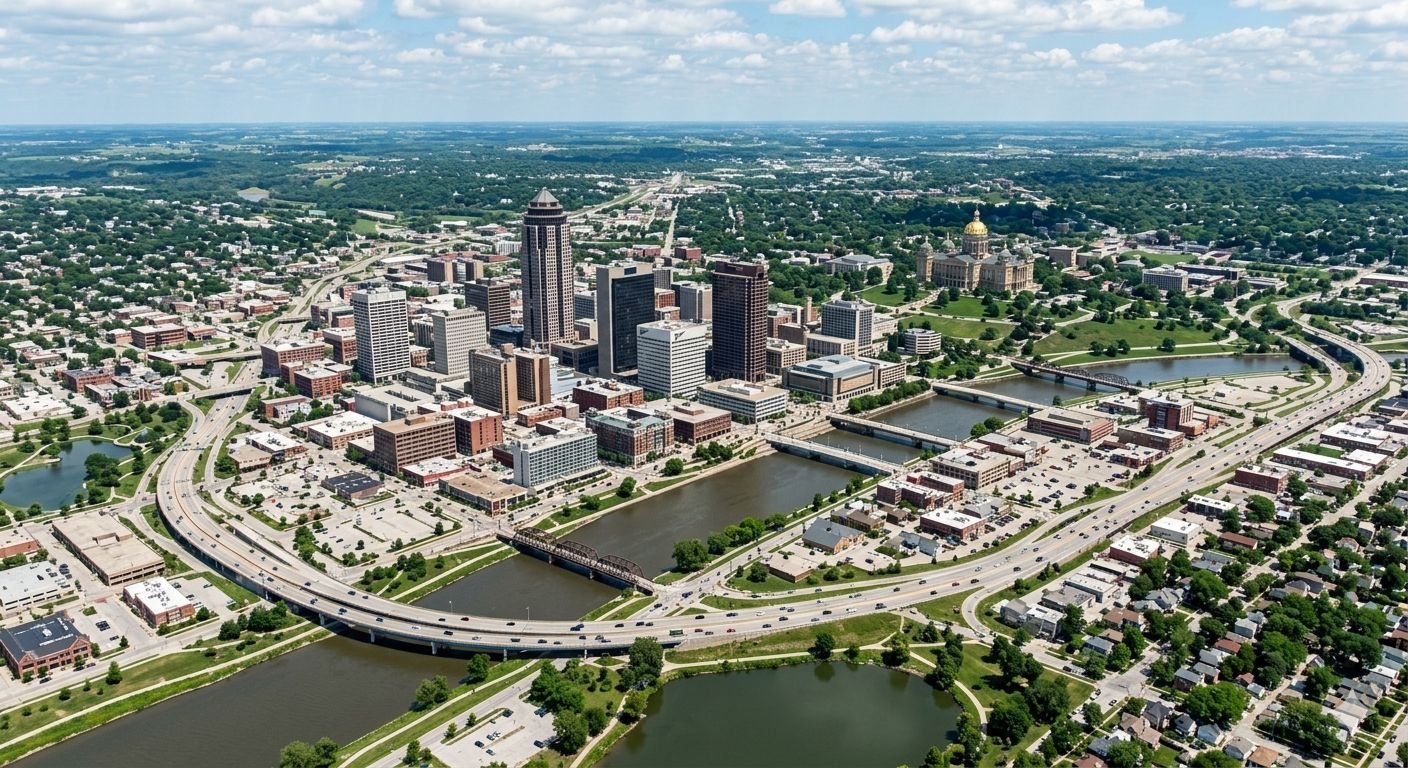
Iowa is one of America’s most underestimated travel destinations. Mention it to someone who has never visited, and they will likely picture an endless flat expanse of corn, nothing more. The reality is far richer and more surprising. Nestled between the Mississippi River to the east and the Missouri River to the west, Iowa is a state of rolling hills, ancient bluffs, glacier-carved lakes, vibrant cities, covered bridges, limestone caves, world-class cycling trails, and a cultural tapestry woven from dozens of immigrant traditions. It rewards who slows down, wanders off the interstate, and pays attention.
Tourism in Iowa generated $7.3 billion in expenditures in 2023, supporting over $1.1 billion in state and local government revenue while employing nearly 71,000 people statewide — figures that tell you this is a state people genuinely come to visit, not just pass through.
Whether you are planning a weekend road trip or a week-long cross-state adventure, this guide will walk you through everything Iowa has to offer.
THE LAY OF THE LAND
Iowa covers roughly 56,000 square miles and sits at the geographic heart of the continental United States. The state is broadly divided into several distinct natural regions. The northeastern corner, known as the Driftless Area, was bypassed by the last glaciers and features dramatic limestone bluffs, deep river valleys, and some of the most rugged scenery in the Midwest. The northwest has the Iowa Great Lakes region, a cluster of glacier-carved lakes popular for summer recreation. Central Iowa is dominated by gently rolling prairie and the capital city of Des Moines. The western edge along the Missouri River features the Loess Hills, a rare geological formation found only in Iowa and along the Yellow River in China. The eastern border along the Mississippi is lined with historic river towns and some of the state’s oldest architecture.
DES MOINES: THE CAPITAL AND CULTURAL HUB
Des Moines is the obvious starting point for most visitors. It is a city that has quietly transformed itself into one of the Midwest’s most livable and dynamic urban centers, with a food scene, arts culture, and trail system that punch well above the city’s weight class.
The Greater Des Moines Botanical Garden, Blank Park Zoo, and the Des Moines Art Center are all well worth a half day each. The art center is particularly impressive, housing works by Georgia O’Keeffe, Francis Bacon, and Grant Wood in a building designed by three different architectural legends — Eliel Saarinen, I.M. Pei, and Richard Meier.
The city’s trail system is extraordinary. Des Moines has developed one of the most extensive urban trail networks in the country, and it connects to longer regional trails reaching far beyond the city limits.
The Downtown Farmers Market, held on Saturday mornings from May through October, is a beloved institution. Stretching across several blocks of Court Avenue, it draws tens of thousands of visitors each week for fresh produce, artisan foods, live music, and community energy. It is a must-visit for fresh produce and local goods.
The Iowa State Capitol building is also worth a visit. Its gold-leafed dome is one of the most distinctive in the country, and free guided tours walk visitors through its stunning interior of marble, mosaics, and murals.
THE HIGH TRESTLE TRAIL AND IOWA’S CYCLING PARADISE
Iowa is genuinely one of the best states in the nation for cycling, and the High Trestle Trail is the crown jewel of its trail network. The trail runs 25 miles between Ankeny and Woodbury and crosses the Des Moines River on a breathtaking 13-story-tall bridge adorned with illuminated steel frames that glow blue at night. It is one of the most photographed bridges in the Midwest and absolutely spectacular at sunset.
Nine miles of new trail completed in Fall 2024 connected the Raccoon River Valley Trail and the High Trestle Trail, creating a 120-mile continuous loop that ranks among the longest trail loops in the country. For cycling enthusiasts, this is a destination-worthy experience in itself.
Iowa is also home to RAGBRAI, the Register’s Annual Great Bicycle Ride Across Iowa, which is the oldest and largest bicycle touring event in the world. Held every July, it draws thousands of riders who spend a week pedaling across the entire width of the state, camping in small towns along the way. The event is a joyful, communal celebration of Iowa’s landscapes and small-town hospitality.
DUBUQUE AND THE MISSISSIPPI RIVER BLUFFS
Dubuque, tucked into the bluffs along the Mississippi in Iowa’s northeastern corner, is one of the state’s most beautiful and historic cities. Founded in the 1780s, it is Iowa’s oldest city, and its Victorian-era architecture, riverfront museums, and dramatic hillside setting make it unlike anywhere else in the state.
The National Mississippi River Museum and Aquarium is a standout attraction. Recent expansions have enlarged the river otter habitat from 600 square feet to a 1,600-square-foot space with outdoor areas and stream features, and new indoor aquariums and a trout stream are among the latest additions. The museum tells the story of the Mississippi River and all the life it sustains, from paddlefish to bald eagles to the river cultures that grew along its banks.
The Fenelon Place Elevator, a funicular railway built in 1882, carries visitors from the lower city to the top of the bluffs for sweeping views of three states — Iowa, Wisconsin, and Illinois — spread across a bend in the river. It is a beloved and quirky piece of local history.
Pikes Peak State Park, located just south of McGregor along the Mississippi, offers some of the most dramatic overlooks in the state. Set where the Mississippi and Wisconsin rivers meet, Pikes Peak State Park is in the northeast of the state on the border with Wisconsin and delights nature lovers with stunning scenery and outstanding natural beauty.
Nearby Effigy Mounds National Monument preserves over 200 prehistoric earthen mounds sacred to Native American tribes, many of them shaped like birds and bears. It is a profoundly moving place, and the forested blufftop trails offer some of the finest walking in the state.
DECORAH AND THE DRIFTLESS REGION
Decorah is a small city in the far northeastern corner of Iowa that has built a remarkable reputation as a destination for outdoor adventure, craft beer, and Scandinavian heritage. Iowa is home to quaint rural towns and villages, some of which exhibit rich Dutch, German, and Scandinavian culture and heritage. Decorah exemplifies the Scandinavian side of that heritage, as it was settled largely by Norwegian immigrants in the mid-1800s.
The Vesterheim Norwegian-American Museum is the largest museum in the United States dedicated to a single immigrant group, and it houses an extraordinary collection of folk art, decorative arts, and historical artifacts. The surrounding downtown is full of independent shops, galleries, and excellent restaurants.
The Upper Iowa River, which winds through the hills around Decorah, is one of the state’s finest canoeing and kayaking rivers, with clear water, limestone bluffs, and minimal crowds. Decorah is also a birdwatching hotspot, particularly during spring migration, when raptors and warblers concentrate along the river valleys.
Every July, Nordic Fest celebrates Scandinavian traditions, especially Norwegian ones, with historic flair — music, crafts, folk costuming, and storytelling set in Iowa’s rolling hills of the northeast, making it part culture celebration and part scenic getaway.
THE AMANA COLONIES
The Amana Colonies are unlike anywhere else in Iowa — or in the United States, for that matter. Founded by German immigrants in 1855, the Amana Colonies have provided decades of education, entertainment, and dining to travelers. The seven villages were established as a communal religious community by a German pietist sect known as the Community of True Inspiration. For nearly a century, residents lived and worked communally, sharing kitchens, property, and labor. The communal system ended in 1932, but the villages retained their distinctive character and craft traditions.
Today, visitors can explore working woolen mills, furniture workshops, bakeries, and wineries. The Amana Heritage Museum tells the story of the colony’s remarkable social experiment. And the restaurants serve hearty German food — schnitzel, bratwurst, sauerkraut, strudel — in portions that reflect a tradition of communal cooking for hard-working people.
The colonies are a short drive west of Cedar Rapids and make an ideal half-day or full-day stop for anyone interested in history, craft, and very good food.
PELLA AND THE TULIP FESTIVAL
Pella is a small city in central Iowa that wears its Dutch heritage with quiet pride year-round and exuberant pride every May. The Historical Village has over 20 traditional buildings to wander around, with a church and blacksmiths lying beside the fully functional Vermeer Windmill, one of its main sights, while attractive Dutch pastry shops offer cheeses, clogs, and costumes.
The Tulip Time Festival is Pella’s signature event. Pella’s annual Tulip Time offers a variety of Dutch cultural experiences with two parades each day of the festival, along with traditional Dutch dancing and singing performances, six museums, and a Craft Market. The tulip gardens are extraordinary in bloom, and the streets fill with costumed performers and the smell of Dutch pastries.
THE FIELD OF DREAMS
Few American films have embedded a particular place so deeply in the cultural imagination as Field of Dreams did with a farm outside Dyersville, Iowa. Visitors can play catch on the original Field of Dreams diamond, carved from cornfields near Dyersville. The baseball diamond and the white farmhouse are exactly as they appeared in the 1989 film, and something about standing in that outfield, surrounded by corn stretching to the horizon, is genuinely moving, even if you are not a baseball fan.
In 2021, Major League Baseball built a temporary stadium adjacent to the site and hosted a regular-season game there, which drew national attention. The site remains one of Iowa’s most popular tourist attractions.
MADISON COUNTY AND THE COVERED BRIDGES
Set about 30 miles to the southwest of Des Moines is the charming countryside of Madison County, which shot to fame following the 1995 film The Bridges of Madison County. Now visitors flock to its fertile fields and farmland and cruise along quaint country lanes before stopping off at picture-perfect towns such as Winterset. The highlight is its delightful covered bridges, of which six remain.
Winterset is also the birthplace of John Wayne, and the John Wayne Birthplace Museum preserves the Western film star’s home and artifacts from his life. The surrounding county is also excellent wine country, with several vineyards and small breweries tucked into its gentle hills.
THE LOESS HILLS
Along Iowa’s western edge runs one of the state’s most unusual and overlooked natural wonders. The Loess Hills are steep, sharply ridged hills made of wind-deposited silt called loess, laid down during the last ice age. The towering Loess Hills offer picturesque scenic drives and hiking on trails that wind through native prairie, oak savanna, and habitat found nowhere else on earth. The views from the ridgelines across the Missouri River valley are expansive and beautiful, especially in the golden light of late afternoon.
The Loess Hills Scenic Byway runs 220 miles along the ridge from Akron in the north to Hamburg in the south and is one of Iowa’s finest road trips.
THE IOWA GREAT LAKES
In the northwest corner of the state, a cluster of clear, glacier-carved lakes forms Iowa’s most popular summer resort area. Lake Okoboji and Spirit Lake are the largest and most visited, and the entire region buzzes with activity from Memorial Day through Labor Day. Okoboji offers lake activities like boating, fishing, and paddleboarding, built around summer staples like a historic amusement park, waterside bars and restaurants, and kid-friendly activities.
Arnolds Park Amusement Park, which has operated on the shores of Lake Okoboji since 1889, is one of the oldest amusement parks in the country and still draws families for its vintage wooden roller coaster, lakeside atmosphere, and summer concerts.
MAQUOKETA CAVES STATE PARK
One of Iowa’s best-kept secrets is Maquoketa Caves State Park in the eastern part of the state. The park contains the largest collection of accessible caves in Iowa, along with unusual rock formations, a natural bridge, and densely forested hiking trails. It is an ideal destination for families with children and for anyone who enjoys exploring underground.
CEDAR RAPIDS
Iowa’s second-largest city is the home of the National Czech and Slovak Museum and Library, a world-class institution dedicated to the Central European immigrants who shaped so much of eastern Iowa’s character. The city also has a strong arts scene centered on the Cedar Rapids Museum of Art, which holds one of the largest collections of Grant Wood paintings in the world. Wood, who was born and spent most of his life in Iowa, painted the iconic American Gothic here, and the museum explores his career and legacy in depth.
IOWA’S FOOD AND DRINK CULTURE
Iowa’s food culture is rooted in agriculture, and that is entirely a good thing. The state produces an extraordinary abundance of corn, soybeans, pork, beef, eggs, and dairy, and its farm-to-table dining scene has grown significantly in recent years. Look for pork tenderloin sandwiches, sweet corn in season, pies at church suppers or cafes, ethnic specialties at heritage festivals, and classic fair foods at county and state fairs.
The breaded pork tenderloin sandwich is Iowa’s most iconic food. Served on a bun that is comically smaller than the enormous, pan-fried cutlet it supports, it is a state institution available at diners, bars, and casual restaurants across Iowa.
Iowa’s craft beer scene has also matured considerably. Iowa City, Des Moines, Cedar Rapids, and Dubuque all have lively brewpub cultures, and the Millstream Brewing Company in the Amana Colonies has been producing award-winning German-style beers since 1985.
Le Mars, a small city in northwest Iowa, holds the quirky distinction of being the Ice Cream Capital of the World. Le Mars is the Ice Cream Capital of the World, and visitors can experience all its sweetness at the Wells Visitor Center and Ice Cream Parlor. Wells Enterprises, which makes Blue Bunny ice cream, is based there and offers visitors a fun and delicious stop. Oh My! Omaha
FESTIVALS AND EVENTS
Iowa’s festival calendar is extraordinarily rich, reflecting the state’s diverse immigrant heritage and strong sense of community. The Iowa State Fair in Des Moines, held every August, is widely regarded as one of the premier state fairs in the country. No cultural guide to Iowa is complete without the Iowa State Fair, held each August in Des Moines and widely regarded as one of the country’s premier state fairs. It draws hundreds of thousands of visitors for livestock competitions, carnival rides, live music, and famously indulgent food on sticks.
The Des Moines Arts Festival draws over 200,000 visitors over three days each summer for visual arts, live performances, food trucks, and local beer and wine in the heart of downtown.
Hinterland, held in a field near Des Moines each summer, has grown into one of the Midwest’s largest multi-day music festivals, attracting major national and international acts.
The Meskwaki Nation, based near Tama, gathers in August for its annual powwow, a four-day event featuring dancing, singing, handcrafts, food, games, and a time of reaffirmation and kinship. Visitors are welcome and encouraged to attend respectfully.
Clear Lake in winter hosts the Color the Wind Festival, the largest winter kite festival in the Midwest, an annual favorite that brings visitors and kite flyers from across the country to see huge inflatable kites take to the sky alongside ice harvesting demonstrations by local Amish families. Oh My! Omaha
PRACTICAL TRAVEL TIPS
The best time to visit Iowa depends on what you are after. Spring, from late April through early June, brings wildflowers, mild temperatures, and the opening of farmers markets. Summer is festival season and the time for lake recreation, though July and August can be hot and humid. Fall is perhaps Iowa’s most beautiful season, with golden light, harvest activity, and spectacular foliage particularly in the Driftless Area and Loess Hills. Winter is quiet but has its charms, especially for those who enjoy the peace of snowy landscapes and cozy small-town hospitality.
Getting around Iowa requires a car. Public transportation between cities is limited, and the state’s greatest pleasures are often found on rural highways and gravel roads between small towns. A road trip is really the ideal format for exploring Iowa, and the state’s scenic byways are well-marked and rewarding.
For travelers, the key to appreciating Iowa lies in slowing down, paying attention, and participating where invited. Attending festivals, fairs, and neighborhood gatherings transforms a drive across the state into a series of memorable encounters. In return for that attention and respect, Iowa offers what many visitors remember most: genuine hospitality and a sense of belonging.
Accommodation options range from major chain hotels in Des Moines and Cedar Rapids to charming bed-and-breakfasts in small towns, historic inns in river cities like Dubuque and Davenport, and farm stays that let visitors experience agricultural life firsthand. Camping is excellent throughout the state park system.
CONCLUSION: Iowa Rewards the Curious
Iowa is not a destination that announces itself loudly. It does not have mountain ranges or ocean coastlines or famous theme parks. What it has is something rarer and, for the right kind of traveler, more satisfying: authenticity. Its landscapes are genuinely beautiful, its history is layered and fascinating, its people are famously warm, and its cultural life, from the Amana Colonies to the Meskwaki powwow to the blazing lights of the High Trestle Trail at night, is richer than most visitors ever expect. Come curious, come unhurried, and Iowa will more than meet you halfway.