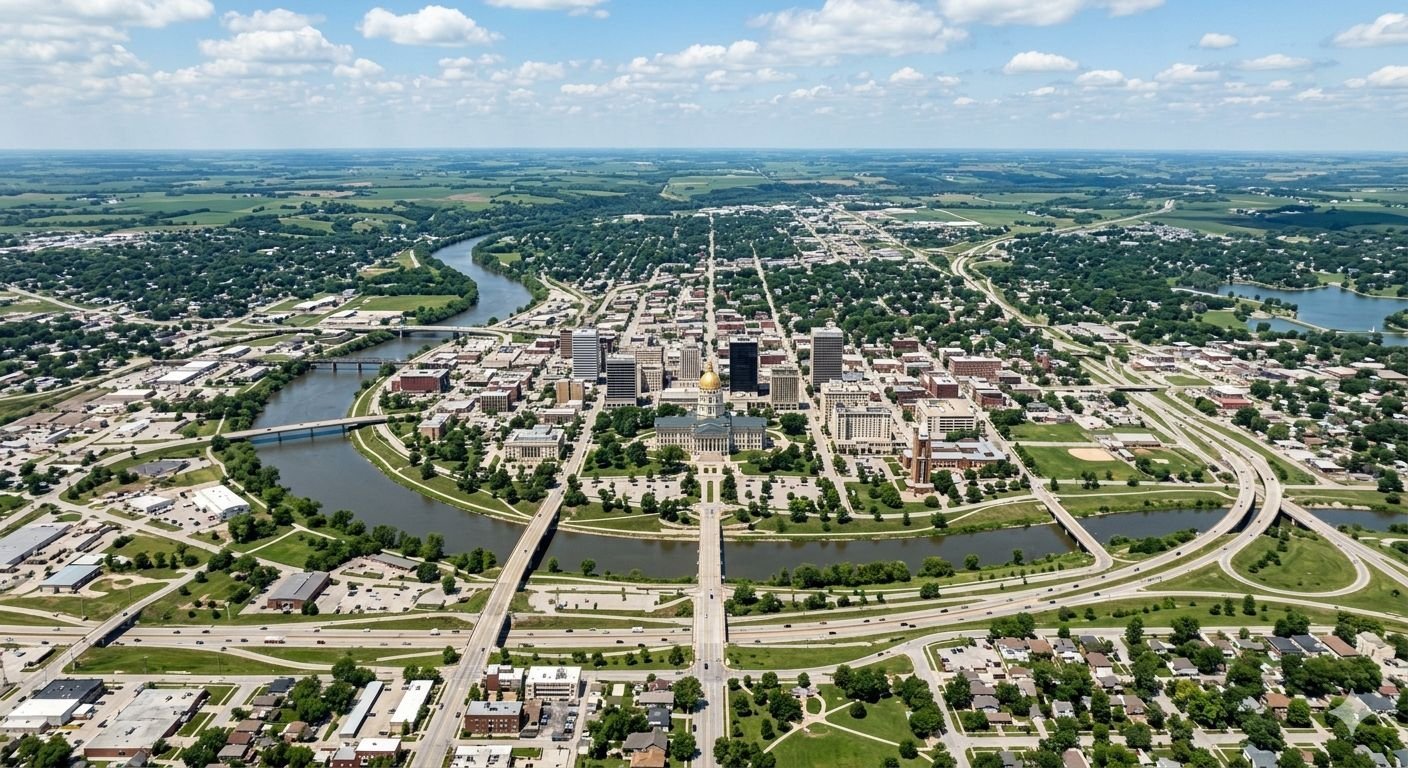
Ask most Americans what they know about Kansas and the answers come quickly: flat, endless wheat fields, tornadoes, and Dorothy wishing she were somewhere else. Ask anyone who has actually traveled through the state and the answers are entirely different. Kansas is a place of extraordinary skies and sweeping horizons, of ancient chalk formations rising from the plains like cathedrals, of some of the most ecologically rare grasslands left on earth, of a history so rich and turbulent it shaped the direction of the entire nation. It is a state where the Wild West is not just a museum exhibit but a living presence in the landscape and culture, where world-class art and space museums appear in the middle of the heartland, and where a drive along a country road at sunset can produce one of the most beautiful views you will ever encounter.
THE LAY OF THE LAND
Kansas covers nearly 82,000 square miles and sits at the exact geographic center of the continental United States. The state is generally understood to slope gently upward from east to west, rising from about 700 feet in elevation near the Missouri border to over 4,000 feet in the far southwestern corner near the Colorado line. Kansas is divided into six distinct travel regions: Northeast, Northwest, Southeast, Southwest, North Central, and South Central, each with its own landscape, history, and character.
The eastern third of the state is more varied than the state’s flat reputation suggests, with rolling wooded hills, river valleys, and the spectacular Flint Hills rising in the east-central region. Moving westward, the terrain opens into the broad High Plains, where the sky becomes the dominant landscape feature and the horizon stretches seemingly to infinity. The western counties hold geological surprises — dramatic chalk formations, canyons, and fossil beds — that startle visitors who arrive expecting only uniformity.
Two rivers define much of the state’s geography and history. The Kansas River, known locally as the Kaw, runs east across the northern part of the state through Lawrence and Topeka to join the Missouri. The Arkansas River cuts diagonally across the south-central and southwestern plains, passing through Wichita and Dodge City on its way to Oklahoma. Along these waterways, the history of westward migration, cattle drives, and frontier settlement played out in scenes that defined an era of American mythology.
THE FLINT HILLS: THE LAST GREAT TALLGRASS PRAIRIE
No landscape in Kansas is more spectacular or more ecologically significant than the Flint Hills, and no experience the state offers is more genuinely moving than a quiet afternoon drive through this ancient grassland. The Flint Hills are a narrow band of rolling hills running north to south through the east-central part of the state, their limestone and chert bedrock making them unsuitable for plowing and thus saving them from the agricultural conversion that destroyed the tallgrass prairie virtually everywhere else.
At one time there were more than 170 million acres of tallgrass prairie across the United States. Today, less than four percent of it remains, and most of it is right here in Kansas, preserved at the Tallgrass Prairie National Preserve.
The Tallgrass Prairie National Preserve, located near Strong City in Chase County, protects nearly 11,000 acres of this irreplaceable ecosystem. The preserve is home to diverse plants and animals, including bison herds that roam freely across the grasslands. The visitor center provides educational exhibits on prairie ecology, and several hiking trails lead through scenic overlooks and native wildflower meadows. Popular trails include the Scenic Overlook and Bottomland Nature Trails, both of which feature educational signs that teach about the region’s delicate biodiversity. The historic Spring Hill Ranch house and barn, built in the 1880s, offer a glimpse into the life of the cattle ranchers who have been the Flint Hills’ primary stewards for more than a century.
The Flint Hills National Scenic Byway, running roughly 47 miles along Highway 177 between Cassoday and Council Grove, is one of the finest scenic drives in the American interior. Stretching through the heart of the Flint Hills, one of the last remaining tallgrass prairie ecosystems in the world, the drive feels like stepping back in time to an era before the prairies were tamed. In spring, the hills turn vivid green and wildflowers dot the roadsides. In summer, ranchers conduct the prescribed burns that have maintained this ecosystem for thousands of years, and the smoke-hazed skies and blackened hillsides give the landscape a primordial quality. In fall, the grasses turn copper and gold and amber in a display that rivals any leaf-peeping destination in New England.
The small town of Cottonwood Falls sits along this byway and is one of the most charming and unspoiled communities in the state. Its 1873 Chase County Courthouse, built of native limestone in the French Renaissance style, is the oldest operating courthouse in Kansas and one of the most beautiful county courthouses in the country. The surrounding countryside, with its ranches, rocky creek beds, and sweeping hilltop views, is ideal for hiking, cycling, and simply absorbing the profound stillness of the prairie.
Council Grove, at the northern end of the byway, is a historic town of considerable significance. It was the last major provisioning stop on the Santa Fe Trail before travelers headed into the open plains, and its well-preserved 19th-century streetscape tells that story with quiet authority. The Kaw Mission State Historic Site preserves the stone mission built in 1851 for the Kaw (Kanza) Native American people, from whose name the state itself takes its identity.
MONUMENT ROCKS: THE CHALK PYRAMIDS OF WESTERN KANSAS
In the far western reaches of the state, in Gove County, one of America’s most astonishing geological formations rises from the flat plains in almost complete isolation. Monument Rocks — also known as the Chalk Pyramids — are a collection of towering chalk spires and formations, some reaching over 70 feet in height, that were once the floor of a vast inland sea that covered Kansas roughly 80 million years ago. Monument Rocks National Natural Landmark was the first natural landmark chosen by the U.S. government for designation. Legends of Kansas
Located on private farmland, people are invited to drive the gravel road to visit the monument. While walking around the attraction, you may see cattle roaming about the area.
The formations bear fossil shells and marine creatures embedded in their chalky walls, and the erosion that carved them continues to shape them slowly with every passing season. The named formations — Charlie the Dog, the Eye of the Needle — have the quality of natural sculpture. There are no entrance fees, no visitor centers, no gift shops. It is simply one of the most extraordinary natural landmarks in America, sitting quietly in the middle of nowhere, waiting for visitors curious enough to find their way to it.
Nearby Castle Rock is another chalk formation of similar origin, and the two make a perfect combination for a western Kansas geological road trip. The area around Oakley, the nearest town of any size, also has the Buffalo Bill Cultural Center and good access to the surrounding high plains country.
DODGE CITY: THE LEGENDARY WILD WEST
No city in America carries a heavier load of frontier mythology than Dodge City, and remarkably, the place largely lives up to its legend. From 1875 to 1886, Dodge City was the end point of the Western cattle trails — the Great Western and the Atchison, Topeka and Santa Fe Railway connected here — and during those years it was simultaneously the most important commercial hub on the southern plains and the most notoriously lawless town in America. Wyatt Earp, Bat Masterson, and Doc Holliday all served as lawmen here. The Long Branch Saloon was a real place. Boot Hill Cemetery earned its name from the cowboys and outlaws buried there with their boots on.
The Boot Hill Museum is located on the original site of Boot Hill Cemetery and brings the Old West to life with its recreated 1870s main street, complete with authentic shops, saloons, and even a blacksmith’s workshop. Exhibits include artifacts from the frontier days, such as cowboy gear, firearms, and historical documents that reveal Dodge City’s role as a once-bustling cattle town. Daily reenactments, including gunfight shows and cowboy-themed performances, add to the immersive Western experience.
Today Dodge City embraces its cowboy past. A statue of James Arness as Marshal Matt Dillon stands in front of the visitors center, the perfect spot to begin a walking tour of town. The city’s Trail of Fame recognizes celebrities and locals for their contributions to the city’s success, from sidewalk markers honoring the cast of Gunsmoke to sculptor tributes to Wyatt Earp and Doc Holliday.
Fort Larned National Historic Site, about 60 miles east of Dodge City, is one of the best-preserved frontier military forts in the country. Built in the 1860s to protect travelers along the Santa Fe Trail, Fort Larned’s stone buildings remain largely intact, and the National Park Service has restored them to their 1860s appearance. Walking the parade ground and through the barracks, officers’ quarters, and blockhouses is an immersive experience in frontier military life.
The Santa Fe Trail itself left its mark on the landscape around Dodge City. The Santa Fe Trail Ruts near Dodge City represent a two-mile section of the former 1,200-mile trail and are the longest continuous stretch of clearly defined Santa Fe Trail rut remains in Kansas. These wagon ruts, worn deep into the Kansas prairie by tens of thousands of loaded wagons, are a tangible connection to one of the great migration stories in American history. Legends of Kansas
WICHITA: THE AIR CAPITAL AND ITS CULTURAL LIFE
Wichita is Kansas’s largest city and, for most visitors, its most complete urban experience. Nicknamed the Air Capital of the World, Wichita is home to several aerospace companies as well as the Kansas Aviation Museum. The aviation industry has been central to Wichita’s identity since the 1920s, when pioneer aviators and aircraft manufacturers established operations here, and the city continues to be a global leader in aircraft design and manufacturing.
But Wichita is far more than its industrial identity. The city has developed a rich arts and cultural scene, a lively food and brewery culture, and a collection of museums and attractions that make it an excellent base for exploring the south-central part of the state.
Wichita has emerged from its bustling cow-town era as a progressive, attractive community. The Old Cowtown Museum re-creates 19th-century Wichita right down to plank sidewalks, covering the period following the arrival of trader Jesse Chisholm, who in 1864 brought cattle north from Texas, establishing the Chisholm Trail and Wichita as a major shipping point. The museum’s 23-acre living history complex includes approximately 50 furnished period buildings and hosts reenactments and events throughout the year.
The Keeper of the Plains, a dramatic 44-foot steel sculpture by Blackbear Bosin at the confluence of the Arkansas and Little Arkansas rivers, is one of the most striking public art installations in the Midwest. The surrounding Mid-America All-Indian Center tells the story of the Native peoples of the Great Plains through art and cultural programming.
Botanica, the Wichita Gardens, is a beautiful 17-acre botanical oasis in the heart of the city, offering a diverse collection of plants, themed gardens, and educational programs. The Wichita Art Museum has a strong collection of American art, and the Exploration Place science museum is an excellent family destination. The Sedgwick County Zoo, one of the largest in the Midwest, houses over 2,500 animals and draws visitors year-round.
Wichita’s Old Town district, a revitalized warehouse neighborhood of restaurants, breweries, music venues, and shops, is the city’s social heart. The area anchors a craft beer scene that includes Wichita Brewing Company, Central Standard Brewing, and River City Brewery, among others.
TOPEKA: HISTORY, JUSTICE, AND A MAGNIFICENT CAPITOL
Topeka, the state capital, punches above its weight as a destination for historically minded travelers, anchored by two sites of genuine national significance.
The Brown v. Board of Education National Historic Site, located in the former Monroe Elementary School, commemorates the landmark 1954 Supreme Court decision that declared racial segregation in public schools unconstitutional. The case took its name from Oliver Brown, a Topeka resident who was one of the plaintiffs. The visitor center and museum provide a deeply moving account of the legal battle and its aftermath, and the building itself — the school that Black children attended while their white counterparts attended the better-resourced Sumner School just a few blocks away — gives the story a powerful physical presence.
The Kansas State Capitol is one of the architectural gems of the Great Plains, a French Renaissance structure whose dome rises 304 feet above the city. Free guided tours take visitors through the building’s richly decorated interior, including murals by John Steuart Curry depicting the abolitionist John Brown in the dramatic Tragic Prelude, one of the most stirring works of public art in the Midwest. Visitors can climb to the dome for panoramic views across Topeka and the surrounding prairie.
The Kansas Museum of History tells the comprehensive story of the state from its Native American origins through the present, with exceptional collections related to the Santa Fe Trail, the Civil War in Kansas, and the pioneer homesteading era.
ABILENE: EISENHOWER’S HOMETOWN AND WILD WEST ROOTS
Abilene occupies a unique place in Kansas history: it was both the childhood home of the 34th President of the United States and, in the early 1870s, the original terminus of the Chisholm Trail and one of the roughest cattle towns on the frontier. This combination of presidential legacy and Wild West history makes it one of the most rewarding small-city stops in the state.
The Eisenhower Presidential Library, Museum, and Boyhood Home in Abilene offer a comprehensive look at the life and legacy of Dwight D. Eisenhower. The museum features detailed exhibits on World War II, the D-Day invasion, and Eisenhower’s time as Supreme Commander of the Allied Expeditionary Forces in Europe. The boyhood home where Eisenhower grew up with his six brothers has been meticulously preserved, and the Place of Meditation where Eisenhower and his wife Mamie are interred completes the complex with a moment of quiet reflection. The Tourist Checklist
The Old Abilene Town complex on South Buckeye Avenue re-creates the wild cattle-town era of the early 1870s, when Wild Bill Hickok served as marshal and the longhorn drives from Texas ended here. The Dickinson County Heritage Center provides additional context on the region’s agricultural and social history.
LAWRENCE: THE FREE STATE CITY AND ITS UNIVERSITY SPIRIT
Lawrence, home of the University of Kansas, is one of the liveliest and most culturally vibrant cities in the state. Founded in 1854 by New England abolitionists determined to make Kansas a free state, Lawrence endured the infamous Quantrill’s Raid of 1863 — in which Confederate guerrillas burned much of the town and killed nearly 200 men and boys — and rebuilt with a determination that became part of the city’s identity.
Lawrence revolves around Massachusetts Street, the main drag lined with art galleries, independent eateries, and an abundance of quirky or vintage boutiques. As a college town, the area is also home to plenty of great local breweries and nightlife spots. The University of Kansas campus has a number of impressive buildings and has been compared to the fictional school of Hogwarts from the Harry Potter universe.
The Spencer Museum of Art on the KU campus has a collection of over 45,000 objects spanning centuries and continents. The Watkins Museum of History tells the story of Lawrence and Douglas County with depth and nuance. Free State Brewing Company, one of the first brewpubs to open in Kansas after prohibition-era restrictions were lifted, remains a Lawrence institution.
The Haskell Indian Nations University, also in Lawrence, is an accredited university for federally recognized Native American tribes and a place of profound historical significance. Founded in 1884 as a residential boarding school for American Indian children, a self-guided walking tour map is available featuring 12 campus buildings designated as U.S. National Historic Landmarks. Legends of Kansas
THE COSMOSPHERE: HUTCHINSON’S WORLD-CLASS SPACE MUSEUM
One of the most unexpected cultural institutions in the American Midwest sits in the small south-central city of Hutchinson. The Kansas Cosmosphere and Space Center — usually just called the Cosmosphere — is the second-largest space museum in the world, trailing only the Smithsonian’s National Air and Space Museum in Washington, DC, and it contains collections that even the Smithsonian does not have.
In the Carey Digital Dome Theater, visitors can watch movies about space exploration on a two-story, domed screen. Hanging from the ceiling is a glamorous black SR-71 Blackbird spy plane. The museum also offers a live rocket science demonstration, a planetarium, a space museum with lots of space suits, and the Apollo 13 command module. The Hall of Space Museum tells the story of the Space Race from its earliest rocketry experiments through the Apollo program and beyond, with an astonishing collection of original hardware, astronaut suits, and mission artifacts. Dr. Goddard’s Lab, a live science performance, brings the history of early rocketry to life for audiences of all ages.
Hutchinson is also home to the Kansas State Fair, held every September and one of the largest state fairs in the Great Plains, drawing hundreds of thousands of visitors for agricultural competitions, carnival rides, live entertainment, and the full range of fair food traditions.
Nearby, the Strataca Underground Salt Museum offers a uniquely subterranean experience — visitors descend 650 feet below the surface into a working salt mine to explore underground chambers and learn about the geology and industry that has been a quiet but significant part of Kansas’s economic story for over a century.
FORT SCOTT AND SOUTHEAST KANSAS: BLEEDING KANSAS AND THE CIVIL WAR
The southeastern corner of Kansas was the site of some of the most violent episodes in the state’s pre-Civil War history, when the question of whether Kansas would enter the Union as a free or slave state drew armed partisans from both sides into a brutal guerrilla conflict known as Bleeding Kansas. Fort Scott, established in 1842 and now a National Historic Site, played a central role in this history.
Fort Scott played a major role in Bleeding Kansas and the early Civil War. It was one of the first places in the nation where Black soldiers served in the Union Army. Visitors can still walk the parade grounds where those men trained, fighting for a country that hadn’t yet promised them equality. Detail Oriented Traveler
The town of Fort Scott itself has a remarkably intact Victorian-era commercial district and a collection of historic homes that make it one of the most architecturally interesting small cities in the state. The surrounding Ozark plateau country — wooded, hilly, and distinctly different from the open plains — gives southeastern Kansas a character quite unlike the rest of the state.
Mine Creek Battlefield near Pleasanton preserves the site of one of the largest cavalry engagements of the Civil War, where Union forces decisively defeated a Confederate army in October 1864. It is a sobering and historically significant place, largely unknown outside of serious Civil War scholarship.
THE SYMPHONY IN THE FLINT HILLS
One of the most singular cultural events in America takes place every June in a different location within the Flint Hills each year. The Symphony in the Flint Hills brings the Kansas City Symphony to the open prairie for an outdoor concert at sunset, with the grasslands stretching to the horizon and the enormous Kansas sky providing a backdrop that no concert hall can match. Thousands of attendees spread blankets and picnic on a hillside while the music carries across the wind-brushed grass. It is an experience that is simultaneously deeply local and genuinely transcendent, and it has become one of the most beloved annual events in the state.
CHEYENNE BOTTOMS: A BIRDING PARADISE
Just north of Great Bend in central Kansas, the Cheyenne Bottoms Wildlife Area is one of the most important wetland complexes in the interior of North America. The Cheyenne Bottoms Wildlife Area is a notable stopover for North American shorebirds. During spring migration, the wetlands fill with hundreds of thousands of shorebirds, waterfowl, and wading birds funneled through this critical stopover on the Central Flyway. Sandpipers, dowitchers, avocets, white pelicans, whooping cranes — Cheyenne Bottoms has recorded more species than perhaps any comparable area of its size in the region. It is a destination that birders from across the country and internationally make pilgrimages to visit during the spring migration window from April through mid-May.
Quivira National Wildlife Refuge, a short drive to the southwest, offers similar wetland birding in a quieter, more intimate setting.
SUNFLOWER FIELDS: KANSAS IN ITS MOST ICONIC FORM
Every August, a scattered but spectacular phenomenon transforms the Kansas landscape: the sunflowers bloom. While the Sunflower State’s association with its namesake flower is well known, the experience of driving through a field of sunflowers stretching to every horizon under a brilliant blue sky is one that photographs cannot adequately convey. Kansas sunflower fields peak in late summer, typically August, and they are found throughout the state but concentrated particularly in the north-central and western regions. Stafford County in south-central Kansas has become especially well known for its sunflower fields and hosts events tied to the bloom each season.
The drive along state highways through sunflower country in late August, with the flat landscape punctuated by miles of yellow-headed flowers all turned to face the morning sun, is the kind of experience that converts skeptics into believers about Kansas’s singular visual power.
FOOD AND DRINK: PLAINS TRADITIONS AND URBAN INNOVATION
Kansas food culture is rooted in the same agricultural abundance that has defined the state’s economy for a century and a half. Wheat, beef, and pork are the foundations. Kansas City-style barbecue — smoked meats with a thick, sweet sauce built on tomatoes and molasses, applied at the end of the cooking process to caramelize over the heat — is one of the great regional American food traditions, and the Kansas side of the Kansas City metro has no shortage of excellent barbecue joints.
Bierocks are a Kansas food tradition of German-Russian immigrant origin: stuffed bread rolls filled with seasoned ground beef and cabbage, baked golden, and eaten as a hearty portable meal. Brought to Kansas by Mennonite settlers from Russia in the 1870s, they are found in home kitchens, church suppers, and local restaurants throughout the state and are a uniquely Kansan contribution to American food culture.
The cinnamon roll has an unlikely but genuine Kansas food connection: for generations, Kansas school cafeterias served cinnamon rolls with chili as a lunchtime combination, and the pairing became so ingrained in the state’s collective memory that it is now considered a comfort food classic. Seek it out at diners and small-town cafes across the state.
Wichita’s food scene has matured considerably, with a diverse array of restaurants reflecting the city’s increasingly multicultural population. The craft brewing scene is statewide and growing, with notable operations in Wichita, Lawrence, Topeka, and Manhattan. River City Brewery, Wichita Brewing Company, and Central Standard Brewing in Wichita; Free State Brewing Company in Lawrence; and Blind Tiger in Topeka are among the most established and respected.
Kansas wine is a younger industry but a genuine one, with wineries in the Flint Hills region and across the eastern part of the state producing wines from both native and hybrid grapes that pair well with the region’s food traditions.
SCENIC DRIVES AND BYWAYS
Kansas rewards the driver more than almost any other mode of traveler. The state has developed a network of designated scenic byways that thread through its most beautiful and historically significant landscapes.
Scenic 7 runs from the Louisiana border to Bull Shoals Lake, and Car and Driver magazine named a portion of it as one of the top 10 driving experiences in the United States. The Flint Hills National Scenic Byway through the tallgrass prairie is incomparable in late spring and early fall. The Western Vistas Historic Byway in the southwestern corner of the state passes through buttes, canyons, mesas, and gypsum hills that look nothing like the Kansas of the popular imagination. The Land and Sky Scenic Byway in the northwest traverses the open High Plains under some of the largest and most dramatic skies in the country.
Driving in Kansas requires a certain disposition — a willingness to be alone on a two-lane highway for miles, to pay attention to subtle variations in landscape that reward close observation, and to stop when something catches your eye, because there may not be another car along for a long time. This is a feature, not a flaw.
PRACTICAL TRAVEL TIPS
Getting There: Wichita Dwight D. Eisenhower National Airport is the primary hub for in-state arrivals, with connections to major cities. Kansas City International Airport, just across the state line in Missouri, offers more routes and is a convenient gateway for northeastern Kansas. Amtrak’s Southwest Chief stops in places like Garden City, Dodge City, and Newton, making train travel a viable and romantic option for those approaching from the east or west.
Getting Around: A rental car is essential for exploring Kansas. The state’s defining experiences — the Flint Hills, Monument Rocks, Dodge City, the scenic byways — all require independent transportation. The interstate system is efficient for covering large distances, but the real Kansas is on the state and county highways.
When to Go: Spring, from late April through early June, is the finest season for the Flint Hills — the grasses are vivid, wildflowers bloom, and temperatures are pleasant. Fall, from September through November, is the best time for road trips, autumn colors, and cultural events. Summer brings the sunflower bloom in August and the State Fair in September, though July and August can be genuinely hot across the open plains. Winter is cold but offers its own rewards — clear air, quiet landscapes, and excellent museum days.
Tornadoes: Kansas is indeed in Tornado Alley, and severe weather is a reality of life in the state, particularly in spring and early summer. Visitors should monitor weather forecasts, know the location of the nearest shelter when staying in rural areas, and treat tornado watches and warnings with appropriate seriousness. That said, tornado tourism itself — the chase tour industry based out of several Kansas cities — has become a legitimate and popular form of adventure travel for those who want a guided, safe experience observing one of nature’s most powerful phenomena.
CONCLUSION: Kansas Earns Your Respect
Kansas does not beg for your attention the way more obviously dramatic landscapes do. It offers itself quietly, on its own terms, in its own time. The reward for travelers who meet it on those terms is a state that surprises, moves, and stays with them. The Flint Hills at golden hour. The chalk towers of Monument Rocks under a full moon. The Boot Hill reenactments in Dodge City. A concert orchestra playing Beethoven to ten thousand people on an open prairie. The Apollo 13 command module in a museum in the middle of Kansas.
Arkansas deserves a spot on any travel list, thanks to places that offer beauty, history, and a deep connection to the land. The same is true, with equal conviction, of Kansas. Come with curiosity, come without assumptions, and let the Sunflower State show you what it has always quietly known about itself: that there is more here than meets the eye, and far more than the stereotypes ever suggested.