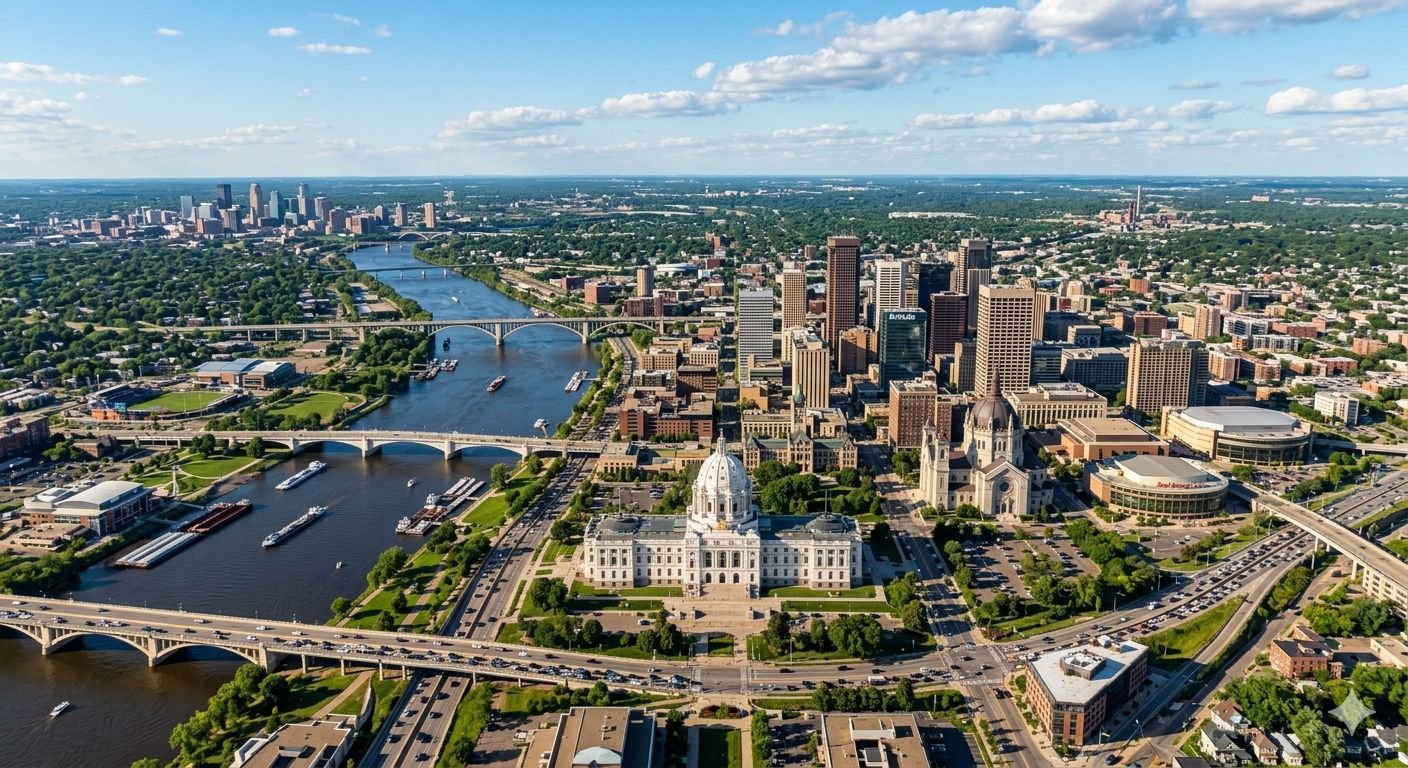
Minnesota is one of the most naturally magnificent and culturally distinctive states in the United States, a land of extraordinary lakes, vast forests, sweeping prairies, and a quality of light that photographers and painters have pursued for generations without ever quite capturing its full beauty. It is a state shaped by glaciers that retreated ten thousand years ago and left behind a landscape of such richness and variety that it continues to astonish those who encounter it for the first time. Minnesota is the Land of Ten Thousand Lakes, though the actual count exceeds fourteen thousand, and water defines the state in ways both literal and spiritual, from the headwaters of the Mississippi River in the north to the dramatic shore of Lake Superior in the northeast to the wild rice lakes of the Ojibwe homeland to the chain of metropolitan lakes that give Minneapolis its distinctive urban character. It is also a state of remarkable cultural vitality, home to one of the finest orchestras in the world, a theater scene that rivals any city of comparable size in the country, a culinary tradition rooted in Scandinavian and Eastern European immigrant heritage that has been transformed by waves of new immigration into one of the most diverse and exciting food cultures in the Midwest. Minnesota is a state that takes its winters seriously and its summers joyfully, that builds skyway systems to connect its downtown buildings and then fills its parks and lakes with outdoor enthusiasts the moment the temperature rises above freezing. It is, in the very best sense, a state that knows who it is, and the traveler who takes the time to discover it will find a place of beauty, intelligence, warmth, and genuine character that leaves a lasting impression.
Minneapolis: City of Lakes and Culture
Minneapolis is one of the great American cities, a place of architectural ambition, cultural sophistication, natural beauty, and a quality of urban life that consistently places it among the most livable cities in the United States. Built on the banks of the Mississippi River at the Falls of Saint Anthony, the only natural waterfall on the river and the power source that drove the flour and lumber mills that made Minneapolis one of the most productive industrial cities in nineteenth-century America, Minneapolis has evolved into a dynamic, progressive, and genuinely cosmopolitan city that offers the traveler an extraordinary range of experiences across every domain of urban life.
The Minneapolis Institute of Art, known universally as Mia, is one of the great encyclopedic art museums of the United States, housing a permanent collection of over 90,000 works spanning five thousand years of human creativity across every culture and medium. The museum’s collection of Asian art is among the finest in the country, and its holdings of period rooms, decorative arts, Impressionist and Post-Impressionist paintings, and works by Minnesota artists are equally distinguished. Remarkably, admission to the permanent collection is entirely free, making Mia one of the most accessible major art museums in the country and a genuine gift to the city and its visitors.
The Walker Art Center is one of the most important contemporary art museums in the United States, a consistently challenging and intellectually stimulating institution that has been presenting the most significant contemporary art, film, dance, theater, and music for decades and remains at the cutting edge of contemporary cultural life. The adjacent Minneapolis Sculpture Garden, an eleven-acre outdoor gallery anchored by the iconic Spoonbridge and Cherry sculpture by Claes Oldenburg and Coosje van Bruggen, is one of the most beloved public spaces in Minneapolis, its collection of large-scale sculptures providing a setting for outdoor enjoyment in all seasons. The Spoonbridge and Cherry has become the defining symbol of Minneapolis’s cultural identity, reproduced on everything from coffee mugs to public murals, and seeing it in person for the first time is a moment of genuine delight.
The Guthrie Theater, located in a dramatic building designed by Jean Nouvel on the banks of the Mississippi River, is one of the finest regional theaters in the United States and a landmark of Minneapolis’s extraordinary performing arts culture. The building’s cantilevered Endless Bridge, extending 178 feet over the river below with no exterior support, is one of the most thrilling architectural experiences in the city, providing dizzying views of the Mississippi and the Stone Arch Bridge from a vantage point that seems to float in mid-air. The theater’s commitment to classical and contemporary drama of the highest quality has made it one of the most respected theatrical institutions in the country.
The Mill City Museum, built into the ruins of the Washburn A Mill that was once the largest flour mill in the world, is one of the finest history museums in the Midwest, its dramatic setting within the fire-scarred ruins of the mill creating an experience that is simultaneously architecturally spectacular and historically illuminating. The museum’s Flour Tower ride, an eight-story theatrical journey through the history of the mill and the flour milling industry that made Minneapolis the Mill City, is one of the most innovative museum experiences in the country. The surrounding Mill District neighborhood, developed on the historic industrial riverfront, is one of the most beautifully designed urban districts in Minneapolis, with the Stone Arch Bridge, a converted railroad bridge now open to pedestrians and cyclists, providing a magnificent vantage point for views of the Falls of Saint Anthony and the Minneapolis skyline.
The Chain of Lakes in southwest Minneapolis is the defining natural feature of the city and the foundation of its remarkable quality of urban outdoor life. Lakes Harriet, Calhoun (now officially Bde Maka Ska), Cedar, Isles, and the smaller Brownie Lake are connected by parkways and trails that form a continuous loop of over thirteen miles through some of the most beautiful urban parkland in the United States. In summer, the lakes are dotted with sailboats, kayaks, and canoes, their beaches filled with swimmers and sunbathers, their surrounding parkways alive with cyclists, runners, and walkers. In winter, the frozen lakes become venues for ice skating, ice fishing, cross-country skiing, and the uniquely Minnesotan art of walking across a frozen lake to a fish house with a thermos of coffee and a sense of seasonal contentment. The Lake Harriet Bandshell hosts free outdoor concerts throughout the summer, and the historic streetcar line that runs between Lakes Harriet and Calhoun provides a charming connection between two of the finest urban lakes in the country.
Nicollet Mall, the pedestrian and transit spine of downtown Minneapolis, is a sixteen-block promenade of shops, restaurants, hotels, and cultural institutions that serves as the commercial heart of the city. The Hennepin Theatre District, anchored by the Orpheum, State, and Pantages theaters, all magnificently restored historic movie palaces of the 1920s, presents Broadway touring productions, concerts, and performing arts events of national caliber. The Target Center, home of the Minnesota Timberwolves NBA team, and Target Field, home of the Minnesota Twins baseball team, anchor the sports end of downtown, with Target Field in particular providing one of the most beautiful downtown ballpark experiences in major league baseball, its open concourses framing views of the Minneapolis skyline and the surrounding neighborhoods.
Minneapolis’s food scene has been transformed over the past two decades into one of the most exciting and diverse in the Midwest, reflecting both the city’s deep Scandinavian and Eastern European roots and the extraordinary wave of immigration from Somalia, Southeast Asia, Latin America, and East Africa that has made Minneapolis one of the most culturally diverse cities in the interior of the country. The Somali community centered on the Cedar-Riverside neighborhood has established Minneapolis as the home of the largest Somali diaspora population in the United States, and the restaurants and markets of the neighborhood offer some of the most authentic Somali cuisine available outside of East Africa. The Hmong Village and the Minneapolis Farmers Market are extraordinary cultural and culinary destinations that reflect the richness of the city’s immigrant communities.
The First Avenue music venue, a converted Greyhound bus depot on the edge of downtown, is one of the most legendary music clubs in the United States, the venue where Prince filmed much of Purple Rain and where an extraordinary roster of musicians have performed over its more than fifty years of operation. Prince, who was born and died in the Minneapolis area, defined the city’s musical identity in a way that few artists have ever defined a place, and the legacy of his extraordinary career is felt throughout the city, from the murals on the walls of North Minneapolis to the purple lighting on landmarks across the downtown.
Saint Paul: The Quieter Twin
Saint Paul, the state capital of Minnesota, sits on the eastern bank of the Mississippi River across from Minneapolis and has always occupied a particular position in the Twin Cities relationship, the quieter, more conservative, more historically rooted of the two cities, with a character that is in many ways more European and more architecturally coherent than its more famous twin.
The Minnesota State Capitol in Saint Paul is one of the finest capitol buildings in the United States, its self-supporting dome, the third largest in the world after Saint Peter’s in Rome and the United States Capitol, rising above the city in a composition of classical grandeur that reflects the ambitions of a young and prosperous state at the turn of the twentieth century. The interior is a treasure house of American mural painting and architectural decoration, with Kenyon Cox’s magnificent lunettes in the Governor’s Reception Room and Edward Simmons’s series of murals in the dome among the finest examples of American academic painting in existence. Free tours of the building are offered daily.
The Science Museum of Minnesota, perched on the bluffs above the Mississippi River in downtown Saint Paul, is one of the finest science museums in the country, with exceptional permanent exhibitions on the natural history of Minnesota, the archaeology and cultures of the Mississippi River Valley, human biology, and a paleontology collection of national significance. The museum’s Omnitheater provides an immersive large-format film experience, and the outdoor terrace offers sweeping views of the Mississippi River and the surrounding bluffs.
Summit Avenue in Saint Paul is one of the best preserved Victorian residential boulevards in the United States, a four-and-a-half-mile stretch of grand houses representing every architectural style popular between 1850 and 1930, from Italianate and Second Empire to Romanesque Revival and Colonial Revival, occupied by the industrialists, railroad barons, and merchant princes who built Saint Paul into one of the wealthiest cities in nineteenth-century America. The James J. Hill House, the massive Richardsonian Romanesque mansion built by the Empire Builder of the Great Northern Railway, is the finest and most important of the Summit Avenue houses and offers tours that illuminate the extraordinary life of one of the most powerful men in American economic history. F. Scott Fitzgerald was born in Saint Paul and lived on Summit Avenue as a young man, and the neighborhood’s atmosphere of genteel prosperity and social ambition is palpable in his early fiction.
The Saint Paul Winter Carnival, held each January and February, is the oldest winter festival in the United States, a celebration of winter that includes ice sculpture competitions, snow sculpture displays, and the construction of an ice palace that has in some years reached extraordinary scale. The festival reflects the Minnesota approach to winter, which is neither denial nor resignation but genuine celebration, a determination to find joy and community in the season rather than merely endure it.
Grand Avenue in Saint Paul is one of the finest shopping and dining streets in the Twin Cities, a boulevard of Victorian commercial buildings housing independent restaurants, boutiques, bookshops, and galleries that reflect the neighborhood’s historic character and its contemporary vitality. The Macalester-Groveland and Summit Hill neighborhoods surrounding Grand Avenue are among the most beautifully preserved residential neighborhoods in the Twin Cities, their streets of Victorian and Craftsman houses providing a setting of urban elegance that rewards aimless walking and exploration.
Duluth and the North Shore of Lake Superior
Duluth, at the western tip of Lake Superior and the head of the Great Lakes shipping system, is one of the most dramatically situated cities in the United States, its downtown and neighborhoods rising steeply from the lake on a hillside that provides panoramic views of the largest freshwater lake in the world by surface area. Lake Superior is not merely a body of water in Duluth — it is a presence, a vast and sometimes tempestuous inland sea whose moods and colors dominate the life of the city and define its character.
The Aerial Lift Bridge, one of the most distinctive mechanical bridges in the United States, spans the ship canal between the Duluth harbor and Lake Superior and rises to allow the enormous lake freighters that still carry iron ore, grain, and coal through the Great Lakes to pass beneath it. Watching a thousand-foot ore boat glide silently through the canal beneath the raised bridge, close enough to touch if you could reach far enough, is one of the most unexpectedly thrilling experiences in Minnesota. The Duluth Shipping News website and app allow visitors to track incoming vessels and time their visits to the canal accordingly.
Canal Park, the revitalized district surrounding the ship canal and the Aerial Lift Bridge, is the most visited area of Duluth, its restaurants, hotels, shops, and the excellent Lake Superior Maritime Visitor Center providing an accessible introduction to the city and the lake. The Lakewalk, a paved promenade extending along the lakefront from Canal Park, provides a magnificent walk along the rocky shore with views of the lake, the harbor, and the lift bridge. The Great Lakes Aquarium, the only all-freshwater aquarium in the United States, explores the extraordinary ecology of Lake Superior and the Great Lakes with genuine scientific depth and engaging presentation.
Glensheen, the magnificent Jacobean Revival mansion built by mining and railroad baron Chester Congdon on the Lake Superior shoreline, is one of the most beautiful historic houses in the upper Midwest and one of the most visited attractions in Duluth. The 39-room mansion and its extensive grounds, preserved almost exactly as they appeared when the Congdon family occupied them, provide a window into the extraordinary wealth generated by the Minnesota iron ranges in the early twentieth century. The house is also the site of one of the most notorious murders in Minnesota history, the 1977 killing of Elisabeth Congdon and her nurse, a crime that has become part of the house’s dark mythology.
The North Shore of Lake Superior, extending from Duluth northeast to the Canadian border, is one of the most beautiful drives in the United States, Minnesota Highway 61 following the rocky shoreline past waterfalls, state parks, fishing villages, and the dramatic rocky headlands of the Sawtooth Mountains. John Steinbeck drove this route in his journey across America described in Travels with Charley and was moved by the grandeur of the lake and the landscape, and the road retains the power to move travelers today.
Gooseberry Falls State Park, one of the most popular state parks in Minnesota, is located on the North Shore and features a series of waterfalls on the Gooseberry River as it descends to Lake Superior through a landscape of ancient basalt rock, boreal forest, and dramatic gorges. The park’s visitor center, hiking trails, and Lake Superior shoreline make it an ideal introduction to the North Shore landscape. Split Rock Lighthouse State Park, further up the shore, preserves one of the most photographed lighthouses in the United States, a 1910 lighthouse and fog signal building perched on a sheer 130-foot cliff above the lake, its classic lines and dramatic setting making it one of the most beautiful structures in Minnesota.
The Boundary Waters Canoe Area Wilderness, in the far northeastern corner of Minnesota along the Canadian border, is one of the most extraordinary wilderness areas in the United States, a million-acre roadless wilderness of over a thousand lakes and streams accessible only by canoe or on foot. The BWCAW, as it is universally known, offers a canoe camping experience of unparalleled quality in the lower forty-eight states, its interconnected lake and portage system allowing paddlers to travel for weeks through a landscape of ancient Canadian Shield rock, boreal forest, and water of extraordinary clarity without encountering a road or a building. The night sky over the BWCAW, far from any light pollution, is among the darkest and most star-filled in the eastern half of the country, and the experience of paddling a canoe across a glassy wilderness lake under a sky brilliant with stars is one that stays with visitors for the rest of their lives. Ely, the small town at the southern gateway to the BWCAW, is a charming and authentic wilderness outfitting community with excellent outfitters, guides, and the International Wolf Center, one of the finest wildlife education institutions in the country.
The Iron Range: Industrial Heritage and Natural Beauty
The Iron Range of northeastern Minnesota, stretching across St. Louis, Itasca, and Koochiching counties, is one of the most historically significant and geologically remarkable landscapes in the United States, the region that produced the iron ore that built the industrial might of twentieth-century America and shaped the lives of the immigrant communities from Finland, Slovenia, Croatia, Italy, and dozens of other countries that came to work its mines.
The Hull-Rust Mahoning Mine in Hibbing is the largest open-pit iron mine in the world, a man-made canyon over three miles long, two miles wide, and 535 feet deep that has been operating continuously since 1895 and has produced more iron ore than any other mine in history. The view from the observation deck above the mine is one of the most staggering industrial landscapes anywhere, a testament to the extraordinary scale of human ambition and its environmental consequences that no visitor can observe without a complex mixture of awe and reflection.
Hibbing is also the birthplace of Bob Dylan, one of the greatest American artists of the twentieth century, and the Bob Dylan Center in nearby Duluth, along with the Dylan-related sites in Hibbing including the house where he grew up and the school where he performed his first concerts, draw pilgrims from around the world who come to trace the origins of one of the most influential musical and literary careers in American history.
The Minnesota Discovery Center in Chisholm is the finest museum of Iron Range history in the region, its outdoor exhibits including a reconstructed mining village, a working narrow-gauge railroad, and actual mining equipment of extraordinary scale providing a deeply engaging exploration of the industrial and social history of the region. The Leonidas Overlook at the adjacent mine site provides views comparable to those at Hull-Rust.
The Finnish-American heritage of the Iron Range is preserved and celebrated at the Finnish American Heritage Center in Embarrass, one of the coldest communities in the contiguous United States, where traditional Finnish sauna culture, rye bread baking, and log building traditions have been maintained with remarkable fidelity by descendants of the original immigrant settlers.
The Mississippi River Headwaters
Itasca State Park, in the lake country of north-central Minnesota, is one of the most historically significant and naturally beautiful state parks in the United States, home to Lake Itasca, the source of the Mississippi River, the greatest river system in North America. The river begins here as a clear, cold stream flowing out of the northern end of Lake Itasca, no more than a foot deep and twenty feet wide, and visitors can wade across the Mississippi River at its source, a genuinely moving experience that connects them to one of the defining geographical features of the continent.
The park encompasses over 32,000 acres of old-growth forest, over 100 lakes, and a remarkable diversity of wildlife including bald eagles, ospreys, loons, black bears, white-tailed deer, and moose. The wilderness drive through the old-growth forest of the park passes trees that were already a century old when Columbus reached the Americas, and the ancient forest atmosphere of massive pines and cathedral light is deeply affecting. Itasca’s Peace Pipe Vista and the Preacher’s Grove, where enormous old-growth red pines tower over the visitor, are among the most awe-inspiring natural environments in Minnesota.
The Mississippi River downstream from its source flows through a landscape of extraordinary beauty and historical significance, passing through the Leech Lake and Mille Lacs Lake regions before descending through Saint Cloud and the Twin Cities to its confluence with the Minnesota and St. Croix rivers. The Great River Road, a National Scenic Byway that follows the Mississippi from Lake Itasca to the Iowa border, is one of the finest long-distance drives in the country, passing through river towns, bluff country, wildlife refuges, and landscapes of genuine grandeur.
Voyageurs National Park
Voyageurs National Park, in the border lake country of northern Minnesota near International Falls, is one of the most unusual and least visited national parks in the country, a water-based wilderness that can only be fully experienced by boat. The park encompasses four large lakes, Rainy Lake, Kabetogama Lake, Namakan Lake, and Sand Point Lake, and hundreds of smaller lakes and islands in a landscape shaped by the same glacial forces that created the Boundary Waters to the east.
The park takes its name from the French-Canadian fur traders who paddled their birchbark canoes through this lake country in the seventeenth, eighteenth, and nineteenth centuries, trading with the Ojibwe people and carrying beaver pelts to the markets of Montreal and beyond. The voyageur tradition of long-distance canoe travel across the northern lakes has been revived as a recreational pursuit, and paddling the same waters that the voyageurs navigated provides a deeply evocative connection to this remarkable chapter of North American history.
Voyageurs is one of the finest stargazing destinations in the eastern half of the United States, its dark skies and water-reflected heavens creating conditions for astronomical observation that are among the best available without traveling to truly remote locations. The park has been designated an International Dark Sky Park, and ranger-led astronomy programs on summer nights provide a profound and humbling connection to the cosmos.
The Minnesota Prairie and the Southwest
The southwestern corner of Minnesota, where the glaciated prairie meets the Minnesota River valley, is a landscape of tremendous historical significance and surprising natural beauty that is often overlooked by travelers focused on the northern lake country and the Twin Cities.
Pipestone National Monument preserves the sacred catlinite quarries where Native American peoples from across the Great Plains have been quarrying the distinctive red stone used to make ceremonial pipes for at least three centuries, and probably much longer. The monument is a place of deep spiritual significance for many Native peoples, and the visitor center provides respectful and illuminating interpretation of the cultural importance of the site. Native American artisans demonstrate the making of pipes in the cultural center, and the walking trail around the quarry and the stunning Winnewissa Falls provides a beautiful complement to the cultural experience.
The Laura Ingalls Wilder sites in Walnut Grove and the surrounding area draw visitors from around the world who come to connect with the landscape that inspired the beloved Little House on the Prairie books. Walnut Grove, the small town on Plum Creek where Laura Ingalls Wilder lived as a child, maintains a museum and an annual Wilder Pageant that celebrates her life and work with genuine affection. The landscape of the southwest Minnesota prairie, flat and vast and sky-dominated, is essentially unchanged from the world Wilder described, and standing in it with the wind moving through the grass and the horizon stretching in every direction provides an immediate and powerful connection to her writing.
Minnesota’s State Parks and Outdoor Recreation
Minnesota’s state park system is one of the finest in the United States, encompassing 75 state parks and recreation areas that protect some of the most beautiful and ecologically significant landscapes in the state. The diversity of the system reflects the extraordinary variety of Minnesota’s natural geography, from the boreal forest and Canadian Shield landscapes of the north to the hardwood forests and river bluffs of the southeast to the prairie pothole wetlands of the southwest.
Tettegouche State Park on the North Shore is one of the most ruggedly beautiful parks in the state, its dramatic basalt cliffs, sea stacks, and waterfalls on the Baptism River creating a landscape of raw geological power. Palisade Head, a 350-foot volcanic cliff face rising directly from Lake Superior, is one of the most dramatic geological features in Minnesota and a destination for rock climbers from across the country. Whitewater State Park in the southeastern bluff country protects a landscape of unusual geological character, its dolomite bluffs and clear trout streams creating a microclimate that supports plant and animal communities normally found much further south. Interstate State Park at Taylors Falls preserves the Dalles of the Saint Croix River, a dramatic gorge of ancient basalt columns carved by glacial meltwater into formations of striking geometric beauty.
The Boundary Waters, the North Shore, and the state’s thousands of lakes provide fishing opportunities of extraordinary quality, and Minnesota fishing culture is a genuine and deeply felt tradition that connects communities across the state to the natural world and to each other. The opener of the walleye season on the second weekend of May is a near-religious event in Minnesota, with hundreds of thousands of anglers taking to the lakes in a celebration of spring and the outdoors that is one of the most genuinely Minnesotan of all experiences.
The Twin Cities Food Scene
The Twin Cities food scene has undergone a remarkable transformation in the past two decades, evolving from a regional reputation built on Scandinavian-influenced comfort food into one of the most exciting and nationally recognized culinary environments in the Midwest. The region’s extraordinary ethnic diversity has been the primary engine of this transformation, with the Somali, Hmong, Mexican, East African, and Southeast Asian communities each contributing culinary traditions of great depth and quality.
The Midtown Global Market in Minneapolis is one of the finest examples of a culturally diverse urban food market in the United States, its former Sears building housing vendors from over twenty countries offering everything from Ecuadorian ceviche to Ethiopian injera to Salvadoran pupusas to Hmong sausage. The market is a genuinely democratic and joyful space that reflects the extraordinary diversity of the Twin Cities in the most pleasurable possible way.
The Scandinavian heritage of Minnesota is still traceable in the food culture of the region, from the lefse and lutefisk that appear at church suppers and family gatherings to the Swedish and Norwegian baked goods available at specialty shops and bakeries across the state. The American Swedish Institute in Minneapolis, housed in a magnificent turn-of-the-century mansion and a striking contemporary addition, celebrates the Scandinavian heritage of the upper Midwest with exhibitions, cultural programming, and an excellent restaurant called Fika that offers contemporary Swedish cuisine of genuine quality.
Practical Travel Information
Minnesota’s climate is one of the most dramatic in the continental United States, with temperature extremes that range from forty below zero in the depths of winter to ninety degrees in the height of summer. The winters are genuinely cold and often snowy, but Minnesotans have developed a culture of winter outdoor activity and indoor sociability that makes the season more bearable and often genuinely enjoyable for visitors who come prepared. The summers are warm, beautiful, and filled with outdoor activity, festivals, and the particular joy of a Minnesota summer day on a lake. Spring and autumn are transitional but often spectacular, with the fall foliage of the hardwood forests in the southeast and the lakeshores of the north providing some of the most beautiful color displays in the upper Midwest.
Minneapolis-Saint Paul International Airport is the primary gateway to Minnesota, a major hub with extensive domestic and international connections. Amtrak’s Empire Builder serves the Twin Cities on its Chicago to Seattle route, and a network of regional airports serves Duluth, Rochester, Bemidji, International Falls, and other communities across the state. For much of Minnesota, particularly the north country and the prairie southwest, a rental car is essential.
Conclusion
Minnesota is a state that rewards the traveler who comes without fixed expectations and allows the place to reveal itself at its own pace. It is a state of quiet grandeur and sudden drama, of urban sophistication and profound wilderness, of Scandinavian reserve and genuine warmth, of long cold winters and summers so beautiful they justify everything. It is a state where the loon’s call across a wilderness lake at dusk and the roar of the crowd at a Twins game on a summer night and the silence of a January morning on a frozen lake and the smell of a fresh walleye fry in a supper club are all part of the same coherent and deeply felt identity. Minnesota does not announce itself loudly or demand attention. It simply exists, in its lakes and forests and prairies and cities, with a beauty and a character so genuine and so deeply rooted that the traveler who discovers it tends to return, year after year, drawn back by something that is difficult to name but impossible to forget.
Leave a Reply
You must be logged in to post a comment.