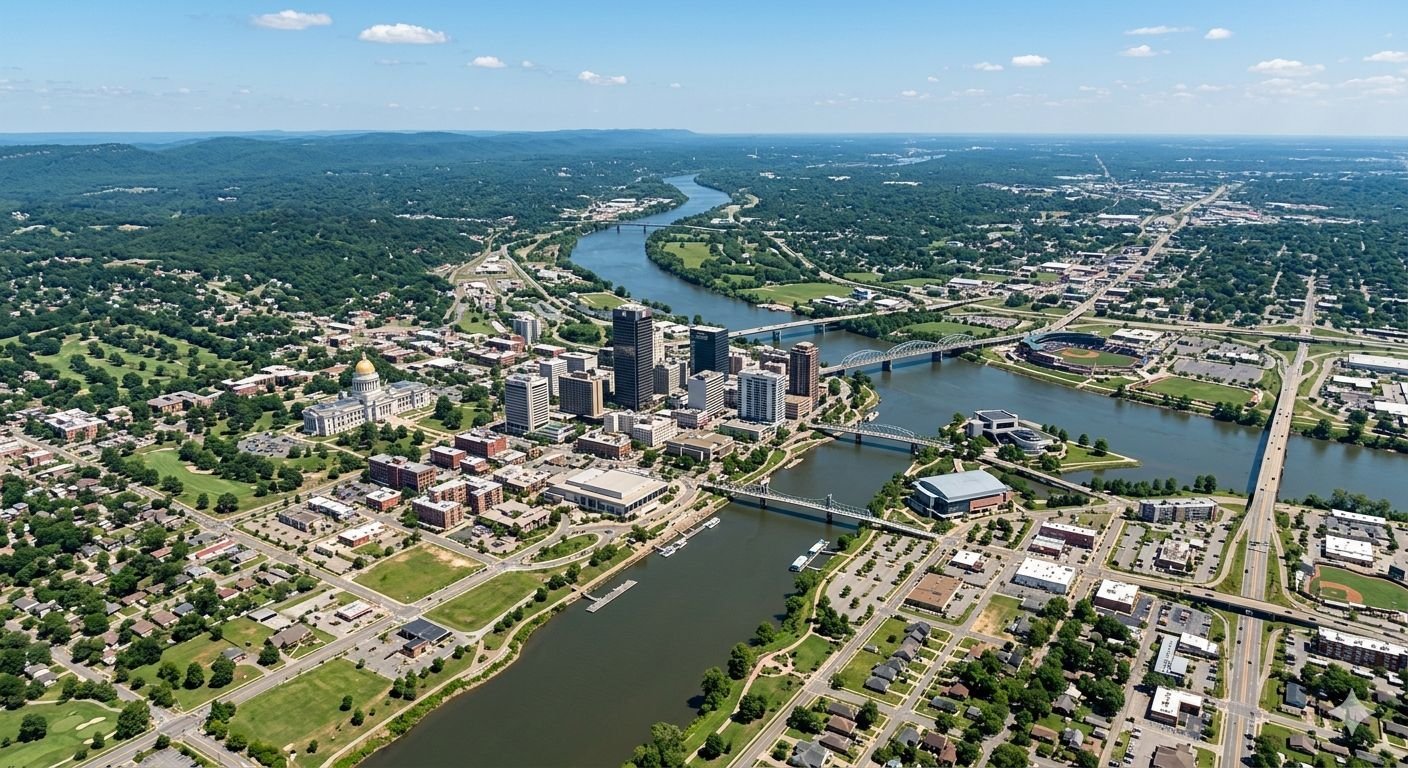
Arkansas does not always make the short list when Americans plan their vacations, and that is its great advantage. While crowds descend on more famous destinations, Arkansas quietly goes about the business of being extraordinary. It is a state of soaring limestone bluffs, wild rivers, ancient thermal springs, world-class art museums, haunting blues music, a place where you can dig for real diamonds and pocket what you find, and a mountain biking scene that has drawn riders from every continent. Arkansas is a unique tapestry of mountains, plains, and fertile delta — its history and heritage part Western frontier, part Ozark pioneer, and part Old South.
The nickname The Natural State is not mere marketing. It is an honest description of a place where nature is the dominant fact of life, where 52 state parks, two national forests, a national park, and the country’s first national river together make up one of the most richly endowed outdoor destinations in the American South. Come for the scenery, stay for the warmth of its people and the unexpected depth of its culture.
THE LAY OF THE LAND
Arkansas covers roughly 53,000 square miles and sits at the geographic crossroads of several distinct American landscapes. The northwestern and north-central parts of the state are dominated by the Ozark Mountains, a plateau of ancient limestone ridges, river valleys, caves, and hardwood forests that extends into Missouri and Oklahoma. The west-central region holds the Ouachita Mountains, older and geologically different from the Ozarks, running in long parallel east-west ridges covered in pine and hardwood.
Between and south of these ranges, the Arkansas River Valley cuts a broad swath across the middle of the state. To the south and southwest lies the Gulf Coastal Plain, transitioning toward Louisiana and Texas. And to the east, the state drops into the Mississippi Delta — flat, fertile, historically significant, and musically legendary.
This diversity of landscape means that within a single state, a traveler can move from mountain wilderness to river delta farmland, from thermal springs to crystal mines, from cutting-edge contemporary art to century-old folk traditions, all within a few hours’ drive.
NORTHWEST ARKANSAS: ART, TRAILS, AND THE OZARK SPIRIT
Northwest Arkansas — the region anchored by the cities of Bentonville, Fayetteville, Rogers, and Springdale — has undergone one of the most remarkable cultural transformations of any region in the American South over the past two decades. Long known primarily as the headquarters of Walmart, the world’s largest retailer, it has been remade by the Walton family’s extraordinary investment in arts and outdoor infrastructure into something genuinely surprising: a world-class destination for culture, cuisine, and cycling.
Crystal Bridges Museum of American Art in Bentonville is the centerpiece of this transformation and one of the finest art museums in the United States. Founded by Walmart heiress Alice Walton and opened in 2011, the museum houses a vast collection of American masterworks — paintings, sculpture, and mixed media, from colonial portraits to contemporary installations.
Works by Norman Rockwell, Georgia O’Keeffe, and Andy Warhol share space in this gorgeously designed, light-filled complex. Designed by architect Moshe Safdie, the museum sits in a wooded ravine and incorporates two spring-fed ponds into its architecture, with curved copper roofs and bridge-like galleries making the building itself part of the experience. Remarkably, general admission to Crystal Bridges is free. The museum also maintains miles of trails connecting its 120-acre park and gardens to downtown Bentonville, weaving sculpture installations into the natural landscape.
Crystal Bridges reflects a larger cultural shift in northwest Arkansas, where Bentonville is fast becoming a hub for design, innovation, and tourism, attracting artists, chefs, and entrepreneurs to what was once a quiet retail headquarters town. The 21c Museum Hotel in Bentonville extends the art experience into the realm of hospitality, with rotating contemporary art installations throughout its public spaces and guest rooms.
Bentonville has also established itself as one of the premier mountain biking destinations anywhere in the world. The town has a vibrant mountain-biking scene that has inspired the nickname Mountain Biking Capital of the World. The Slaughter Pen trail system alone offers dozens of miles of expertly built singletrack threading through the Ozark hillsides, ranging from gentle beginner loops to demanding technical challenges. Riders come from across the country and internationally to ride the northwest Arkansas trail network, which spans multiple cities and connects to greenway corridors throughout the region.
Fayetteville, home of the University of Arkansas, adds a youthful energy to the region. The Dickson Street corridor is the hub of nightlife, dining, and music, and the Walton Arts Center brings major performing arts productions to the region. The Botanical Garden of the Ozarks features themed gardens and the region’s only butterfly house on 86 picturesque acres in the city’s northeast.
Eureka Springs, tucked into the Boston Mountains a short drive east of Bentonville, is one of the most singular small towns in America. Named one of America’s Dozen Distinctive Destinations by the National Trust for Historic Preservation, Eureka Springs first drew visitors because of its natural springs with purported healing powers. During the late 1800s and early 1900s, the city became a popular spa resort, and today its entire downtown district is on the National Register of Historic Places.
The town is built on hillsides so steep that some streets exist on three levels, and no two intersections are at the same elevation. Victorian mansions cling to the bluffs, boutique hotels occupy historic buildings, and galleries, studios, and eclectic shops fill every available corner. Eureka Springs has long been a welcoming, openly inclusive community, and it draws artists, free thinkers, and visitors who appreciate its irreducible quirkiness.
Thorncrown Chapel, located in the woods near Eureka Springs, is one of the great works of American architecture — a soaring glass and wood structure designed by Arkansas architect E. Fay Jones that rises 48 feet into the Ozark forest. Named one of the finest buildings of the 20th century by the American Institute of Architects, it receives visitors year-round and is a profound experience regardless of one’s religious background.
The Christ of the Ozarks, a 70-foot white concrete statue of Christ standing on Magnetic Mountain outside Eureka Springs, is equally striking in its own way — a landmark visible from much of the surrounding landscape and one of only two such statues in America.
THE BUFFALO NATIONAL RIVER: AMERICA’S FIRST NATIONAL RIVER
If there is a single experience that defines the wild soul of Arkansas, it is the Buffalo National River. The country’s first national river, designated in 1972, the Buffalo River flows roughly 135 miles and includes nearly 95,000 acres of public land along its corridor. It has been the topic of a full-length book, the subject of a feature article, and the cornerstone for the state’s environmental movement. The stream descends nearly 2,000 feet through layers of sandstone, limestone, and chert, and its many bluffs are the highest in all the Ozark Mountains.
Running wild for 135 miles through the Ozark Mountains, the Buffalo National River is one of the last undammed rivers in the lower 48 states. It is a paradise for canoeists, hikers, and campers who want a taste of raw, unspoiled Arkansas.
Floating the Buffalo in a canoe or kayak is the quintessential Arkansas outdoor experience. Spring brings high water and exhilarating rapids on the upper stretches; by summer, the lower river mellows into long, glassy pools beneath towering bluffs.
The region is rich in wildlife, from deer and otters to bald eagles, with 200 species of birds making it a hotspot for birdwatchers. In spring, wildflowers blanket the forest floor; in fall, the hardwoods explode with color. Hemmed-In Hollow Falls, accessible by trail from the river corridor, is the tallest waterfall between the Rockies and the Appalachians and one of the most spectacular natural features in the entire South.
Numerous outfitters along the river rent canoes and kayaks and provide shuttle services. The river corridor has campgrounds, rustic cabins, and the small town of Jasper nearby, which serves as the gateway community and is home to some beloved local restaurants and a modest but welcoming overnight infrastructure.
The Boxley Valley, at the western end of the national river, is one of the most beautiful spots in Arkansas — a pastoral cove of farms, old barns, and elk grazing in meadows at dawn and dusk. The elk herd was reintroduced in the 1980s and has thrived spectacularly. Seeing a bull elk in velvet against a backdrop of limestone bluffs as morning mist lifts off the river is a scene that belongs in a nature documentary.
THE OZARK FOLK CENTER AND MOUNTAIN VIEW
Mountain View, a small town in the heart of the Ozarks, calls itself the Folk Music Capital of the World, and on weekends the courthouse square fills with pickers and fiddlers playing traditional Ozark music in an informal, joyous jam that has been going on for generations. It is one of the most authentic musical experiences in America — not a performance for tourists, but a living tradition that happens to welcome all comers.
The Ozark Folk Center State Park preserves and celebrates the traditional arts, crafts, and music of the Ozark Mountains. Demonstrations of blacksmithing, weaving, quilting, chair caning, and dozens of other traditional crafts run alongside live music performances in an outdoor amphitheater. The Folk Center is a rare and genuinely moving institution — a place dedicated not to nostalgia but to the living continuation of a cultural tradition that might otherwise fade.
Blanchard Springs Caverns, located in the Ozark National Forest near Mountain View, is another unmissable attraction. This living cave dates back to over 300 million years ago and has one of the largest deposits of flowstone in the country. Seasonal tours are offered where visitors explore the living cave, witnessing stalactites, stalagmites, flowstones, and more. The caverns are operated by the US Forest Service and are among the most impressive show caves in the eastern United States.
The Ozark Highlands Trail, a 178-mile backpacking route, winds along mountaintops and bluffs, past waterfalls and over streams, through some of the most remote and scenic country in the Ozark National Forest and the Buffalo National River corridor. It is one of the great long-distance trails of the American South.
HOT SPRINGS: THE SPA CITY
Hot Springs is one of America’s most historically rich and genuinely fascinating small cities. People have used the hot springs here for more than two hundred years to treat illnesses and to relax. Both rich and poor came for the baths, and a town built up around the Hot Springs Reservation. Hot Springs National Park — the first unit ever set aside in what would become the national park system, established in 1832 — surrounds the city itself, a remarkable arrangement in which a working downtown exists inside a national park.
Bathhouse Row is the visual and spiritual center of Hot Springs: a line of eight magnificent Beaux-Arts bathhouses built between 1912 and 1923 along the base of Hot Springs Mountain. At their peak these establishments welcomed hundreds of thousands of visitors annually, from presidents and celebrities to ordinary Americans seeking healing waters.
Today several have been restored and reimagined. Buckstaff remains a traditional bathhouse where visitors can still soak in the thermal waters and receive a massage exactly as visitors did a century ago. Fordyce Bathhouse serves as the national park visitor center, its restored interiors offering a window into the extravagant world of the early-20th-century spa. And the Superior Bathhouse has been reimagined as something entirely novel — the Superior Bathhouse Brewery, the first brewery to be located inside a national park, uses the natural thermal water in its brewing process.
Hot Springs was also the boyhood home of President Bill Clinton, and his childhood home is preserved nearby.
The city has reinvented itself from its historical identity as a spa town and thoroughbred racing hub into a lively arts community with galleries, boutiques, excellent restaurants, and a thriving music and events scene. Garvan Woodland Gardens, located on the shores of Lake Hamilton, is part of the University of Arkansas’s Fay Jones School of Architecture and is the only botanical garden in the nation that occupies all of a peninsula in a major water body. Popular attractions include the Anthony Chapel, a work of art featuring a 57-foot open-rafter ceiling supported by pine columns and crossbeams.
Three lakes — Hamilton, Catherine, and Ouachita — surround the city and provide outstanding opportunities for boating, fishing, and water sports. Lake Ouachita, at over 40,000 acres, is one of the clearest lakes in the country and is beloved by scuba divers for its underwater visibility.
Oaklawn Park, one of America’s great horse racing venues, runs Thoroughbred racing each winter and spring, and a casino now operates on the grounds year-round.
PETIT JEAN STATE PARK: ARKANSAS’S FIRST AND FINEST
Petit Jean Mountain, rising above the Arkansas River Valley between the Ozarks and Ouachitas, is home to Arkansas’s first state park, established in 1923, and by many accounts its most beloved. The park’s signature attraction is Cedar Falls, a stunning 95-foot waterfall that drops into a sandstone canyon in a scene of remarkable beauty. The Seven Hollows Trail loops through a landscape of box canyons, natural bridges, rock shelters, and cedar forest. The park’s historic Mather Lodge, perched on the mountain’s rim with views across the river valley, dates to the 1930s and remains a working lodge and restaurant in the finest tradition of the national park rustic style.
The park also contains ancient cave paintings — the Bear Cave petroglyphs — left by Native Americans thousands of years ago, and the Winrock Farm, once owned by Winthrop Rockefeller, who served as Arkansas governor in the late 1960s.
MOUNT MAGAZINE: THE ROOF OF ARKANSAS
At 2,753 feet, Magazine Mountain is the highest point in Arkansas, and Mount Magazine State Park, perched atop its flat summit, offers some of the most dramatic views available anywhere in the state. The mountain’s sheer south face drops 1,000 feet in an almost vertical cliff, and the views from the edge stretch across the Arkansas River Valley in a breathtaking panorama. The park is an exceptional destination for hang gliding, birding — the area is known for rare butterfly species as well as birds — and hiking on trails that follow the mountain’s rim.
CRATER OF DIAMONDS STATE PARK: DIG FOR YOUR OWN TREASURE
Few tourist attractions anywhere in the world can match the pure delight of Crater of Diamonds State Park near Murfreesboro. Crater of Diamonds State Park is the only diamond-producing site in the world open to the public for digging. Visitors pay a modest daily fee, receive a soil sifter, and then spend as long as they like searching the 37-acre plowed field — the eroded surface of an ancient volcanic pipe — for diamonds and semi-precious stones. And whatever they find, they keep.
This is not a gimmick. More than 35,000 diamonds have been found here since the park opened, ranging from tiny chips to gems of several carats. In 2021, a visitor found a 4.38-carat diamond, one of the largest in recent years. The field also produces amethyst, garnet, jasper, quartz, and agate. The experience is equal parts treasure hunt, geology lesson, and pure Southern eccentricity.
LITTLE ROCK: THE CAPITAL AND ITS CIVIL RIGHTS LEGACY
Little Rock, Arkansas’s capital and largest city, deserves more credit than it typically receives as a travel destination. It is a city of genuine vitality, with excellent restaurants, a lively arts scene, and a riverfront district that has been substantially revitalized in recent years.
The most historically significant site in the city — and one of the most important in the entire South — is the Little Rock Central High School National Historic Site. In September 1957, nine Black students, known to history as the Little Rock Nine, attempted to integrate the previously all-white Central High School in the face of a hostile crowd and the Arkansas National Guard, called out by Governor Orval Faubus to block integration. President Eisenhower ultimately sent in the 101st Airborne Division to enforce the Supreme Court’s desegregation ruling. The school continues to operate as a high school while simultaneously serving as a national historic site, and the visitor center across the street provides a deeply moving account of this pivotal episode in American civil rights history.
The William J. Clinton Presidential Library, an architecturally striking glass structure cantilevered over the Arkansas River, tells the story of the 42nd presidency and is one of the largest presidential libraries in the country. The nearby River Market District has transformed the downtown riverfront into a lively neighborhood of restaurants, bars, the Ottenheimer Market Hall, and the Arkansas Museum of Fine Arts, which recently completed a major renovation and expansion, with a collection spanning the 1300s to the present day encompassing 14,000 works.
The Historic Arkansas Museum in downtown Little Rock preserves the oldest surviving structures in the capital, including several houses from the 1820s, and tells the story of the state’s territorial and early statehood era.
THE ARKANSAS DELTA: BLUES, HISTORY, AND THE GREAT RIVER
Eastern Arkansas is a world apart from the mountains and spa towns of the west. Here the land flattens into the Mississippi Delta — an immense, fertile plain of cotton and rice fields, catfish ponds, and hardwood bottomlands that stretches to the great river. This landscape has an austere beauty and a cultural depth that rewards visitors who take the time to explore it.
Helena, on the Mississippi River, is the epicenter of Arkansas’s blues heritage. The King Biscuit Blues Festival is held here annually, attracting top blues musicians. Additionally, the Delta Cultural Center offers interpretive exhibits to celebrate the region’s rich musical history. The festival and museum draw blues enthusiasts from around the world. The King Biscuit Time radio program, which launched from Helena in 1941, is the longest-running daily blues radio show in the world and continues to broadcast today.
Johnny Cash was born in Kingsland, Arkansas, and visitors can tour the childhood home in the Arkansas Delta where the Man in Black spent his earliest years, gaining an understanding of the landscape and poverty that shaped one of America’s most important musical voices. The Delta is also deeply connected to the early history of rock and roll — the convergence of blues, gospel, and country music in this region during the 1940s and 1950s was the seedbed from which American popular music grew.
The Toltec Mounds Archaeological State Park preserves one of the largest and most complex Native American ceremonial and civic centers in the lower Mississippi Valley, with mounds dating back to between 700 and 1100 AD.
SCENIC DRIVES: THE OZARK AND OUACHITA BYWAYS
Arkansas rewards the road-tripping traveler more than almost any state in the South. One of the most scenic drives in the nation, Scenic 7 runs from the Louisiana border to Bull Shoals Lake near the Missouri state line, passing through both the Ouachita and Ozark Mountains. Numerous resorts, attractions, and scenic overlooks are found along its route, and Car and Driver magazine named a portion of Scenic 7 Byway as one of the top 10 driving experiences in the United States.
The Talimena National Scenic Byway, running along the ridge of the Ouachita Mountains from Mena, Arkansas, into Oklahoma, offers dramatic ridgeline views across miles of national forest. The Great River Road follows the Mississippi River’s western bank through the Delta, passing through towns steeped in Civil War and blues history. The Arkansas Scenic 7 Byway and the
Crowley’s Ridge Parkway round out a remarkable collection of designated scenic routes that make a road trip through Arkansas an endlessly rewarding proposition.
FOOD AND DRINK: SOUTHERN ROOTS AND NEW FLAVORS
Arkansas food is Southern to its core, but it is more varied and ambitious than that shorthand suggests. The state has a strong tradition of smoked barbecue — particularly whole hog and pork ribs — and the best pit barbecue joints, often found in rural small towns, are institutions that have been feeding generations of locals and savvy travelers for decades.
Fried catfish is the signature dish of the Delta and a beloved staple statewide. Catfish farms are common throughout eastern Arkansas, and local fish houses serving farm-raised catfish with hush puppies, coleslaw, and fried pickles represent one of the great regional dining experiences in the American South. Fried chicken, biscuits and gravy, turnip greens, black-eyed peas, and sweet potato pie complete the traditional repertoire.
The rise of northwest Arkansas as a cultural destination has brought with it a sophisticated restaurant scene. Bentonville, Fayetteville, and Rogers now have nationally recognized chefs, farm-to-table restaurants, and a level of culinary ambition that would surprise visitors who still think of the region as flyover country. The food hall culture and craft brewery scene in northwest Arkansas in particular have expanded dramatically.
Arkansas is also a surprisingly productive wine region, with wineries concentrated in the Arkansas River Valley near Altus, where German immigrant families planted vineyards in the 1880s. The Post Familie Winery and Wiederkehr Wine Cellars are among the most established, producing wines from both native American grape varieties and European vinifera that pair beautifully with the region’s food traditions.
Arkansas is the leading rice producer in the United States, with Riceland Foods headquartered in Stuttgart, the world’s largest miller and marketer of rice. Stuttgart also calls itself the Duck Hunting Capital of the World, hosting the World’s Championship Duck Calling Contest each November during the Wings Over the Prairie Festival.
FESTIVALS AND EVENTS
Arkansas has a rich and year-round festival calendar that celebrates everything from folk music to blues to diamonds. The Arkansas Folk Festival in Mountain View each April is one of the oldest folk festivals in the country and draws musicians and craftspeople from across the region. The Bikes, Blues, and BBQ rally in Fayetteville in late September is one of the largest motorcycle rallies in America, raising millions for charity alongside its celebration of bikes, music, and barbecue.
The Wildflower Weekend in the Buffalo National River area each April draws nature enthusiasts to witness the spectacular spring bloom on the Ozark hillsides. The Toad Suck Daze festival in Conway each May is a beloved example of the uniquely Arkansas tradition of small-town celebration — its name derived from a historical tavern at an old river crossing. And the GloWild Lantern Festival at Little Rock Zoo in winter has become one of the state’s most visually spectacular events, turning the zoo grounds into a glowing landscape of illuminated art.
PRACTICAL TRAVEL TIPS
Getting There: Little Rock’s Bill and Hillary Clinton National Airport is the main gateway, with connections to major hub cities across the country. Northwest Arkansas Regional Airport in Bentonville-Fayetteville has seen dramatically expanded service in recent years and now offers direct flights from numerous cities. Fort Smith and Jonesboro have smaller regional airports.
Getting Around: A rental car is essential for exploring Arkansas. The state’s greatest rewards are found off the interstates, on winding mountain highways and rural byways that connect small towns, state parks, and natural areas. Distances between key destinations can be significant, so planning a road-trip route makes the most sense.
When to Go: Spring, from late March through May, is arguably the finest season — wildflowers are spectacular, rivers run at good floating levels, temperatures are mild, and the Ozark forests are luminously green. Fall, from late September through November, brings spectacular foliage particularly in the Ozarks and Ouachitas, as well as cool hiking weather and harvest festivals. Summer is hot and humid but is prime time for river floating, lake recreation, and outdoor events. Winter is quiet but has its pleasures, especially for birders and those who appreciate the stark beauty of bare-branched Ozark ridgelines against gray skies.
All 52 state parks are free to enter and offer diverse experiences. Whether you are a history buff, love to hike, paddle, bike, wildlife watch, fish, kick back and relax, or all of the above, there is a state park for you. This makes Arkansas an exceptionally accessible and affordable destination for families and budget-conscious travelers.
CONCLUSION: Arkansas Rewards Every Kind of Traveler
Arkansas is proof that the best travel experiences are often found in places that do not advertise themselves loudly. From the art temples of Bentonville to the wild bends of the Buffalo River, from the steaming thermal baths of Hot Springs to the diamond fields of Murfreesboro, from the folk music of Mountain View to the blues festivals of Helena, the state delivers experiences that are genuine, varied, and often spectacular — without the crowds that besiege better-known destinations.
Many of Arkansas’s attractions remain uncrowded, which makes exploring them feel even more special. Travelers looking for inspiration, quiet adventure, or something a little different will find it here — without having to go far or fight through crowds. With its mix of natural wonder and cultural gems, Arkansas delivers more than most expect.
Come with an open road, an open mind, and a little extra room in your pocket — you might just bring home a diamond.
Leave a Reply
You must be logged in to post a comment.