Author: TN

  • Miami, Florida: Vibrant streets, turquoise seas, and endless hospitality

    There is a moment that happens to almost every first-time visitor to Miami — usually somewhere along the causeway crossing Biscayne Bay toward South Beach, with the glittering Atlantic ahead and the downtown skyline rising behind, the air thick and warm and carrying the faint salt of the sea — when the city reveals itself as something genuinely extraordinary. Not just a beach destination. Not just a party town. Not just a collection of Art Deco facades and neon signs and rooftop bars. Something larger and stranger and more beautiful than any of those things alone.

    Miami is one of the most fascinating cities in the United States — a place that occupies a unique position at the intersection of North America, Latin America, and the Caribbean, shaped by wave after wave of immigrant communities who have arrived here over a century and built something that exists nowhere else on Earth. It is simultaneously an American city and a Latin city, a gateway to the Americas and a destination in its own right, a subtropical paradise and a global financial center, a capital of art and design and a capital of pleasure.

    The numbers alone suggest its scale and significance. Greater Miami is home to approximately 6.2 million people, making it the largest metropolitan area in Florida and the eighth largest in the United States. Miami International Airport is one of the busiest in the country for international travel, connecting the city directly to over 100 international destinations. The Port of Miami is the busiest cruise port in the world. The city’s art fair, Art Basel Miami Beach, is the most important contemporary art event in the Western Hemisphere. And Miami Beach’s ocean-facing strip of Art Deco architecture is the largest collection of Art Deco buildings in the world.

    But statistics capture nothing of what makes Miami genuinely special. What makes Miami special is the light — that extraordinary, saturated, tropical light that makes everything look slightly more vivid than it does anywhere else. The music — salsa and reggaeton and Miami bass and electronic music pouring simultaneously from cars and restaurants and open-air bars at every hour of the day. The food — Cuban sandwiches and Haitian griot and Peruvian ceviche and Jamaican jerk chicken and Israeli mezze and Japanese omakase, all within a few miles of each other. The warmth — of the climate, yes, but also of the people, who bring a Latin exuberance and generosity of spirit to daily life that transforms the experience of being here.
    Miami is a city that lives outdoors. It is a city that dresses up to go out. It is a city that takes its coffee standing at a ventanita window, its music loud and its sunsets seriously. It is, in the best possible sense, a city that is entirely, unapologetically itself.
    This guide will take you through everything you need to know to experience it fully.

    GETTING THERE
    Miami International Airport (MIA) is the primary gateway to the city and one of the most important airports in the Americas. Located approximately eight miles northwest of downtown Miami, it handles over 50 million passengers annually and serves as the largest hub for American Airlines, which operates an extraordinary number of routes connecting Miami to domestic destinations and to Latin America, the Caribbean, and Europe. Among major American airports, MIA consistently ranks first or second in the number of international passengers processed annually, reflecting Miami’s role as the de facto gateway between the United States and Latin America.

    The airport’s international terminal connects passengers from across the globe, with direct services from virtually every major Latin American city, the Caribbean islands, major European hubs including London, Madrid, Paris, Frankfurt, and Amsterdam, and a growing number of routes to Asia and the Middle East. For domestic travelers, Miami is connected to virtually every major American city with multiple daily departures.

    Ground transportation from MIA is convenient. The Miami International Airport Metrorail Station, connected to the terminal by the MIA Mover automated people mover, provides a direct rail connection to downtown Miami and the broader Metrorail network. The journey from the airport to downtown Brickell takes approximately 15 minutes by rail. Taxis and rideshares through Uber and Lyft are readily available outside the baggage claim areas. The SuperShuttle shared van service and hotel shuttle services provide additional options. Rental car facilities are located in the adjacent Miami Intermodal Center, connected to the terminal by the MIA Mover.

    Fort Lauderdale-Hollywood International Airport (FLL), located approximately 30 miles north of Miami in Broward County, is an important secondary airport for the Miami area. It is heavily used by low-cost carriers including Spirit, Frontier, and Southwest, and often offers significantly cheaper fares than MIA for the same destinations. The trade-off is the additional journey time to Miami proper — typically 35 to 45 minutes by car under normal traffic conditions, though the drive can be considerably longer during peak hours on I-95 or I-595.
    Palm Beach International Airport (PBI), about 70 miles north of Miami, is a third option used primarily by travelers headed to Palm Beach County rather than Miami, though it serves as an alternative for budget-conscious travelers willing to make the longer drive south.

    Amtrak serves Miami at the Miami Central Station, which opened in 2018 as the anchor of the massive MiamiCentral mixed-use transit hub in downtown. The Silver Star and Silver Meteor routes connect Miami to Orlando, Jacksonville, Savannah, Washington D.C., Philadelphia, New York, and Boston — a long but scenic journey up the Eastern Seaboard. Brightline, Florida’s private intercity passenger rail service, operates high-speed trains between Miami and Orlando, with stops in Fort Lauderdale, Boca Raton, West Palm Beach, and Aventura. The Brightline service has dramatically improved intercity rail travel in Florida and is the first new private passenger railroad in the United States in over a century.

    By car, Miami sits at the southern terminus of Interstate 95, which runs north along the eastern seaboard all the way to Maine. The Florida Turnpike connects Miami to Orlando and the rest of central and northern Florida. US Route 1 (the Overseas Highway) extends south from Miami through the Florida Keys to Key West, one of the most scenic drives in the United States. Interstate 75, known locally as Alligator Alley in its western segment, cuts across the Everglades to connect Miami with Naples and the Gulf Coast of Florida.

    GETTING AROUND
    Miami is, like most of South Florida, a city shaped substantially around the automobile, and renting a car provides maximum flexibility for visitors who want to explore beyond a single neighborhood. The city’s expressway system — I-95, I-395, I-195, the Dolphin Expressway (SR 836), and the Airport Expressway — moves traffic efficiently between the major zones, though rush hour congestion on I-95 in particular can be severe in both directions.
    That said, Miami has invested significantly in its public transportation infrastructure, and for visitors staying in or near the major tourist corridors, car-free travel is increasingly practical.

    The Miami Metrorail is an elevated heavy rail system with two lines serving the greater Miami area. The Orange Line runs from Palmetto in the northwest through the airport, downtown, and Brickell, with an extension to Dadeland South in the southern suburbs. It is particularly useful for connections between the airport and downtown. The Green Line branches from the system and serves additional neighborhoods. The system is clean, reliable, and air-conditioned — a significant virtue in the Miami heat.

    The Miami Metromover is a free automated people mover system that circulates through downtown Miami and the Brickell financial district, connecting the major office buildings, hotels, museums, and transit hubs. It is genuinely useful for navigating downtown without a car and provides elevated views of Biscayne Bay and the downtown skyline.
    The Miami Beach area is served by the South Beach Local bus (the SBL), an inexpensive circulator that runs through the Art Deco District and along Washington Avenue and Collins Avenue. The City of Miami Beach also operates the Beach Trolley service, which runs several routes connecting South Beach with Mid-Beach and North Beach. Dedicated bicycle lanes on several key streets and the Citi Bike Miami bike-share program make cycling a viable option in the relatively flat terrain of Miami Beach.

    The Venetian and MacArthur Causeways connecting mainland Miami to Miami Beach carry significant traffic. The Julia Tuttle Causeway connects to Mid-Beach. The 79th Street Causeway reaches North Beach. During peak periods — Friday and Saturday evenings, major events, holiday weekends — crossing the causeways by car can involve significant delays, making transit or rideshare a smarter choice for evening outings to South Beach.

    Ridesharing through Uber and Lyft is extremely popular throughout Miami and is particularly useful for evenings out when parking in South Beach or Wynwood is difficult and potentially expensive. Water taxis operated by various private operators offer scenic crossings of Biscayne Bay between downtown Miami and Miami Beach, combining transportation with sightseeing.
    Cycling is excellent within Miami Beach and along the extensive network of dedicated paths in Coconut Grove, Key Biscayne, and the broader waterfront areas. The terrain is uniformly flat, distances within neighborhoods are manageable, and the weather is conducive to outdoor cycling for most of the year.

    WHERE TO STAY
    Miami’s accommodation landscape is one of the most varied and glamorous in the United States, with extraordinary concentrations of design hotels in South Beach and luxury resort properties throughout the metro area.
    South Beach
    South Beach is the most popular area for first-time visitors and offers the highest concentration of hotels in the city, ranging from iconic luxury properties to boutique design hotels to budget-oriented options.

    The Fontainebleau Miami Beach is the most historically significant and architecturally celebrated hotel in Miami. Designed by Morris Lapidus and opened in 1954, it defined the Miami Modern (MiMo) architectural style with its sweeping curved facade, kidney-shaped pool, and exuberant interior spaces. The property has hosted presidents, celebrities, and cultural figures throughout its seven-decade history and has appeared in James Bond films, Scarface, and countless other productions. Its enormous pool complex, nightclub LIV — one of the most celebrated in the world — and roster of restaurants make it a self-contained resort experience.

    The Setai Miami Beach, occupying a pair of buildings that include a beautifully restored 1936 Art Deco tower, is widely regarded as the finest hotel in South Beach and one of the best in Florida — a place of extraordinary elegance, three temperature-distinct pools reflecting the tones of the ocean, and impeccable service. The Eden Roc Miami Beach, another Morris Lapidus masterpiece from 1955, was fully renovated in recent years and combines mid-century modern architecture with contemporary luxury.

    The 1 Hotel South Beach brings a nature-inspired, sustainability-focused luxury aesthetic to a South Beach landmark, with living walls of plants, reclaimed wood finishes, and spectacular ocean views. The Faena Hotel Miami Beach, opened in 2015 at the northern end of the Art Deco District, is perhaps the most theatrical hotel in the city — a collaboration between developer Alan Faena and director Baz Luhrmann that produced an environment of surreal, maximalist opulence anchored by a gilded woolly mammoth skeleton in the ballroom and a roster of extraordinary restaurants and performance spaces.

    For smaller boutique properties, the Art Deco District along Collins Avenue and Ocean Drive is lined with lovingly restored 1930s hotels that have been converted into stylish boutique properties. The Delano South Beach remains a design hotel icon — its all-white interiors and rippling curtains, designed by Philippe Starck in 1995, were enormously influential on hotel design globally. The National Hotel, the Raleigh, the Betsy, and the Catalina are among the other distinguished mid-scale Art Deco boutique options.

    Mid-Beach and North Beach
    Mid-Beach, roughly between 23rd and 63rd Streets on Miami Beach, has seen significant new hotel development in recent years. The Nobu Hotel Miami Beach, the W South Beach, and the Loews Miami Beach Hotel are all well-regarded options in this area, which offers slightly more space and slightly less intensity than the South Beach core.

    Brickell and Downtown Miami
    The Brickell neighborhood — Miami’s financial district on the mainland, connected to South Beach by the MacArthur Causeway — has developed rapidly into a sophisticated urban neighborhood with its own strong hotel offerings. The East Miami Hotel in the Brickell City Centre complex, the Kimpton EPIC Hotel with its rooftop pool overlooking Biscayne Bay, and the Four Seasons Hotel Miami all offer excellent Brickell-based options for visitors whose primary interest is the city’s business, arts, or restaurant scenes rather than the beach.

    Coral Gables
    The Biltmore Hotel Coral Gables, opened in 1926 in a historic Mediterranean Revival building that served as a military hospital during World War II, is one of the great historic hotels of Florida. Its enormous free-form pool — at one time the largest hotel pool in the world — its 18-hole golf course, and its ornate Spanish-Moorish architecture make it one of the most distinctive accommodation experiences in the Miami area.

    Coconut Grove
    The Mayfair Hotel & Spa and several smaller boutique properties in Coconut Grove offer a more intimate, village-like atmosphere in one of Miami’s most beautiful and historically significant neighborhoods.

    Key Biscayne
    The Ritz-Carlton Key Biscayne, located on this barrier island just south of Miami Beach, offers a genuine resort experience — beachfront, lush tropical landscaping, multiple pools, and a sense of remove from the urban intensity of South Beach — that appeals to families and travelers seeking relaxation over nightlife.

    THE ART DECO HISTORIC DISTRICT
    No visit to Miami is complete without a thorough exploration of the Art Deco Historic District, the most concentrated and celebrated collection of Art Deco architecture in the world. Located in the southern portion of Miami Beach, the district encompasses roughly one square mile of low-rise buildings constructed primarily between 1923 and 1943, constituting over 800 historic structures that together were added to the National Register of Historic Places in 1979 in one of the first such listings of 20th-century architecture in the United States.
    The Art Deco style as expressed in Miami Beach is a specific regional variant sometimes called Tropical Deco or Streamline Moderne — characterized by flat roofs with decorative parapets, horizontal racing stripes called “eyebrows” over windows that provide shade, porthole windows, nautical motifs, pastel color palettes applied to stucco exteriors, and a generally optimistic exuberance that reflects both the aesthetic spirit of the late 1930s and the particular character of a resort town on the edge of the tropics.

    Ocean Drive, running along the eastern edge of South Beach parallel to the beach, is the most famous street in the district and one of the most photographed streetscapes in the world. The buildings along its western side — the Leslie, the Carlyle, the Cardozo (owned for many years by Gloria Estefan), the Clevelander, the Park Central — present their decorative facades to the wide sidewalk cafés and then to the beach and ocean beyond, creating a theatrical outdoor living room where the boundary between public and private dissolves in the most Miami of ways. The street was memorably used as the backdrop for the television series Miami Vice, which along with the work of preservationist Barbara Capitman in the 1970s and 1980s is largely responsible for the district’s rescue from demolition and its subsequent transformation into the globally recognized landmark it is today.

    Collins Avenue, running parallel to and one block west of Ocean Drive, has a slightly less tourism-heavy concentration of Art Deco buildings along its length, with many hotels that were renovated more quietly and serve a more mixed clientele. Washington Avenue, another block west, was historically the commercial spine of South Beach and retains a grittier, more authentic character than the tourist-polished Ocean Drive, with Jewish delis, bodegas, and independent businesses mixed among the nightclubs and restaurants.

    The Art Deco Welcome Center on Ocean Drive, operated by the Miami Design Preservation League, offers self-guided audio tours and scheduled walking tours led by knowledgeable docents who illuminate the architectural history, the preservation story, and the fascinating social history of the district in compelling depth.

    The nightly illumination of Ocean Drive — the neon signs and façade lighting that comes alive after dark and turns the streetscape into a glowing, saturated spectacle — is one of the most purely pleasurable sights in Miami and should be experienced at least once by every visitor, ideally on foot with a drink in hand and nowhere particular to be.

    NEIGHBORHOODS TO EXPLORE
    Wynwood
    Wynwood, a former warehouse district north of downtown Miami, has undergone one of the most dramatic creative transformations of any urban neighborhood in the United States over the past 15 years. Beginning in the mid-2000s, when developer Tony Goldman began commissioning murals on the exterior walls of the neighborhood’s industrial buildings, Wynwood evolved from a neglected light-industrial area into the global capital of street art — and subsequently into one of the most visited art districts in the world.

    The Wynwood Walls, an outdoor museum of large-scale murals by internationally recognized street artists, is the centerpiece of the district and one of Miami’s most visited attractions. The walls have featured works by Shepard Fairey, Os Gemeos, Kenny Scharf, Futura, RETNA, and dozens of other major figures in contemporary street art, and are refreshed periodically to keep the collection evolving. The surrounding streets of Wynwood extend the gallery experience outward — virtually every available exterior wall in the neighborhood has been treated as a canvas, creating an immersive outdoor art experience that stretches for blocks in every direction.

    Beyond the art, Wynwood has developed a robust ecosystem of galleries, studios, restaurants, breweries, cocktail bars, boutique shops, and creative offices. The Wynwood Brewing Company, J. Wakefield Brewing, and Boxelder craft beer bar have helped establish the neighborhood as a destination for craft beer enthusiasts. The food scene spans everything from wood-fired pizza to Venezuelan arepas to Korean fusion. The neighborhood is most alive on the second Saturday of each month during Wynwood Art Walk, when galleries open simultaneously for evening events and the streets fill with an eclectic crowd of art lovers, tourists, and Miami creatives.

    Little Havana
    Little Havana, stretching along SW 8th Street (Calle Ocho) west of downtown Miami, is the cultural heart of Miami’s Cuban-American community and one of the most important Cuban communities outside of Cuba itself. The neighborhood’s identity was forged by the waves of Cuban exiles who arrived in Miami beginning in the 1960s following Fidel Castro’s revolution, and their cultural imprint remains profound and visible on every block.

    Domino Park — officially Máximo Gómez Park — at the corner of Calle Ocho and SW 15th Avenue is perhaps the most iconic gathering place in Little Havana. Elderly Cuban men sit at concrete tables playing dominoes with intense concentration, as they have for decades, while observers watch and the rhythms of the neighborhood swirl around them. It is a scene of genuine, unrehearsed cultural vitality.

    The restaurants and cafeterias of Calle Ocho serve some of the finest Cuban food in the world outside of Havana — ropa vieja (shredded braised beef), lechón asado (slow-roasted pork), picadillo, black beans and rice, maduros (sweet fried plantains), and the indispensable Cuban sandwich (ham, roasted pork, Swiss cheese, pickles, and mustard pressed in Cuban bread). Versailles Restaurant, a Little Havana institution since 1971, is the most famous Cuban restaurant in Miami and one of the most famous in the world — a gathering place for the Cuban exile community that has hosted presidents, celebrities, and every Miami politician of significance.

    The ventanita — the little window — is a uniquely Miami institution found throughout Little Havana and Cuban neighborhoods across the city. Small counter windows dispensing café cubano (strong, sweetened espresso served in a tiny cup), cortadito (espresso cut with steamed milk), and café con leche are on virtually every other block. The ritual of standing at a ventanita with a small plastic cup of coffee and striking up a conversation with a stranger is one of the most authentically Miamian experiences available.
    The Calle Ocho Festival, held each March, is one of the largest street festivals in the United States — a mile-long outdoor party celebrating Latin music, food, and culture that transforms the neighborhood and draws hundreds of thousands of visitors.

    Coral Gables
    Coral Gables is one of the most beautiful planned communities in the United States — a city unto itself within the Miami metro area, developed in the 1920s by George Merrick according to a Mediterranean Revival vision that produced wide boulevards, entrance gates of coral rock and keystone, decorative plazas, and hundreds of homes built to strict architectural standards. The result is a neighborhood of extraordinary coherence and beauty — orange trees lining the streets, bougainvillea cascading over coral rock walls, and a sense of unhurried elegance that feels like a world apart from the frenetic energy of South Beach.

    The Venetian Pool, carved from a coral rock quarry in 1923, is one of the most extraordinary public swimming pools in the world — a freshwater pool of 820,000 gallons fed by artesian wells and landscaped with caves, waterfalls, a bridge, and a loggia of remarkable architectural beauty. Swimming in the Venetian Pool on a hot Miami afternoon is an experience of almost surreal loveliness.

    Miracle Mile, the retail spine of Coral Gables, is lined with boutiques, restaurants, and bridal shops along a beautifully maintained pedestrian-friendly corridor. The Actors’ Playhouse at the Miracle Theatre, housed in a wonderfully preserved 1948 Art Deco movie palace, is one of the finest regional theaters in Florida.
    The University of Miami anchors the southern edge of Coral Gables, bringing intellectual energy and a substantial student population to the neighborhood. The Lowe Art Museum on the UM campus holds an impressive collection of art including a notable Pre-Columbian collection and works by Picasso, Gauguin, and Monet.

    Coconut Grove
    Coconut Grove — “The Grove” to Miamians — is Miami’s oldest neighborhood, a bohemian village of banyan tree-lined streets, waterfront parks, galleries, bookshops, and outdoor cafés that predate the city of Miami itself. The neighborhood was settled in the late 19th century by Bahamian immigrants, New England intellectuals, and adventurers drawn to the subtropical wilderness of Biscayne Bay, and it retains something of that independent, free-spirited character even as it has gentrified significantly in recent decades.

    Peacock Park along the bayfront, the walking trails through the hammock forests of the neighborhood, and the pleasure of cycling or walking through streets canopied by enormous fig trees make the Grove one of the most physically beautiful neighborhoods in Miami. Cococwalk, a recently renovated open-air shopping and dining complex, anchors the commercial core. The Barnacle Historic State Park preserves the 1891 home of Ralph Munroe, one of Coconut Grove’s founding figures, in a setting of extraordinary natural beauty on the bay.
    The marinas and yacht clubs of Coconut Grove reflect the neighborhood’s deep connection to Biscayne Bay and the sailing culture that has thrived here for over a century. Dinner Key Marina is one of the largest in Florida.

    Brickell
    Brickell, Miami’s financial district along Brickell Avenue south of downtown, has transformed in the past decade from a daytime-only office corridor into one of the city’s most vibrant urban neighborhoods. The Brickell City Centre, a massive mixed-use development featuring luxury retail, restaurants, offices, hotels, and residences connected to the Metrorail and Metromover, has become a genuine urban hub. Mary Brickell Village and the streets surrounding it are packed with restaurants, bars, and nightlife options that serve the dense residential population living in the gleaming high-rise towers that have risen throughout the neighborhood.

    Design District
    The Miami Design District, located north of downtown and east of Wynwood, is a neighborhood that has been developed over the past two decades into one of the world’s premier luxury retail and design destinations. Every major European luxury fashion house has a presence here — Louis Vuitton, Hermès, Chanel, Dior, Prada, Gucci, Celine, Bottega Veneta, and dozens of others occupy architecturally significant flagship stores designed by internationally recognized architects. The Palm Court at the center of the district is anchored by a spectacular Buckminster Fuller-inspired geodesic dome installation and surrounded by cultural programming, art installations, and outdoor dining.

    The Design District also houses the Institute of Contemporary Art Miami (ICA Miami), a nonprofit museum offering free admission that presents ambitious exhibitions of contemporary art in a beautiful purpose-built building designed by Aranguren + Gallegos Arquitectos.

    BEACHES
    Miami’s beaches are among the finest urban beaches in the world — wide, sandy, well-maintained, and backed by one of the most dramatic beachfront architectural environments anywhere.
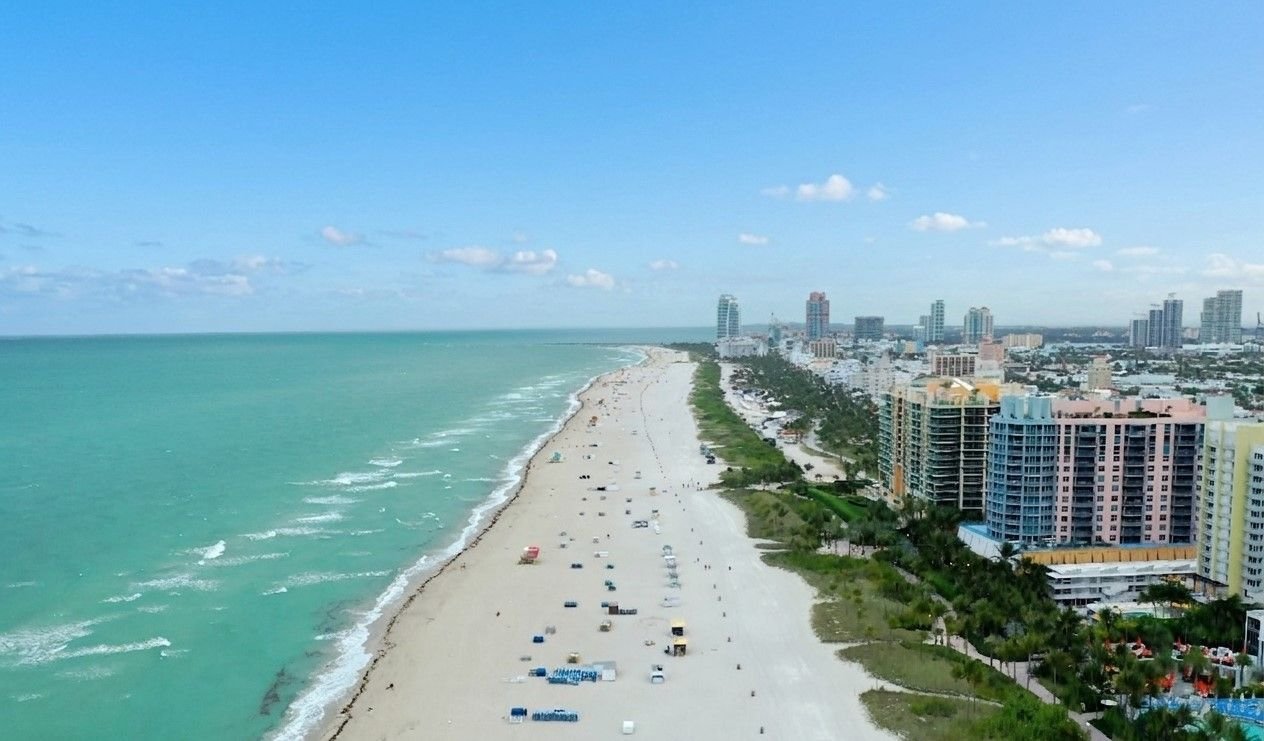
    South Beach, stretching from South Pointe Park at the southern tip of Miami Beach north to approximately 23rd Street, is the most famous beach in Miami and one of the most photographed stretches of sand in the world. The beach itself is genuinely excellent — the sand is white and fine, the water a stunning shade of turquoise green in the shallows transitioning to deep blue further out, the waves generally mild enough for swimming.

    The beach is wide enough to accommodate the substantial crowds that descend on weekends and holidays without feeling impossibly crowded. The backdrop — the Art Deco buildings along Ocean Drive, the palms, the lifeguard stands painted in tropical colors — is one of the most cinematic beachscapes on Earth.
    Lummus Park, the strip of parkland between Ocean Drive and the beach, is the social heart of South Beach’s outdoor life — a perpetual gathering place for sunbathers, volleyball players, rollerbladers, dog walkers, and people-watchers of every description. The beach is serviced by numerous concession stands, restrooms, and outdoor showers.

    Mid-Beach (roughly 23rd to 63rd Streets) and North Beach (63rd Street north to the Surfside neighborhood line) offer slightly less crowded and more residential alternatives to South Beach. The beaches here are equally beautiful, the infrastructure equally good, and the atmosphere considerably more relaxed. North Beach in particular has been undergoing a quiet renaissance, with interesting independent restaurants and a community of artists and young families who have been priced out of South Beach.

    South Pointe Park, at the very southern tip of Miami Beach, is a beautifully designed waterfront park with a pier from which you can watch cruise ships departing Government Cut — the main shipping channel between the Port of Miami and the Atlantic. The park’s lawn areas, playground, and waterfront views make it a popular gathering spot for local families and a pleasant alternative to the more crowded main beach sections.

    Key Biscayne, reached by the Rickenbacker Causeway from the mainland southeast of downtown, contains two exceptional parks. Crandon Park on the northern portion of the island offers a wide, beautiful beach backed by tropical forest, picnic areas, and a restored vintage amusement park carousel. Bill Baggs Cape Florida State Park at the southern tip of the island preserves a natural barrier island landscape of sea grape, mangrove, and pine hammock, with a historic lighthouse (the oldest standing structure in Miami-Dade County, built in 1825) and a quieter, wilder beach experience than the managed shores of Miami Beach proper.

    Haulover Beach, north of Bal Harbour and connected to Miami Beach via Collins Avenue, has a section that is clothing-optional — the largest legal nude beach in Florida — and attracts a diverse, body-positive crowd. The non-clothing-optional sections of Haulover are also excellent and frequently less crowded than South Beach.

    ART BASEL AND THE ARTS SCENE
    Miami has established itself as one of the most important cities in the world for contemporary art, and the annual Art Basel Miami Beach fair is the central event in that story.
    Art Basel Miami Beach, held each December in the Miami Beach Convention Center, is the American edition of the prestigious Swiss art fair and is widely regarded as the most important contemporary art event in the Western Hemisphere. Over 250 of the world’s leading galleries participate, presenting works spanning painting, sculpture, installation, photography, film, and digital art from thousands of artists. The fair draws collectors, curators, critics, artists, and art enthusiasts from every corner of the globe, transforming Miami Beach for one week each December into a global art capital.

    Art Basel week is also one of the great social events of the Miami calendar — a week in which the city’s already considerable capacity for parties, openings, performances, and cultural programming is amplified to an extraordinary degree by the influx of art world figures, collectors, and celebrities. Satellite fairs — including Art Miami, NADA Miami, Untitled Art Fair, Scope Miami Beach, and dozens of others — spread throughout the city and its surroundings, turning the entire metro area into a sprawling art destination.

    Beyond Art Basel week, Miami’s permanent art scene is substantial and growing. The Pérez Art Museum Miami (PAMM), designed by Herzog & de Meuron and located on Biscayne Bay in Museum Park downtown, is the city’s premier museum of modern and contemporary art, with a collection and exhibition program of international significance. The building itself — elevated on concrete pillars above the bayfront, with hanging gardens of tropical plants and terraces overlooking the water — is one of the finest pieces of contemporary architecture in Florida. The adjacent Phillip and Patricia Frost Museum of Science, also in Museum Park, houses a world-class natural history and science museum with a spectacular three-level aquarium at its center.

    The Bass Museum of Art in South Beach, housed in a 1930 Art Deco building with a contemporary expansion, presents a strong collection of European and international art alongside ambitious temporary exhibitions. The Margulies Collection at the Warehouse, a private collection of extraordinary depth and breadth open to the public in Wynwood, is one of the finest private contemporary art collections in the United States.

    The performing arts in Miami are anchored by the Adrienne Arsht Center for the Performing Arts of Miami-Dade County — a stunning complex designed by Cesar Pelli that opened in 2006 and is one of the largest performing arts centers in the United States. The Arsht Center is home to the Florida Grand Opera, Miami City Ballet, and the New World Symphony, and presents Broadway touring productions, major concert performances, and international arts programming throughout the year.

    The New World Symphony, an orchestral academy founded by conductor Michael Tilson Thomas and housed in a spectacular Frank Gehry-designed building in South Beach, presents free outdoor concert broadcasts projected onto the exterior wall of its building on selected evenings — one of the most beloved free cultural events in Miami.

    FOOD AND DINING
    Miami’s food scene is one of the most exciting and diverse in the United States, reflecting the extraordinary cultural richness of a city that is simultaneously American, Cuban, Latin American, Caribbean, and international.

    Cuban food is the foundation of Miami’s culinary identity, and understanding it is essential to understanding the city. The Cuban sandwich — pressed Cuban bread filled with roasted pork, ham, Swiss cheese, pickles, and mustard — is Miami’s iconic food, found everywhere from gas station counters to high-end restaurants, and the debate over who makes the best version is conducted with genuine passion. Versailles on Calle Ocho is the most famous Cuban restaurant in the world, and for good reason — the food is excellent, the portions enormous, and the experience of eating among the Cuban exile community in a dining room that has witnessed decades of Miami history is genuinely moving. El Cristo, La Carreta, and Islas Canarias are other celebrated Cuban dining institutions.

    The Haitian community in Miami has contributed a rich culinary tradition that remains relatively undiscovered by mainstream food tourism despite being extraordinary. Haitian griot — fried pork marinated in citrus and spices — with rice and beans, pikliz (spicy pickled vegetables), and plantains at restaurants in Little Haiti and the areas north of downtown is some of the most flavorful food in the city.

    Peruvian cuisine has made an enormous impact on the Miami dining scene, reflecting a large and dynamic Peruvian community. Ceviche — raw fish marinated in lime juice and seasoned with ají amarillo, red onion, and cilantro — is perhaps Peru’s greatest culinary contribution, and Miami’s Peruvian restaurants serve versions of exceptional quality. Ceviche 105 in Little Havana is one of the most beloved Peruvian restaurants in the city, serving an extraordinary variety of ceviches and tiraditos alongside classic Peruvian dishes.

    Seafood is magnificent throughout Miami, reflecting access to the waters of the Atlantic, Biscayne Bay, and the Gulf. Stone crab claws — available from mid-October through May from the stone crab fishery in the Florida Keys and Gulf of Mexico — are a Miami seasonal obsession. Joe’s Stone Crab in South Beach, which has been serving stone crab claws since 1913, is one of the most famous restaurants in Florida and essentially invented the stone crab dining tradition. The wait for a table without a reservation can be substantial, but the experience is worth it. Garcia’s Seafood Grille and Fish Market on the Miami River is a beloved, unpretentious local institution for fresh local seafood in a waterfront setting.

    The high-end dining scene in Miami is genuinely world-class. Zuma Miami at the EPIC Hotel in Brickell, the Miami outpost of the internationally celebrated Japanese izakaya concept, is consistently regarded as one of the finest restaurants in the city. Quinto La Huella at the Faena Hotel brings the beloved Uruguayan parrilla tradition to Miami with extraordinary beef and wood-fire cooking. The Surf Club Restaurant at the Four Seasons Surfside, from Thomas Keller — one of the greatest chefs in America — brings the legendary Keller sensibility to a historic oceanfront club setting. Mandolin Aegean Bistro in the Design District is a beloved garden restaurant serving Greek and Turkish meze that has become one of the most popular dining experiences in Miami for its food, atmosphere, and beautiful outdoor space.

    The breakfast and brunch culture in Miami is enthusiastic and well-developed. Eating House in Coral Gables, Michael’s Genuine Food & Drink in the Design District, and Greenstreet Cafe in Coconut Grove are among the city’s most beloved morning and midday destinations. The smoothie and açaí bowl culture of South Beach reflects the city’s health-conscious beach culture, with numerous juice bars and healthy café concepts throughout the beach communities.

    The food hall format has taken root in Miami with considerable success. Time Out Market Miami at Bayside in downtown presents a curated selection of Miami’s best restaurant concepts in a lively, communal setting. The Citadel in the Little River neighborhood brings together local food vendors, live music, and community programming in a beautifully converted Art Deco building.

    NIGHTLIFE
    Miami’s nightlife is legendary throughout the world, and with good reason. The city has one of the most vibrant, diverse, and sheer-volume-of-options nightlife scenes in the United States — a function of its warm climate, its Latin cultural energy, its tourist economy, and its position as a gathering point for creative and wealthy people from across the Americas and Europe.
    South Beach’s nightclub scene centers on a handful of mega-clubs that operate at a scale and level of investment that rivals anything in Las Vegas or Ibiza. LIV at the Fontainebleau is consistently ranked among the best nightclubs in the world — a cavernous, theatrically designed space with a resident roster of international DJ talent, regular celebrity appearances, and an energy that must be experienced to be understood. Admission is selective and often expensive, with table service required for premium positioning. Story on Washington Avenue is another major player in the South Beach club scene, with an enormous main room and a booking policy that brings major DJs and performers regularly.

    The rooftop bar scene in Miami is exceptional. The Broken Shaker at the Freehand Miami hotel is one of the most celebrated craft cocktail bars in the city — a beautiful, lush outdoor space of mismatched furniture, tropical plants, and creative cocktails that has won national awards and attracted a devoted following. The Sugar bar at the EAST Miami hotel in Brickell offers spectacular rooftop views of the downtown skyline over treetop-level plantings. The Watr at the 1 Hotel South Beach and the Goodtime Hotel’s rooftop pool bar are among the most fashionable outdoor drinking destinations on the beach.

    The Wynwood and Brickell neighborhoods have developed distinct nightlife cultures that contrast productively with the South Beach mega-club experience. Wynwood’s bars and music venues — Wood Tavern, Gramps, Shots Miami, and others — tend toward a more art-focused, indie-music-oriented crowd that reflects the neighborhood’s creative identity. Brickell’s nightlife is more polished and corporate-adjacent, with upscale cocktail bars and lounges catering to the financial district crowd.

    Live music in Miami reflects the city’s extraordinary musical heritage. The Latin music tradition — rooted in Cuban son and bolero, subsequently diversified through Colombian cumbia, Puerto Rican salsa, Dominican merengue, and the Miami-specific sounds of freestyle and Miami bass — permeates the city’s musical landscape. Ball & Chain on Calle Ocho in Little Havana, a beautiful restored bar that was a jazz club in the 1930s and 1940s, presents live salsa, jazz, and Latin music nightly in one of the most atmospheric rooms in Miami. Hoy Como Ayer, also in Little Havana, is a beloved intimate venue for traditional Cuban music and dancing.

    The LGBTQ+ nightlife scene in South Beach, centered on the blocks around Espanola Way and the bars of Washington Avenue, is one of the most vibrant in Florida and draws visitors from across the southeastern United States.

    NATURAL WONDERS AND OUTDOOR ACTIVITIES
    Miami’s natural setting is one of its most extraordinary and underappreciated assets.
    The Florida Everglades, the largest subtropical wilderness in the United States, begin at the western edge of Miami-Dade County. Everglades National Park — a UNESCO World Heritage Site, International Biosphere Reserve, and Wetland of International Importance — encompasses 1.5 million acres of sawgrass prairie, mangrove forest, cypress swamp, and coastal estuary that constitute the only subtropical preserve in North America. The park’s Royal Palm area, Anhinga Trail, and Gumbo Limbo Trail are accessible to day visitors from Miami in approximately 45 minutes and offer extraordinary wildlife encounters — anhingas drying their wings on cypress branches, alligators sunning on the trail margins, roseate spoonbills wading in the shallows, and the rare Florida panther moving through the shadows of the pine flatwoods.

    Airboat tours through the Everglades — operating from several facilities along the Tamiami Trail (US 41) at the northern edge of the park — are one of the most thrilling and distinctively Floridian experiences available to Miami visitors. The flat-bottomed boats powered by giant aircraft propellers can skim across the sawgrass prairie at considerable speed, covering ground that is inaccessible by any other means and bringing visitors into contact with the alligators, wading birds, and extraordinary plant life of the Glades.

    The Florida Keys, accessible via US Route 1 (the Overseas Highway) south of Miami, constitute one of the most unique and beautiful island chains in the world. The 113-mile drive from Florida City through 42 bridges over open water to Key West — including the famous Seven Mile Bridge — is one of the great road trips in America, passing through a landscape of improbable beauty where the highway seems to float on the surface of the sea. Key Largo, the nearest Key to Miami, is the gateway to the Florida Reef — the third largest barrier reef system in the world and the only living coral barrier reef in the continental United States — offering world-class snorkeling and scuba diving in waters of extraordinary clarity and marine life diversity. John Pennekamp Coral Reef State Park in Key Largo is the premier destination for reef exploration.

    Biscayne National Park, immediately south of Miami and largely underwater, protects the northern portion of the Florida Reef along with mangrove coastline, sea grass beds, and the northernmost Florida Keys. The park is 95 percent water and is best explored by snorkeling, scuba diving, glass-bottom boat tours, or kayaking through the mangrove tunnels of its coastal fringe.
    Water sports are central to Miami life. Paddleboarding on the calm waters of Biscayne Bay, kayaking through the mangroves of Oleta River State Park in North Miami, sailing out of the marinas of Coconut Grove or Miami Beach, kitesurfing in the consistent winds at Hobie Beach on the Rickenbacker Causeway, and deep-sea fishing in the Gulf Stream waters just offshore are all excellent options for the water-oriented visitor.

    Virginia Key, the small island adjacent to Key Biscayne on the Rickenbacker Causeway, is home to the Deering Estate — a beautifully preserved historic estate with natural hammock and coastal prairie environments — and the Virginia Key Beach Park, a historic stretch of shoreline that was designated as Miami’s “colored beach” during the era of racial segregation and is now a park of both natural beauty and historical significance.

    SPORTS
    Miami is a genuine major-league sports city with passionate fan bases and strong franchises across multiple sports.
    The Miami Marlins play Major League Baseball at loanDepot Park in the Little Havana neighborhood — a beautiful retractable-roof stadium that replaced the old Sun Life Stadium in 2012 and is notable for its striking exterior design, its extraordinary aquarium tanks installed behind home plate, and its capacity to host games in the Miami heat and rain with the roof closed.
    The Miami Heat are one of the most celebrated franchises in the NBA, with a history that includes six Finals appearances and three championships — and the legacy of LeBron James’s four seasons in Miami alongside Dwyane Wade and Chris Bosh. The Heat play at Kaseya Center (formerly FTX Arena, formerly AmericanAirlines Arena) on the downtown waterfront, with Biscayne Bay visible beyond the arena floor. Miami Heat games carry an energy and fashion consciousness that reflects the broader Miami cultural ethos.

    The Miami Dolphins, the oldest professional sports franchise in Florida, play at Hard Rock Stadium in Miami Gardens — the same facility that hosts the Formula 1 Miami Grand Prix each May, the annual Orange Bowl college football game, and major concerts. The Dolphins were the only NFL team to complete a perfect season, going 17-0 in 1972 under coach Don Shula, a record that has never been equaled.

    Inter Miami CF, co-owned by David Beckham, brought major league soccer to Miami and generated enormous global attention when Argentine superstar Lionel Messi joined the club in 2023. The arrival of Messi transformed Inter Miami from a struggling expansion franchise into one of the most followed clubs in the world and sparked an unprecedented surge of interest in soccer throughout South Florida.
    The Miami Open, held each March at the Hard Rock Stadium tennis complex in Miami Gardens, is one of the most prestigious tennis tournaments in the world — a Masters 1000 event for men and a Premier Mandatory event for women that draws the world’s top players for two weeks of competition and attracts enormous crowds.

    PRACTICAL TIPS FOR VISITORS
    Weather and When to Go
    Miami’s climate is tropical — warm and humid year-round, with a distinct wet season from May through October and a dry season from November through April. The dry season, corresponding roughly to the winter months in the Northern Hemisphere, is generally considered the ideal time to visit. Temperatures from December through March are magnificent — warm, sunny days in the mid-70s to low 80s Fahrenheit with low humidity and clear blue skies. This is peak season, and hotel rates, flight prices, and crowds all reflect its popularity.

    Summer in Miami is hot, humid, and wet. Temperatures regularly reach the upper 80s to low 90s Fahrenheit with humidity that makes it feel significantly warmer. Afternoon thunderstorms — often violent, with lightning and heavy rain — are a near-daily occurrence from May through September. The storms typically pass quickly, and mornings are often beautiful. The heat is real but manageable with appropriate hydration, sunscreen, and strategic timing of outdoor activities.

    Hurricane season runs from June 1 through November 30, with peak activity in August and September. Miami has been directly struck by major hurricanes — most recently Hurricane Irma in 2017 — and the possibility of tropical weather disrupting a visit must be factored into summer and fall travel plans. Travel insurance is strongly recommended for Miami visits during hurricane season.
    Art Basel week in December and the winter holiday period through New Year’s are the most expensive and crowded times to visit. Hotel rates during Art Basel can be extraordinary — planning and booking far in advance is essential.

    Language
    Miami is effectively a bilingual city. Spanish is spoken natively by a substantial portion of the population, and in many neighborhoods — particularly Little Havana, Hialeah, and significant portions of the city — Spanish is the primary language of daily life. English is universally understood in tourist areas, hotels, and restaurants, but having even a basic familiarity with Spanish is genuinely useful and appreciated by locals. Portuguese is also widely spoken in the Brazilian community, and Haitian Creole is common in Little Haiti and other Haitian-American communities.

    Sun and Heat Safety
    The Miami sun is extremely powerful year-round, and visitors consistently underestimate it. High-SPF sunscreen applied generously and frequently, quality sunglasses, and a hat are essential for any outdoor time. The combination of sun, heat, and humidity can lead to dehydration quickly — drinking water consistently throughout the day, well beyond when you feel thirsty, is important. The hottest and most dangerous hours are typically between noon and 4 p.m.

    Getting Into Nightclubs
    South Beach’s major nightclubs are selective about admission, particularly for men. Arriving with a group of women, or as a mixed group, significantly improves the likelihood of admission. Booking a table in advance through the club’s reservation system guarantees entry but involves a minimum spend commitment that can be substantial. Dressing well — the Miami standard for nightclub attire is fashionable and stylish — is important at the major venues. Lines can be long on Friday and Saturday nights, and arriving earlier (11 p.m. rather than 1 a.m.) often results in easier entry.

    Tipping
    Standard American tipping culture applies throughout Miami. Restaurant servers expect 18 to 20 percent, and many restaurants in tourist areas automatically add a service charge to bills — check before adding an additional tip. Bartenders expect a dollar or two per drink. Valet parking, hotel services, and rideshare drivers all appreciate appropriate gratuities.

    Safety
    Miami is generally a safe city for tourists in the main visitor areas of South Beach, Brickell, Coconut Grove, Wynwood, Coral Gables, and the beach communities. Standard urban awareness applies — keep valuables secured on the beach (theft from unattended bags is the most common crime affecting tourists), be aware of your surroundings in less familiar neighborhoods, and exercise appropriate caution late at night in areas you are unfamiliar with.

    CONCLUSION
    Miami is a city that does not ask for your approval. It does not moderate itself for comfort or domesticate its energy for easy consumption. It is hot and loud and beautiful and excessive and complicated and alive in a way that few cities anywhere in the world manage to be. It smells of salt water and gardenias and frying plantains and the specific perfume of tropical rain on warm asphalt. It sounds like reggaeton from a passing car and the crack of dominoes on a park table and the roar of a crowd at a Heat game and the laughter rising from an outdoor bar at midnight.

    It is a city built by people who came from somewhere else — from Cuba and Haiti and Colombia and Venezuela and Brazil and Nicaragua and Jamaica and Argentina and Israel and all the other places whose cultures have layered here into something new and singular. It carries the weight of that history and the energy of those arrivals — the hunger and hope that have characterized every wave of immigration — in its music and its food and its architecture and its street life.

    And beneath and beyond all the human construction, the natural world presses in. The bay glitters. The reef breathes in its slow, ancient rhythm. The Everglades, vast and indifferent and irreplaceable, extend westward toward the horizon. The Atlantic rolls in from the east with the same patient power it has always had, washing the famous shore clean again each morning.
    Miami rewards everyone who comes to it with curiosity and openness. It will feed you extraordinarily well. It will show you art that changes how you see the world. It will give you a night that you will remember for decades. And if you are lucky — if you come at the right moment, in the right light, in the right company — it will reveal itself as something genuinely rare: a city that is fully, irrepressibly, magnificently itself.
    Welcome to Miami. The Magic City is ready for you.

  • Florida: Where Every Day Feels Like Vacation

    Florida: Where Every Day Feels Like Vacation

    Florida is one of the most visited destinations on Earth. Year after year, it ranks among the top travel destinations in the United States, welcoming over 130 million visitors annually — more than any other state in the nation. It is not difficult to understand why. Florida offers a combination of warm weather, extraordinary beaches, world-famous theme parks, vibrant cities, unique wilderness, and a cultural diversity that makes it unlike anywhere else in the American South. From the white sand Gulf Coast beaches of the Panhandle to the coral reefs of the Florida Keys, from the Art Deco glamour of Miami Beach to the timeless stillness of the Everglades, Florida contains multitudes — and rewards travelers who take the time to move beyond the obvious and discover its deeper, stranger, and more beautiful layers.

    Why Visit Florida
    Florida’s appeal begins with geography. The state occupies a long, narrow peninsula jutting southward into the warm waters of the Atlantic Ocean and the Gulf of Mexico, giving it over 1,300 miles of coastline — more than any other state in the contiguous United States except Alaska. That coastline encompasses barrier islands, mangrove estuaries, limestone springs, coral reefs, and some of the most beautiful beaches in the world. The climate is warm for most of the year, with a subtropical south and a more temperate north, making it a year-round destination and a magnet for visitors escaping winter in colder parts of the country and the world.
    Beyond the beaches, Florida offers an unmatched concentration of tourist infrastructure. The Orlando area alone contains more major theme parks than any other place on Earth. The state’s cities — Miami, Tampa, Jacksonville, Orlando, and others — each have their own distinct character and offer their own reasons to visit. And underlying all of it is a natural world of genuine wonder: Florida is home to 175 state parks and three national parks, protecting ecosystems found nowhere else on the planet.

    Miami and South Florida
    Miami is the gateway to Florida for millions of international visitors and one of the most cosmopolitan, visually striking, and culturally vibrant cities in the United States. It is a city of contradictions — glamorous and gritty, ancient and hypermodern, deeply Latin and thoroughly American — and those contradictions are precisely what give it its electric energy.
    Miami Beach, connected to the mainland by a series of causeways, is the city’s most famous neighborhood and one of the most recognizable urban landscapes in the world. South Beach – the southern tip of Miami Beach — is the heart of it all: a compact grid of streets lined with the largest concentration of Art Deco architecture anywhere on Earth. The buildings along Ocean Drive, Collins Avenue, and Washington Avenue, pastel-colored and neon-lit, were built in the 1920s and 1930s and restored to their current glory through a preservation effort that began in the 1970s. The Art Deco Historic District is a UNESCO-recognized cultural treasure, and walking its streets — particularly in the golden light of late afternoon, with the beach just a block away — is one of the genuinely iconic Florida experiences. The Wolfsonian-FIU museum on Washington Avenue is an outstanding institution dedicated to the art, design, and propaganda of the 1885–1945 period, with a collection that is as fascinating as it is unexpected.

    The beach itself stretches for miles — white sand and the clear turquoise water of the Atlantic, lined with lifeguard stands in cheerful primary colors that have become symbols of the city. The Lincoln Road Mall, a pedestrian promenade through the heart of Mid-Beach, is lined with restaurants, shops, and the imposing building of the New World Center concert hall, designed by Frank Gehry.
    Little Havana on the Miami mainland is the spiritual center of the city’s Cuban-American community, which has shaped Miami’s culture, politics, and food scene profoundly since the Cuban exile community began arriving in large numbers after 1959. Calle Ocho — Southwest 8th Street — is the neighborhood’s main artery, lined with Cuban restaurants, cigar shops, domino parks, and music venues. The annual Calle Ocho Festival each March is one of the largest street festivals in the United States. The food here — ropa vieja, lechón asado, Cuban sandwiches, and café cubano served in tiny paper cups — is outstanding and deeply authentic.

    Wynwood is Miami’s arts district, a former warehouse neighborhood that has been transformed over the past 15 years into one of the most visually spectacular open-air art galleries in the world. The Wynwood Walls, an outdoor museum of large-scale murals by internationally celebrated street artists, draws visitors from around the world and has inspired similar projects in dozens of other cities. The neighborhood surrounding the Walls has filled with galleries, design studios, breweries, restaurants, and bars, making it one of the most energetic and creative urban districts in Florida.

    Coconut Grove is Miami’s oldest neighborhood, a leafy, bohemian enclave along the bay that retains a village-like feel despite being surrounded by the metropolis. The Brickell neighborhood to the north is Miami’s financial and luxury high-rise district, dramatically transformed in the past decade and now home to the Brickell City Centre, exceptional restaurants, and a skyline that rivals any in the American South.
    The Florida Keys begin just south of Miami, connected to the mainland by the Overseas Highway — one of the great engineering achievements of the 20th century and one of the most spectacular drives in the United States. The highway stretches 113 miles from Florida City to Key West, crossing 42 bridges over open water, with the Atlantic on one side and Florida Bay on the other. The Seven Mile Bridge, spanning the gap between Marathon and the Lower Keys, is one of the most dramatic bridge drives in the world.

    The Keys are a string of low-lying limestone islands — former coral reefs exposed by changes in sea level — with a character entirely unlike the rest of Florida. Life here moves more slowly. The water is warm, clear, and shallow. The coral reef system running along the Atlantic side of the Keys is the only living coral barrier reef in the continental United States and one of the most biodiverse marine ecosystems in the world. John Pennekamp Coral Reef State Park at Key Largo, the first undersea park in the United States, offers snorkeling and diving in waters of extraordinary clarity and beauty. Islamorada, a loose collection of islands in the Upper Keys, is considered one of the premier sport fishing destinations in the world. Marathon, roughly the midpoint of the Keys, is home to the Dolphin Research Center and the outstanding natural history museum at Crane Point.

    Key West, at the end of the highway, is unlike anywhere else in Florida — or anywhere else in the United States. The southernmost city in the continental United States (just 90 miles from Cuba), Key West is a compact, walkable island of wooden Conch houses, bougainvillea-draped lanes, and an atmosphere of cheerful hedonism that has been attracting artists, writers, drifters, and dreamers for over a century. Ernest Hemingway lived here for much of the 1930s and wrote some of his most celebrated work in a studio above the pool at what is now the Hemingway Home and Museum — where approximately 50 descendants of his famous six-toed cats still roam the grounds. The Harry S. Truman Little White House, where Truman spent 175 days of his presidency on working vacations, is another outstanding historic site. Duval Street is the main artery of Key West’s nightlife — a mile-long stretch of bars, restaurants, and shops where the celebrated Sunset Celebration at Mallory Square draws crowds every evening to watch the sun drop into the Gulf of Mexico, accompanied by street performers, vendors, and a genuine sense of communal festivity that has been going on for decades.

    Everglades National Park covers 1.5 million acres at the southern tip of the Florida peninsula and is one of the most ecologically unique places on Earth. The Everglades is not a swamp in the conventional sense but a slow-moving river of grass — a vast, shallow sheet of water moving imperceptibly southward through a sea of sawgrass prairie toward the mangrove coast and Florida Bay. It is the largest subtropical wilderness in the United States and a UNESCO World Heritage Site, supporting an extraordinary diversity of wildlife. Alligators are ubiquitous — visitors see them regularly from roadside pull-offs along the main park road. American crocodiles, found in the United States only in South Florida, inhabit the mangrove areas near Flamingo. The bird life is spectacular: roseate spoonbills, great blue herons, snowy egrets, wood storks, and anhingas are commonly seen. Florida panthers — one of the most endangered mammals in North America — roam the park’s interior, though sightings are rare. Airboat tours from the park’s northern edges offer a thrilling way to experience the landscape, though the most intimate encounters come from paddling the park’s extensive canoe trails through mangrove tunnels and open bays.

    Orlando and Central Florida
    Orlando is the theme park capital of the world. The greater Orlando area contains a concentration of major entertainment attractions found nowhere else on Earth, drawing over 75 million visitors a year to what was, before Walt Disney’s arrival in the 1960s, a quiet agricultural town surrounded by orange groves.
    Walt Disney World Resort is the largest and most visited theme park resort in the world, covering an area roughly the size of San Francisco across four major theme parks, two water parks, a shopping and entertainment district, and dozens of hotels. Magic Kingdom, the flagship park, is the most visited theme park on Earth — its iconic Cinderella Castle, visible from almost anywhere in the park, is one of the most photographed structures in Florida. EPCOT, originally envisioned as a futuristic model city, has evolved into a park celebrating technology and world cultures, with a World Showcase section representing 11 countries through food, architecture, and entertainment that is genuinely excellent. Hollywood Studios and Animal Kingdom round out the major parks. A Walt Disney World vacation requires careful planning — the parks are so large and so popular that spontaneous visits rarely result in seeing more than a fraction of what is available. Advance dining reservations, park pass bookings, and strategic use of the Lightning Lane system are essential for maximizing the experience.

    Universal Orlando Resort has grown dramatically in recent years and now presents a genuine rival to Disney for many visitors. The Wizarding World of Harry Potter, split between the two parks (Islands of Adventure and Universal Studios Florida) and connected by the Hogwarts Express, is one of the most immersive themed environments ever built and remains the most talked-about theme park land in Orlando. Epic Universe, Universal’s massive new third park, opened in 2025 and has added extraordinary new themed worlds to the resort’s offerings. Universal tends to appeal particularly to teenagers and adults, with some of the most technically sophisticated and thrilling rides in the world.

    SeaWorld Orlando has reinvented itself significantly over the past decade, pivoting away from its orca shows toward a broader marine conservation and thrill-ride identity. Its sister park Busch Gardens Tampa, about 75 miles west, is one of the finest zoological parks in the United States combined with a world-class collection of roller coasters.
    LEGOLAND Florida in Winter Haven is one of the best theme parks in the country for young children — smaller, less overwhelming, and genuinely imaginative. The nearby Bok Tower Gardens in Lake Wales is one of Florida’s most overlooked treasures — a National Historic Landmark featuring a 205-foot Gothic and Art Deco carillon tower set within gardens designed by Frederick Law Olmsted Jr., with a serene beauty that makes it one of the finest public gardens in the American South.

    Beyond the theme parks, Orlando has developed into a genuinely interesting city. The Dr. Phillips Center for the Performing Arts is an outstanding venue that brings Broadway shows and major performing arts to the city. The Orlando Museum of Art and the Cornell Fine Arts Museum at Rollins College in Winter Park are worthwhile cultural institutions. Winter Park itself — a gracious, tree-shaded suburb connected to a chain of lakes — is one of the most charming communities in Florida, with an excellent farmers market, the Charles Hosmer Morse Museum of American Art (home to the world’s most comprehensive collection of works by Louis Comfort Tiffany), and a relaxed, walkable main street along Park Avenue.

    Kennedy Space Center Visitor Complex on the Atlantic coast, about an hour east of Orlando, is one of the most extraordinary attractions in Florida. The complex tells the complete story of America’s space program, from the early Mercury missions through the Apollo era and the Space Shuttle program to the current era of commercial spaceflight. The Vehicle Assembly Building — one of the largest buildings in the world by volume — is visible from miles away. Up-Close tours bring visitors to launch pads and restricted areas of the actual spaceport. The Atlantis exhibit, displaying the retired Space Shuttle orbiter at eye level with a recreated payload bay, is genuinely breathtaking. On launch days — which occur with increasing frequency as commercial operators join NASA at the complex — the experience of watching a rocket launch from nearby viewing areas is one of the most viscerally exciting things a visitor can do in Florida.

    Northeast Florida
    Jacksonville is the largest city by area in the contiguous United States — a sprawling, diverse metropolis straddling the St. Johns River near the Georgia border. Often overlooked by tourists heading to more famous Florida destinations, Jacksonville has genuine appeal. Its beaches — Jacksonville Beach, Neptune Beach, and Atlantic Beach — are excellent and far less crowded than those further south. The Cummer Museum of Art and Gardens, set along the St. Johns River with formal gardens descending to the water, has a collection of Old Masters and American art of surprising quality. The city’s craft beer scene and restaurant culture have developed considerably in recent years.

    St. Augustine is the oldest continuously occupied European settlement in the United States, founded by Spanish explorers in 1565 — 55 years before the Pilgrims landed at Plymouth Rock. Walking its narrow streets feels genuinely different from anywhere else in Florida. The Castillo de San Marcos, a massive coquina stone fort completed by the Spanish in 1695 and overlooking Matanzas Bay, is one of the best-preserved colonial fortifications in North America and a National Monument of genuine historical power. The historic district — its streets too narrow for modern traffic, lined with Spanish colonial buildings, courtyard restaurants, and centuries-old churches — is one of the most pleasant urban walking experiences in Florida. The Lightner Museum, housed in the former Alcazar Hotel built by railroad magnate Henry Flagler in 1888, contains an eclectic collection of Gilded Age art and objects in a building of astonishing opulence. St. Augustine’s beaches — particularly the wild, undeveloped stretches of Anastasia Island — are outstanding.

    Amelia Island, at the very northeastern tip of Florida just south of the Georgia border, is one of Florida’s most refined and least crowded resort destinations. The island’s southern end is occupied by Fernandina Beach, a Victorian-era town with a beautifully preserved historic district of gingerbread houses and an excellent selection of restaurants and independent shops. The beaches of Amelia Island are wide, relatively uncrowded, and backed by dunes and maritime forest rather than the hotel towers that line much of the Florida coast. The Ritz-Carlton Amelia Island and the Omni Amelia Island Resort are among the finest coastal resort hotels in the state.

    Northwest Florida — The Panhandle
    The Florida Panhandle is a long, narrow strip of land along the Gulf of Mexico between Alabama and the main body of Florida, and it contains some of the most extraordinary beaches in the world. The sand here is unlike the sand anywhere else — blindingly white, made of pure quartz crystal ground fine by millennia of river transport from the Appalachian Mountains, and so reflective that it stays cool even in the hottest summer sun. The Gulf water along the Panhandle is shallow, calm, and a shade of emerald green so vivid it seems almost artificial.
    Pensacola at the western end of the Panhandle is one of Florida’s most historically layered cities, having been claimed at various times by Spain, France, Britain, the Confederate States of America, and the United States. The Historic Pensacola Village downtown preserves buildings from the Spanish and British colonial periods in a compact, walkable area. The National Naval Aviation Museum at Naval Air Station Pensacola is one of the largest aviation museums in the world and is completely free — an extraordinary collection of historic naval aircraft including the original Blue Angels jets, with a full-motion flight simulator and an IMAX theater. Pensacola Beach on Santa Rosa Island is consistently ranked among the finest beaches in the United States.

    Destin and the Emerald Coast are the most popular beach destinations in the Panhandle, drawing millions of visitors each year to the communities of Destin, Fort Walton Beach, and the extraordinary planned community of Seaside — the real-life model for the fictional town in the film The Truman Show, a beautifully designed New Urbanist community of pastel houses, white picket fences, and pedestrian-friendly streets that is one of the most photographed communities in Florida.
    30A, the scenic highway running along a string of communities east of Destin, is one of the most pleasant drives in Florida. The towns along it — Rosemary Beach, Alys Beach, WaterColor, Watercolor, Grayton Beach — offer a more refined, less commercial alternative to the dense hotel and condo towers of Destin, with excellent restaurants, art galleries, boutique shops, and the extraordinary natural beach at Grayton Beach State Park, consistently rated one of the finest beaches in the United States.

    Panama City Beach is the Panhandle’s most boisterous resort town — a long strip of hotels, water parks, and entertainment venues that has earned a reputation as a spring break destination. It is not for everyone, but the beach itself is undeniably beautiful, and Pier Park is a major shopping and entertainment complex.
    Apalachicola and the Forgotten Coast to the east represent the Panhandle at its most unspoiled and authentic. Apalachicola is a small fishing town of considerable charm — its 19th-century commercial buildings line a waterfront on Apalachicola Bay, which produces some of the finest oysters in the United States. The surrounding area, including St. George Island — a long, narrow barrier island with a state park at its eastern end protecting miles of undeveloped beach — is one of the least commercialized stretches of Florida coastline, beloved by those who know it.

    Tampa Bay and the Gulf Coast
    Tampa has emerged over the past decade as one of the most dynamic mid-sized cities in the United States, with a booming downtown, an outstanding food scene, and a range of attractions that make it one of the most underrated destinations in Florida.
    Ybor City, Tampa’s historic Latin Quarter, was founded in the 1880s by Cuban, Spanish, and Italian cigar makers and became one of the largest cigar-producing centers in the world. The neighborhood’s brick streets, wrought-iron balconies, and restored cigar factory buildings now house restaurants, bars, and nightclubs in a district that is vibrant after dark and fascinating by day. Columbia Restaurant, founded in 1905 and the oldest restaurant in Florida, serves Cuban and Spanish food in a series of ornate dining rooms in a building that occupies an entire city block — a Tampa institution of genuine greatness.

    The Tampa Riverwalk, a 2.6-mile pedestrian and cycling path along the Hillsborough River connecting downtown Tampa’s major attractions, has transformed the city’s relationship with its waterfront. The Florida Aquarium along the Riverwalk is excellent. The Tampa Museum of Art and the adjoining Glazer Children’s Museum are outstanding. The Henry B. Plant Museum, housed in the extraordinary Moorish Revival Tampa Bay Hotel built in 1891, preserves one of the most opulent Victorian interiors in the South and tells the story of the railroad magnate who transformed Tampa from a small town into a regional center.

    St. Petersburg, across Tampa Bay, has reinvented itself as one of the most surprising arts destinations in Florida. The Salvador Dalí Museum, housed in a purpose-built building of dramatic architectural design on the St. Petersburg waterfront, contains the largest collection of Dalí’s work outside of Spain — including major paintings, sculptures, and drawings spanning his entire career. The adjacent waterfront district, Beach Drive, is lined with restaurants and galleries overlooking the bay. The Morean Arts Center, the Museum of Fine Arts, and The James Museum of Western & Wildlife Art round out a cultural offering that punches well above the city’s weight. St. Pete Beach and the beaches of the barrier islands to the west — Pass-a-Grille, Treasure Island, Madeira Beach, and Indian Rocks Beach — offer some of the best Gulf Coast beach experiences in Florida.

    Sarasota is widely considered the cultural capital of Florida’s Gulf Coast — a city of theater, opera, ballet, and art that reflects the influence of the Ringling family, who made it their winter home in the early 20th century. The John and Mable Ringling Museum of Art houses one of the finest collections of Baroque paintings in the United States, displayed in a magnificent Italian Renaissance-style palazzo on a 66-acre estate overlooking Sarasota Bay. The adjacent Circus Museum and the Ca’ d’Zan — the Ringling family’s extraordinary Venetian Gothic mansion — are included in the museum admission and together make for one of the richest cultural days in all of Florida. Sarasota’s beaches, particularly Siesta Key Beach, have been repeatedly named the finest beach in the United States by various ranking organizations — its sand is nearly pure quartz, extraordinarily fine and white, and the Gulf water off its shores is shallow and warm.

    Fort Myers and the Lee Island Coast offer a more affordable and less crowded Gulf Coast experience, with excellent shelling beaches on Sanibel and Captiva Islands — Sanibel in particular is famous for its extraordinary shell collecting, made possible by the island’s east-west orientation, which causes shells to accumulate on its beaches in numbers found nowhere else on the Gulf Coast. The J.N. “Ding” Darling National Wildlife Refuge on Sanibel protects a magnificent mangrove estuary accessible by car, bicycle, and kayak, and is one of the finest wildlife refuges in the eastern United States.

    Florida’s Natural World
    Florida’s natural environment is one of its greatest and most underappreciated assets. Beyond the Everglades, the state protects an extraordinary range of ecosystems.
    The Florida Springs are among the state’s most remarkable natural features — over 700 freshwater springs bubble up from the Floridan Aquifer throughout the state, many of them large enough to swim in and maintaining a constant temperature of approximately 68°F year-round. Ichetucknee Springs State Park in the north-central part of the state allows visitors to tube through a crystal-clear spring run in one of the most purely enjoyable outdoor experiences in Florida. Silver Springs State Park, the site of the original Silver Springs attraction that opened in 1878 and became one of the most visited destinations in Florida before Disney arrived, allows visitors to see the springs’ extraordinary clarity through glass-bottom boats — a tradition that continues to this day. Crystal River and Kings Bay, a complex of springs on the Gulf Coast, is the primary winter gathering place for Florida manatees — gentle, slow-moving marine mammals that aggregate in the warm spring water from November through March, and visitors can snorkel among them in a managed and respectful encounter that is one of the most memorable wildlife experiences in North America.

    Dry Tortugas National Park, accessible only by boat or seaplane from Key West, is one of the most remote and least visited national parks in the eastern United States and one of the most extraordinary. The park consists of seven small coral islands 70 miles west of Key West, dominated by Fort Jefferson — a massive, unfinished Civil War-era brick fortification that is the largest masonry structure in the western hemisphere. The waters surrounding the Dry Tortugas contain some of the most pristine coral reef ecosystems in Florida, and the snorkeling is exceptional. The park is a critical nesting ground for sooty terns and frigatebirds, and the spring bird migration brings extraordinary concentrations of warblers and other neotropical migrants to the islands.

    Practical Travel Information
    Getting Around
    Florida is a driving state. While the major cities have developing public transit systems — Miami’s Metrorail and Metromover being the most useful for visitors — a car is essential for exploring anything beyond the immediate urban cores. The Florida Turnpike and Interstate 95 run the length of the peninsula on the east side; Interstate 75 and US Highway 41 (the Tamiami Trail) serve the west side and the south. The drive from Miami to Key West on US 1 and the Overseas Highway takes approximately three and a half hours under normal traffic conditions and is one of the great American road trips.

    Best Time to Visit
    Florida’s seasons are roughly the inverse of most of the United States. The best time to visit most of the state is from October through April — the dry season, when temperatures are warm but not oppressive, humidity is lower, and rainfall is minimal. The summer months — June through September — bring intense heat, very high humidity, daily afternoon thunderstorms, and the threat of hurricanes. This is the slow season for most of the state, and prices drop accordingly, making it a reasonable tradeoff for budget-conscious travelers. South Florida, including Miami and the Keys, is at its most pleasant from December through April. The Panhandle has something of a more conventional Southern season — pleasant in spring and fall, very busy in summer when the beaches are at their warmest.

    Wildlife
    Florida’s wildlife is one of its great gifts to visitors. Alligators are found in virtually every body of fresh water in the state and are commonly seen from roads and trails throughout central and south Florida. They are generally not aggressive toward humans when given appropriate space, but should never be fed or approached — feeding alligators is illegal in Florida and dangerous. Manatees are seen in coastal waters throughout the state, particularly near power plant warm water outflows in winter. Bottlenose dolphins are abundant along both coasts. Sea turtles — loggerheads, greens, and leatherbacks — nest on Florida’s Atlantic coast beaches each summer, and many communities offer guided nighttime turtle walks during nesting season. The Florida Scrub-Jay, found only in Florida, is a federally threatened species that can be seen at Merritt Island National Wildlife Refuge and several other locations.

    Food and Culture
    Florida’s cuisine reflects its extraordinary cultural diversity. In Miami and South Florida, Cuban food is a fundamental part of the culinary landscape. The Haitian, Jamaican, Bahamian, and broader Caribbean communities have brought their own remarkable food traditions. In Central Florida, the growing Puerto Rican and Dominican communities have enriched the restaurant scene significantly. The Gulf Coast, with its proximity to the Gulf’s extraordinary seafood resources, offers outstanding grouper, stone crab, mullet, and Gulf shrimp. Stone crab claws — harvested sustainably by removing one claw and returning the crab to the water to regenerate — are a Florida delicacy available from October through May, and Joe’s Stone Crab in Miami Beach, which has been serving them since 1913, is one of the most iconic dining experiences in the state.

    A Few Final Thoughts
    Florida is a state that rewards depth of engagement. The visitor who spends a week on a single beach resort sees something real but misses the full picture — the ancient springs of the interior, the cultural complexity of Miami, the architectural history of St. Augustine, the wild remoteness of the Dry Tortugas, the strange and beautiful stillness of the Everglades. Florida is also a state of genuine environmental fragility: its coral reefs are threatened by warming oceans and water quality issues, its springs by overdrawing of the aquifer, its coastlines by sea level rise. Visiting with awareness of that fragility — supporting conservation-minded operators, respecting wildlife and natural areas, and engaging with the organizations working to protect these irreplaceable ecosystems — is part of being a thoughtful traveler in this extraordinary place. Florida gives generously to those who visit it. It deserves generosity in return.

  • New York City: Experience the Wild Side of the Big Apple

    Few cities on Earth carry the weight of myth, ambition, and sheer human energy that New York City does. Perched on the northeastern coast of the United States, New York is simultaneously the financial capital of the world, one of its greatest cultural incubators, a gastronomic paradise, and a place where the full spectrum of human experience plays out on the streets every single day. Whether you arrive by plane, train, or car, the moment you catch your first glimpse of that iconic skyline, something shifts inside you. New York is not just a destination — it is an experience unlike any other.

    Spread across five distinct boroughs — Manhattan, Brooklyn, Queens, The Bronx, and Staten Island — New York City covers 302 square miles and is home to over 8.3 million residents who speak more than 800 languages. Every neighborhood tells a different story. Every block holds a surprise. This guide will help you navigate it all.

    GETTING THERE
    New York City is served by three major airports. John F. Kennedy International Airport (JFK), located in Queens, is the largest and handles the majority of international flights. Newark Liberty International Airport (EWR), technically in New Jersey, is a convenient and often less congested alternative. LaGuardia Airport (LGA), also in Queens, primarily serves domestic routes and has undergone a major modernization in recent years.

    From JFK, travelers can take the AirTrain to the subway system for an affordable and reliable ride into Manhattan. Taxis, rideshares, and express buses are also readily available. From Newark, the NJ Transit train connects to Penn Station in Midtown Manhattan. Shuttle services and car transfers are a comfortable, if more expensive, option from all three airports.
    Amtrak serves Penn Station and Moynihan Train Hall with routes connecting New York to Boston, Washington D.C., Philadelphia, and beyond. Long-distance bus companies such as Greyhound and BoltBus also operate frequent routes in and out of the city.

    GETTING AROUND THE CITY
    The New York City Subway is the backbone of urban transportation here. Running 24 hours a day, 7 days a week, it is one of the few metro systems in the world that never shuts down. With 472 stations spread across the five boroughs, it is both the most efficient and most economical way to travel around the city. A single-ride MetroCard costs $2.90, and unlimited weekly passes are available for frequent riders. The subway can be intimidating at first, but a little time with a map and the MTA’s official app makes navigation straightforward.

    Buses complement the subway beautifully, especially in areas with limited train access. Yellow taxis and rideshare services like Uber and Lyft are ubiquitous. Ferries operated by NYC Ferry connect waterfront neighborhoods across all five boroughs and offer some of the most scenic commutes imaginable. Citi Bike, the city’s bike-share program, has thousands of docking stations throughout Manhattan, Brooklyn, and Queens, making cycling an increasingly popular option for short trips.
    For those who want to see the city up close, walking is often the best choice — especially in Midtown and Lower Manhattan, where attractions are dense and the streets themselves are part of the experience.

    WHERE TO STAY
    New York offers accommodation for every budget and taste, though it is worth noting that hotel prices here run significantly higher than in most American cities.
    Midtown Manhattan is the most popular base for tourists, placing you within walking distance of Times Square, Central Park, and the Theater District. Luxury options abound: the Plaza Hotel on Fifth Avenue is one of the most storied addresses in the city, while The Peninsula, The St. Regis, and the Four Seasons offer world-class service and elegance. Mid-range travelers will find solid options in the many Marriott, Hilton, and Hyatt properties scattered throughout Midtown.

    The Upper West Side offers a quieter, more residential feel while still being close to Central Park and the Museum of Natural History. Downtown neighborhoods like the Financial District and Tribeca have seen a boom in boutique hotel openings in recent years, and staying there gives you easy access to the 9/11 Memorial and the Brooklyn Bridge.
    For a hipper, more neighborhood-oriented experience, Brooklyn has become a destination in its own right. Williamsburg, DUMBO, and Park Slope all offer boutique hotels, bed-and-breakfasts, and short-term apartment rentals through platforms like Airbnb. The commute to Manhattan is easy via subway.
    Budget travelers should look into hostels — options like HI NYC Hostel on the Upper West Side offer clean, safe, and social environments at a fraction of hotel prices.

    TOP ATTRACTIONS
    New York City’s list of iconic landmarks is almost overwhelming, but here are the must-see experiences that define a visit.
    Central Park sits at the heart of Manhattan, stretching 843 acres from 59th Street to 110th Street. Designed by Frederick Law Olmsted and Calvert Vaux in the 1850s and 1860s, the park is a masterpiece of landscape architecture. Visitors can rent rowboats on the Lake, visit the Bethesda Fountain, catch a free Shakespeare in the Park performance in summer, picnic on Sheep Meadow, stroll the Literary Walk, or visit Strawberry Fields, the memorial to John Lennon. The park is equally magical in all four seasons — blanketed in snow in winter, ablaze with cherry blossoms in spring, lush and green in summer, and painted in gold and crimson in autumn.

    The Statue of Liberty and Ellis Island are among the most emotionally resonant sites in the country. Lady Liberty, a gift from France dedicated in 1886, stands on Liberty Island in New York Harbor. Ferries depart from Battery Park in Lower Manhattan. Tickets to climb to the crown must be reserved months in advance, but even the free view from the grounds is extraordinary. Adjacent Ellis Island, where over 12 million immigrants were processed between 1892 and 1954, is now home to a profoundly moving museum of American immigration history.
    The Empire State Building, completed in 1931, remains one of the great Art Deco masterworks of architecture. The 102-story skyscraper dominated the skyline for decades and continues to be one of the most visited buildings in the world. The observation deck on the 86th floor offers a 360-degree panorama of the city that is especially spectacular at dusk and after dark.

    One World Trade Center and the 9/11 Memorial & Museum stand as a testament to resilience in Lower Manhattan. The memorial’s twin reflecting pools, set in the footprints of the original Twin Towers, are ringed by bronze panels inscribed with the names of every victim of the September 11, 2001 attacks and the 1993 World Trade Center bombing. The museum below ground is one of the most powerful and thoughtfully designed museums in the United States. One World Trade Center itself, rising 1,776 feet — a deliberate reference to the year of American independence — houses an observation deck with sweeping views.

    Times Square is loud, chaotic, neon-bright, and utterly unlike anywhere else on earth. The commercial crossroads of the world draws over 50 million visitors a year, and while many New Yorkers famously avoid it, first-time visitors find the energy intoxicating. The area is best experienced at night, when the giant digital billboards turn the streets into a canyon of light. The famous New Year’s Eve ball drop here is watched by over a billion people worldwide each year.

    The Brooklyn Bridge, opened in 1883, is one of the great engineering achievements of the 19th century. Walking across the pedestrian promenade offers breathtaking views of the Manhattan skyline, the East River, and the bridge’s own magnificent Gothic towers. Allow about 30 minutes for the crossing each way.
    The Metropolitan Museum of Art, known simply as “the Met,” is one of the largest and finest art museums in the world. Its collection spans 5,000 years of human creativity, from Egyptian antiquities and Greek sculpture to European masters, American paintings, African art, Asian ceramics, and a rooftop garden with contemporary installations and stunning views of Central Park. Plan to spend at least half a day here.

    The Museum of Modern Art (MoMA) in Midtown houses the world’s most important collection of modern and contemporary art, including Van Gogh’s “The Starry Night,” Picasso’s “Les Demoiselles d’Avignon,” Monet’s “Water Lilies,” and works by Warhol, Pollock, Kahlo, and countless others.
    The High Line is a 1.45-mile elevated park built on a former freight rail line on Manhattan’s West Side. Opened in 2009, it has become one of the city’s great urban design success stories, threading through the Meatpacking District, Chelsea, and Hell’s Kitchen with gardens, art installations, food vendors, and spectacular views of the Hudson River. It is beloved by locals and visitors alike.

    The Brooklyn Museum, the American Museum of Natural History, the Guggenheim Museum (housed in Frank Lloyd Wright’s spiral masterpiece on Fifth Avenue), the Whitney Museum of American Art in the Meatpacking District, and the Intrepid Sea, Air & Space Museum on the Hudson River round out a world-class museum landscape.
    Rockefeller Center is a complex of 19 commercial buildings in Midtown that has been a hub of New York life since the 1930s. The Top of the Rock observation deck on the 70th floor offers one of the best panoramic views in the city — uniquely, you can see the Empire State Building from here, which you cannot from the Empire State Building itself. The ice skating rink in the sunken plaza below is one of New York’s most beloved winter traditions.

    NEIGHBORHOODS TO EXPLORE
    Beyond the landmarks, New York’s true character lives in its neighborhoods.
    Greenwich Village in Lower Manhattan has been the bohemian heart of the city since the early 20th century, home to jazz clubs, off-Broadway theaters, and the LGBTQ+ rights movement, which was born at the Stonewall Inn on Christopher Street in 1969. Today it is a neighborhood of charming tree-lined streets, brownstones, and excellent restaurants.
    SoHo (South of Houston Street) mixes cast-iron architecture with high-end boutiques, art galleries, and bustling café culture. Chinatown and Little Italy, adjacent to each other in Lower Manhattan, offer rich immigrant history and excellent food. The Lower East Side has roots as a historic Jewish immigrant neighborhood and has evolved into one of the city’s hippest dining and nightlife destinations.

    Harlem, stretching across upper Manhattan, is the cultural capital of Black America — the birthplace of the Harlem Renaissance, home to the Apollo Theater on 125th Street, and a neighborhood of extraordinary brownstone architecture, gospel brunches, and soul food restaurants.
    Williamsburg in Brooklyn is the epicenter of the city’s creative and foodie scenes, packed with independent restaurants, breweries, vintage shops, and music venues. DUMBO (Down Under the Manhattan Bridge Overpass) offers stunning views of the Manhattan skyline from between the bridge’s towers and has become a tech and arts hub. Park Slope and Cobble Hill offer quintessential Brooklyn brownstone living, artisan coffee, and a relaxed neighborhood pace.

    Astoria in Queens is the city’s Greek community hub and home to some of the best Middle Eastern and Mediterranean food in the city. Flushing, also in Queens, is one of the largest Chinatowns in North America, with extraordinary dumpling shops, hot pot restaurants, and bubble tea cafés.
    The Bronx is home to the New York Botanical Garden, the Bronx Zoo — one of the largest metropolitan zoos in the world — and the birthplace of hip-hop culture in the South Bronx. Arthur Avenue is the Bronx’s authentic Little Italy, beloved by those in the know for its old-school Italian delis, bakeries, and trattorias.

    FOOD AND DRINK
    Eating in New York City is one of life’s great pleasures. The city has more restaurants per square mile than almost anywhere on earth, and the diversity of cuisines reflects its extraordinary immigrant history.
    No visit is complete without a proper New York slice — thin-crusted, foldable, and best eaten standing at a counter. Di Fara in Brooklyn, Joe’s Pizza in Greenwich Village, and Prince Street Pizza in SoHo are among the most revered. The New York bagel, boiled before baking for that distinctive chewy crust, is another non-negotiable — Ess-a-Bagel and Russ & Daughters on the Lower East Side are institutions.

    The city’s fine dining scene is world-class. Eleven Madison Park, Le Bernardin, Per Se, and Daniel regularly rank among the best restaurants in the world. Michelin stars are awarded generously here, and prix fixe tasting menus at these establishments are unforgettable special-occasion experiences.
    The street food scene is equally thrilling. Halal carts serve chicken and rice with white sauce on street corners across the city. Knishes, pretzels, hot dogs from sidewalk carts, and roasted nuts in winter are part of the urban texture. The Smorgasburg open-air food market in Williamsburg on Saturdays is a showcase of the city’s most creative small food vendors and a great weekend activity.

    For drinks, New York’s cocktail bar culture is sophisticated and experimental. The Dead Rabbit in the Financial District has won awards as one of the best bars in the world. Employees Only in the West Village is a speakeasy-style institution. Brooklyn’s craft beer scene is anchored by breweries like Brooklyn Brewery and Other Half.

    ARTS, CULTURE, AND ENTERTAINMENT
    New York’s cultural calendar is inexhaustible. Broadway — the stretch of theaters in and around Times Square — is the pinnacle of American theater. Shows like “Hamilton,” “The Lion King,” “Chicago,” and dozens of others run year-round. Tickets range from expensive to surprisingly affordable through TKTS booths in Times Square and online lotteries. Off-Broadway and Off-Off-Broadway theaters offer adventurous work at lower price points.

    Jazz is woven into the city’s DNA. The Village Vanguard in Greenwich Village has hosted nearly every major jazz artist of the past century and continues to present world-class performances nightly. Smalls Jazz Club, Blue Note, and Jazz at Lincoln Center are essential for fans of the genre. Lincoln Center itself — a complex of concert halls on the Upper West Side — is home to the New York Philharmonic, the Metropolitan Opera, and the American Ballet Theatre, among others.

    Carnegie Hall, opened in 1891, remains one of the world’s most prestigious concert venues. Madison Square Garden hosts major concerts and sporting events. The Barclays Center in Brooklyn and Forest Hills Stadium in Queens offer concert experiences in different settings.
    The New York Film Festival, the Tribeca Film Festival, and New York Fashion Week are among the major cultural events that draw global attention. The U.S. Open tennis tournament is held at the USTA Billie Jean King National Tennis Center in Flushing Meadows every August and September.

    SPORTS
    New York is a city of passionate sports fans with teams across all major leagues. The New York Yankees and the New York Mets represent the city in Major League Baseball, playing at Yankee Stadium in the Bronx and Citi Field in Queens respectively. The New York Giants and New York Jets share MetLife Stadium in New Jersey for NFL games. The New York Knicks play NBA basketball at Madison Square Garden, while the Brooklyn Nets call the Barclays Center home. The New York Rangers skate at MSG, while the New York Islanders are based on Long Island. Soccer fans can watch New York City FC at Yankee Stadium or the New York Red Bulls in New Jersey.
    Attending a live game in New York is a uniquely atmospheric experience, especially a Yankees game on a summer evening or a Rangers playoff match when the Garden is electric.

    SHOPPING
    New York is a shopper’s paradise at every price point. Fifth Avenue between 49th and 59th Streets is the world’s most famous luxury shopping corridor, home to Tiffany & Co., Bergdorf Goodman, Saks Fifth Avenue, and the flagship stores of virtually every major luxury brand. Madison Avenue on the Upper East Side continues the luxury theme.
    SoHo is ideal for designer boutiques and emerging fashion brands. The Meatpacking District mixes designer flagships with lifestyle brands. For independent and vintage shopping, Williamsburg and the East Village are the places to explore. The Chelsea Markets on the West Side offer a curated mix of food vendors and specialty shops inside a beautiful converted factory building.

    Century 21, when open, has historically been the go-to destination for discounted designer goods. Macy’s flagship in Herald Square is the world’s largest department store.
    Flea markets add texture to the shopping scene — the Brooklyn Flea in DUMBO and Williamsburg offers antiques, vintage clothing, handmade goods, and artisan food vendors on weekends.

    PRACTICAL TIPS FOR VISITORS
    New York can feel overwhelming, but a little preparation makes all the difference.
    The best times to visit are spring (April through June) and fall (September through November), when temperatures are mild, the city is beautiful, and the cultural calendar is full. Summer is hot, humid, and crowded but comes with free outdoor concerts, festivals, and long evenings. Winter can be brutally cold but brings the magic of the holiday season — the department store windows along Fifth Avenue, the Christmas tree at Rockefeller Center, and ice skating at Bryant Park.

    Tipping is a firm expectation in New York. Restaurants expect 18 to 20 percent on meals. Bartenders expect at least a dollar per drink. Hotel housekeeping, taxi drivers, and delivery workers all appreciate tips.

    Cell service is generally excellent throughout the city. Free Wi-Fi is available at most coffee shops, many parks, and through LinkNYC kiosks on street corners.
    Safety has improved dramatically in New York over the past three decades, and the city is generally quite safe for tourists in most areas. Standard urban common sense applies — be aware of your surroundings, keep valuables secured, and avoid poorly lit isolated areas late at night.
    The New York CityPASS bundles admission to several top attractions at a discount and is worth considering for first-time visitors who plan to visit multiple major sites.

    CONCLUSION
    New York City defies summary. It is too large, too layered, too alive to be fully captured in any single guide. The best way to experience it is to walk, explore, eat, get lost, stumble into a jazz bar on a Tuesday night, find a diner at 3 a.m., watch the sun rise over the East River, or sit on a bench in Central Park as the city wakes around you. New York rewards curiosity and punishes passivity. It will exhaust you and electrify you in equal measure.

    Whatever brings you here — the skyline, the food, the culture, the history, the sheer spectacle of millions of lives intersecting — you will leave changed. And you will almost certainly want to come back.
    Welcome to New York. There is no place like it on earth.

  • New York State: Urban Pulse, Natural Peace

    New York is arguably the most famous destination in the United States and one of the most visited places on Earth. It is a state of extraordinary contrasts — a place where the most densely populated and culturally intense urban environment in the Western Hemisphere exists alongside vast wilderness, working farms, historic small towns, world-class wine regions, and mountain landscapes of genuine grandeur. Most visitors, when they think of New York, think of New York City — and the city deserves every superlative applied to it. But the state that surrounds it is equally rich, equally surprising, and far less explored by the millions who pass through each year. From the tip of Manhattan to the shores of Lake Erie, from the Adirondack High Peaks to the vineyards of the Finger Lakes, New York State is one of the great travel destinations in North America.

    Why Visit New York
    New York State receives over 250 million visitors a year, the vast majority of them drawn to New York City. The city alone justifies the journey for most travelers — it is a place of unmatched cultural density, where more museums, restaurants, theaters, musical venues, neighborhoods, and human stories are packed into a relatively small geographic area than anywhere else in the United States. It is a city that has defined modernity, shaped global culture, and served as the entry point and proving ground for wave after wave of immigrants whose influence has made it the most cosmopolitan place in the world.
    But beyond the city, New York State offers experiences that surprise even seasoned travelers. The Hudson Valley is one of the most historically and scenically rich river corridors in North America. The Catskill Mountains have been reinvented as a destination for thoughtful travelers seeking good food, art, and nature within a few hours of the city. The Finger Lakes produce wines of genuine international distinction. Niagara Falls is one of the great natural wonders of the world. And the Adirondack Mountains contain the largest protected wilderness area in the contiguous United States — larger than Yellowstone, Glacier, and Grand Canyon National Parks combined.

    New York City
    New York City is not merely a city but a civilization — a place so large, so dense, so relentlessly various that a lifetime of visits would not exhaust its possibilities. It is home to approximately 8.3 million people within the five boroughs, and the greater metropolitan area encompasses over 20 million, making it the largest urban area in the United States by a significant margin. The city is composed of five boroughs — Manhattan, Brooklyn, Queens, the Bronx, and Staten Island — each of which is itself a complex world of neighborhoods, cultures, and experiences.

    Manhattan
    Manhattan is a narrow island, 13 miles long and 2 miles wide at its broadest, packed with an intensity of human activity and cultural production that has no parallel anywhere in the world. It is organized around a grid of numbered streets running east-west and avenues running north-south, with Broadway cutting diagonally across the grid from tip to tip — a layout that makes orientation relatively straightforward once grasped.
    Lower Manhattan is where the city began and where its most historic layers are most visible. The Financial District, centered on Wall Street, is built on the bones of the original Dutch settlement of New Amsterdam, and several streets — including Stone Street and the winding lanes around the Fraunces Tavern — preserve something of the pre-grid street pattern of the colonial city. The 9/11 Memorial and Museum at the site of the World Trade Center is one of the most powerful and moving memorial sites in the United States. The twin reflecting pools, occupying the footprints of the original towers and surrounded by the names of the nearly 3,000 people who died in the attacks, are objects of extraordinary emotional force. The museum below ground tells the story of the attacks and their aftermath with intelligence, sensitivity, and unflinching honesty. One World Trade Center, the tallest building in the Western Hemisphere, offers an observation deck with panoramic views of the city and surrounding region from its 102nd floor.

    The Brooklyn Bridge, completed in 1883 and for many years the longest suspension bridge in the world, remains one of the most beautiful and historically significant pieces of infrastructure in American history. Walking across it from Manhattan to Brooklyn — a journey of about 30 minutes — is one of the essential New York experiences, offering views of the Manhattan skyline, the harbor, and the river that are among the finest in the city.
    The neighborhoods of Lower Manhattan and the areas immediately north reward slow exploration. Tribeca — the Triangle Below Canal Street — is one of Manhattan’s most handsome neighborhoods, its 19th-century cast-iron warehouses now housing restaurants, galleries, and expensive loft apartments. SoHo, just north, was the center of New York’s art scene in the 1970s and 1980s and retains the most extraordinary concentration of cast-iron architecture in the world — block after block of elaborately ornamented 19th-century commercial buildings now largely given over to retail. The streets of SoHo on a weekend afternoon are crowded and commercialized, but looking above the ground-floor storefronts at the upper floors of the buildings reveals one of the great architectural ensembles in New York.

    Greenwich Village has been the bohemian heart of New York since the early 20th century. Its irregular, pre-grid streets — a legacy of the colonial-era lanes that predated the Manhattan grid — make it the most European-feeling neighborhood in the city. Washington Square Park, with its grand triumphal arch at the foot of Fifth Avenue, is the neighborhood’s living room — a gathering place of chess players, students, musicians, and dog walkers that has served as the center of Village life for over a century. The surrounding blocks contain some of the finest 19th-century townhouses in New York. The West Village, the neighborhood’s western extension toward the Hudson River, is one of the most beautiful and intimate streetscapes in the city — narrow lanes lined with Federal and Greek Revival rowhouses, excellent restaurants, and a charm that is almost impossible to articulate but immediately felt.
    The High Line is one of the most celebrated urban design achievements of the 21st century — a 1.45-mile elevated linear park built on a disused freight rail line on Manhattan’s West Side. The park winds from the Meatpacking District in the south to Hudson Yards in the north, offering planted gardens, art installations, and extraordinary views of the Hudson River and the city’s western architecture. The Meatpacking District below the High Line’s southern end has been transformed from a working industrial neighborhood into one of Manhattan’s most fashionable districts. Hudson Yards, at the High Line’s northern terminus, is a massive new development on the former West Side Rail Yards that contains The Shed — an extraordinary flexible arts venue — and the Vessel, a climbable honeycomb structure of interlocking staircases by Thomas Heatherwick that has become one of the most controversial and discussed public sculptures in recent New York history.

    Midtown Manhattan is the city’s commercial core and the location of many of its most iconic landmarks. The Empire State Building, completed in 1931 and for 40 years the tallest building in the world, remains the most beloved skyscraper in New York and offers observation decks on the 86th and 102nd floors with views that justify every superlative. The Chrysler Building, just to the east, is widely considered the most beautiful skyscraper ever built — its Art Deco steel crown, eagle gargoyles, and Nirosta steel cladding make it one of the great works of architecture of the 20th century. Grand Central Terminal, the Beaux-Arts masterpiece completed in 1913 at the intersection of 42nd Street and Park Avenue, is one of the finest public spaces in the United States — its Main Concourse, with its turquoise celestial ceiling map and floods of natural light from the arched windows, is breathtaking. The terminal sees approximately 750,000 people pass through it daily, and its lower levels contain one of the best food markets in Midtown.

    Fifth Avenue is one of the most famous streets in the world — lined with flagship retail stores, luxury hotels, and iconic institutions. The New York Public Library’s Stephen A. Schwarzman Building at 42nd Street and Fifth Avenue is one of the finest Beaux-Arts buildings in the United States, its two marble lions flanking the entrance serving as unofficial mascots of the institution. The Rose Main Reading Room, restored to its original gilded splendor, is one of the great interior spaces in New York. St. Patrick’s Cathedral, directly across Fifth Avenue from Rockefeller Center, is the largest decorated Neo-Gothic Catholic cathedral in North America and a powerful presence in the heart of Midtown.
    Rockefeller Center is a complex of 19 commercial buildings from the 1930s that represents one of the finest examples of large-scale urban planning in American history. Its Art Deco architecture, public art program, and public spaces — including the famous ice skating rink in winter — make it one of the most visited destinations in the city. Top of the Rock, the observation deck on the 70th floor of 30 Rockefeller Plaza, offers what many consider the finest view of Manhattan available anywhere — including a view of the Empire State Building that the Empire State Building’s own observation deck cannot provide.

    Times Square is the most visited tourist destination in the United States, drawing approximately 50 million visitors a year to its intersection of Broadway and Seventh Avenue. It is simultaneously one of New York’s most overwhelming and most exhilarating experiences — a canyon of electronic billboards, theater marquees, pedestrian plazas, and unceasing human activity that is spectacular in its way, though New Yorkers themselves generally avoid it. The theater district surrounding Times Square contains 41 Broadway houses presenting the finest commercial theater in the English-speaking world. A Broadway show — whether a classic revival, a new musical, or a dramatic play — remains one of the essential New York experiences, and the diversity of productions available on any given night is remarkable.

    Central Park is one of the great achievements of American landscape architecture and one of the most beloved public spaces in the world. The park covers 843 acres in the middle of Manhattan — an enormous green rectangle stretching from 59th Street to 110th Street — and was designed by Frederick Law Olmsted and Calvert Vaux beginning in 1858. Its landscapes, which include meadows, woodland, rocky outcroppings, lakes, a formal garden, and dozens of other distinct environments, were entirely man-made — the site was largely swampland and rocky terrain before Olmsted and Vaux transformed it. Today the park receives approximately 42 million visitors a year and serves as the backyard, playground, and escape valve for millions of New Yorkers. The Bethesda Fountain and Terrace at the center of the park is its great formal centerpiece. The Ramble, a 36-acre woodland of winding paths in the middle of the park, is one of the finest urban birdwatching locations in the country. The park is at its most magical in early spring, when the cherry trees and crabapples bloom, and in autumn, when the surrounding buildings glow in the late afternoon light above the turning foliage.

    Museum Mile is a stretch of Fifth Avenue along the eastern edge of Central Park containing the greatest concentration of world-class museums of any street in the world. The Metropolitan Museum of Art — the Met — is the largest art museum in the Western Hemisphere and one of the finest in the world, with a collection of over 1.5 million objects spanning 5,000 years of human civilization. A single day is barely sufficient to scratch the surface of its permanent collection, which includes everything from ancient Egyptian temples to medieval European armor to Impressionist masterpieces to contemporary American design. The museum also operates the Met Cloisters in Fort Tryon Park at the northern tip of Manhattan — a remarkable reconstruction of several medieval European monastic cloisters, housing an extraordinary collection of medieval art in a setting of serene beauty above the Hudson River. The Solomon R. Guggenheim Museum, housed in Frank Lloyd Wright’s extraordinary spiral building of 1959, is one of the most architecturally significant museum buildings in the world. The Whitney Museum of American Art, which relocated from the Upper East Side to a dramatic new building by Renzo Piano at the southern end of the High Line in 2015, is the premier institution for American art of the 20th and 21st centuries. The Museum of Modern Art — MoMA — in Midtown contains one of the finest collections of modern and contemporary art in the world, including Van Gogh’s Starry Night, Picasso’s Les Demoiselles d’Avignon, and Warhol’s Campbell’s Soup Cans.

    The Upper West Side, running along the western edge of Central Park toward the Hudson River, is one of the most pleasant residential neighborhoods in Manhattan for walking — lined with beautiful brownstones, excellent independent bookshops, neighborhood restaurants, and the outstanding food market of Zabar’s, a New York institution since 1934. The American Museum of Natural History, facing Central Park on Central Park West, is one of the largest and most comprehensive natural history museums in the world, with 45 permanent halls covering everything from the cosmos to ocean life to human origins, anchored by the spectacular dinosaur fossil halls.
    Harlem, north of Central Park, is one of the most historically significant African-American communities in the United States — the center of the Harlem Renaissance of the 1920s and 1930s, when an extraordinary flowering of African-American literature, music, art, and intellectual life transformed American culture. The neighborhood today is a complex, rapidly gentrifying community that retains its cultural identity and institutional richness. The Apollo Theater on 125th Street has been the most important venue in African-American music history since the 1930s — its Amateur Night has launched the careers of Ella Fitzgerald, Billie Holiday, James Brown, and countless others. The Studio Museum in Harlem is one of the finest small art museums in New York. The food scene along 125th Street and in the surrounding blocks reflects Harlem’s African-American, Caribbean, and increasingly international population.

    Brooklyn
    Brooklyn is New York City’s most populous borough — home to 2.7 million people — and has emerged over the past two decades as one of the most creative and culturally vibrant urban environments in the world. It is a borough of enormous geographic and cultural diversity, encompassing everything from the brownstone-lined streets of Brooklyn Heights and Park Slope to the Caribbean communities of Crown Heights and Flatbush to the industrial waterfront of Red Hook to the beaches and amusement parks of Coney Island.
    Brooklyn Heights is the borough’s most historic neighborhood — a 19th-century enclave of Federal and Greek Revival townhouses overlooking the East River and the Manhattan skyline. The Brooklyn Heights Promenade, a cantilevered walkway above the Brooklyn-Queens Expressway, offers what many consider the finest view of the Manhattan skyline available anywhere — a panorama of towers above the river, best appreciated at dusk when the buildings begin to light up.

    Dumbo — Down Under the Manhattan Bridge Overpass — is the neighborhood directly below the bridge approaches on the Brooklyn waterfront, a former industrial district of cobblestone streets and massive brick warehouses that has become one of Brooklyn’s most fashionable and photographed neighborhoods. The view of the Manhattan Bridge framed by the buildings of Washington Street, with the Empire State Building visible in the distance, is one of the most reproduced images of New York. Brooklyn Bridge Park, stretching along the waterfront below Dumbo and Brooklyn Heights, is one of the finest urban parks created in New York in recent decades.

    Williamsburg, just north of the bridge along the East River waterfront, was the center of Brooklyn’s creative renaissance in the early 2000s and remains one of the most energetic neighborhoods in the borough, with an exceptional restaurant scene, excellent bars and music venues, and the outstanding Smorgasburg open-air food market on weekends from spring through fall. Bushwick, further east, has become the center of Brooklyn’s street art scene — its streets and warehouse walls covered in murals by international artists that make walking through the neighborhood a continuously surprising visual experience.

    Prospect Park, designed by Olmsted and Vaux after their success with Central Park, is Brooklyn’s great green heart — 585 acres of meadows, woodland, and a beautiful lake that serves the same role for Brooklyn that Central Park serves for Manhattan. The Brooklyn Museum, facing the park’s northern entrance, is one of the largest art museums in the United States, with a collection of Egyptian art that is among the finest outside Cairo, outstanding American period rooms, and a strong collection of contemporary art. The Brooklyn Botanic Garden, adjacent to the museum, is 52 acres of cultivated gardens famous above all for its Japanese Garden and Cherry Esplanade, where the cherry blossom bloom in April draws enormous crowds and creates one of the most beautiful scenes in New York.

    Coney Island, at the southern tip of Brooklyn on the Atlantic Ocean, is one of New York’s most storied and most melancholy places — a former resort of extraordinary popular vitality that declined sharply in the mid-20th century and has never fully recovered its former glory, yet retains a battered, irresistible character. The boardwalk, the Nathan’s Famous hot dogs (an institution since 1916), the Wonder Wheel, the Cyclone roller coaster (a National Historic Landmark), and the New York Aquarium make it a genuinely enjoyable destination for families and for anyone interested in American popular culture history.

    Queens, the Bronx, and Staten Island
    Queens is the most ethnically diverse urban area in the world — a borough where over 160 languages are spoken and where neighborhoods like Flushing (with its extraordinary Chinese and Korean food scene), Jackson Heights (South Asian and Latin American communities), and Astoria (Greek, Middle Eastern, and increasingly diverse) offer some of the finest and most authentic international dining experiences available anywhere in the United States. The Queens Museum, Noguchi Museum, and MoMA PS1 make it an important destination for art lovers as well.
    The Bronx is home to the New York Yankees and Yankee Stadium, the Bronx Zoo — one of the largest and finest metropolitan zoos in the world — and the New York Botanical Garden, whose 250 acres contain one of the great plant collections in the world and a Victorian-era greenhouse of extraordinary beauty. The Arthur Avenue neighborhood in the Belmont section of the Bronx is the city’s most authentic Italian-American community, with an indoor market and surrounding streets of butchers, cheese shops, pasta makers, and old-school red-sauce restaurants that preserve a New York food tradition increasingly rare elsewhere in the city.
    Staten Island is the least visited of the five boroughs and offers, somewhat surprisingly, some of the finest views of Manhattan available anywhere — from the free Staten Island Ferry, which crosses New York Harbor and offers a close approach to the Statue of Liberty. Snug Harbor Cultural Center, a complex of 19th-century Greek Revival buildings on a 83-acre park, houses several museums including the Staten Island Museum and the Chinese Scholar’s Garden — a remarkable recreation of a traditional Ming dynasty garden.

    The Hudson Valley
    The Hudson River Valley stretches from the northern suburbs of New York City to the capital Albany, a distance of roughly 150 miles. It is one of the most historically and scenically rich river corridors in North America — the landscape that inspired the Hudson River School, America’s first great artistic movement, and that shaped the American sense of landscape and national identity in the 19th century.
    The Catskill Mountains to the west of the river have been reinvented as a destination for creative, food-conscious travelers from New York City seeking an alternative to the Hamptons or the Berkshires. The towns of Woodstock, Rhinebeck, Hudson, Tivoli, and Phoenicia each have their own character and their own appeal. Hudson, in particular, has transformed itself from a struggling post-industrial town into one of the most surprising small cities in New York — its long main street, Warren Street, lined with exceptional antique dealers, art galleries, restaurants, and hotels that would not look out of place in any major city. Woodstock, forever associated with the countercultural movement of the 1960s (though the actual 1969 festival took place 60 miles away in Bethel), remains an arts community of genuine vitality.

    The Hudson River School landscapes that inspired Thomas Cole, Frederic Church, Albert Bierstadt, and their contemporaries can still be seen essentially unchanged from many points along the valley. Olana, the Persian-inspired mansion of Frederic Church perched on a hilltop above the river near Hudson, is one of the finest house museums in the United States — the views from its grounds over the river toward the Catskills are precisely the landscape Church painted, and standing in them is a genuinely moving experience.
    The valley is rich in historic estates and sites. Hyde Park is home to both Springwood — the Franklin D. Roosevelt National Historic Site, including the Roosevelt home, library, and museum — and Vanderbilt Mansion National Historic Site, a Gilded Age Beaux-Arts palace on the river’s eastern bank. The Culinary Institute of America, also in Hyde Park, operates several outstanding student-run restaurants open to the public and is one of the finest culinary schools in the world. Kykuit, the Rockefeller estate in Sleepy Hollow, offers exceptional tours of the house and its sculpture garden, which contains a remarkable collection of 20th-century sculpture including works by Picasso, Calder, and Giacometti displayed against the river landscape.
    West Point, on a dramatic bend of the Hudson just north of the Hudson Highlands, is home to the United States Military Academy — one of the most beautiful campus settings in the United States. Visitors can tour the campus, visit the excellent West Point Museum, and attend concerts at Eisenhower Hall. The view of the river from Trophy Point is among the finest in the valley.

    The Finger Lakes
    The Finger Lakes region of central New York is one of the most beautiful and least known wine regions in the world — a landscape of long, narrow lakes gouged by glaciers into the rolling hills south of Lake Ontario, surrounded by gorges, waterfalls, and vineyards. The lakes themselves — eleven of them, of varying sizes, the largest being Seneca and Cayuga — moderate the climate in a way that allows the cultivation of cool-climate wine grapes, particularly Riesling, which reaches its finest American expression here.
    The Rieslings of the Finger Lakes have attracted international attention and critical acclaim — dry, mineral, and site-specific, they rival the great Rieslings of Germany and Alsace and represent America’s most compelling contribution to the world of white wine. Dry Rosé and Cabernet Franc also excel here. The wine trail along each lake — particularly the Seneca Lake Wine Trail, the largest in the region — connects dozens of wineries, many of them small, family-owned operations producing wines of genuine distinction.

    Ithaca, at the southern tip of Cayuga Lake, is home to Cornell University and Ithaca College and has a character disproportionate to its size — a food scene of remarkable quality, excellent independent bookshops, a strong arts community, and the extraordinary natural feature of Ithaca Gorge, where Cascadilla Creek has carved a dramatic canyon through the city itself. The Ithaca Commons is one of the most pleasant downtown pedestrian areas in upstate New York. Taughannock Falls State Park, a short drive north of the city along the lake, contains a waterfall with a sheer drop of 215 feet — higher than Niagara Falls.
    Watkins Glen State Park, at the southern tip of Seneca Lake, is the most visited state park in New York — a two-mile gorge trail following Glen Creek through a succession of waterfalls, narrow canyon passages, and natural stone bridges of breathtaking beauty. The gorge has been carved into the shale and sandstone bedrock by the creek over thousands of years, creating a landscape of otherworldly intimacy. The town of Watkins Glen itself is also famous as a historic auto racing venue.

    Niagara Falls and Western New York
    Niagara Falls is one of the great natural wonders of the world and the most powerful waterfall in North America by volume of water. The falls actually consist of three waterfalls — the American Falls, the Bridal Veil Falls, and the Canadian Horseshoe Falls — straddling the border between the United States and Canada on the Niagara River between Lake Erie and Lake Ontario. The Horseshoe Falls on the Canadian side is the most spectacular, with a crest of approximately 2,600 feet and a drop of 167 feet, sending a thundering volume of water over its edge at a rate that is almost incomprehensible in person. The mist rises hundreds of feet into the air and creates a perpetual rainbow on sunny days.
    Niagara Falls State Park on the American side is the oldest state park in the United States, established in 1885. The Maid of the Mist boat tour, which has been operating since 1846, takes visitors directly into the basin of the Horseshoe Falls — passengers wear blue ponchos that provide minimal protection from the drenching spray, and the experience of standing at the rail as the boat moves into the wall of water is one of the most viscerally thrilling things available at any natural attraction in the United States.

    Buffalo, just south of Niagara Falls at the eastern end of Lake Erie, is one of America’s great underrated cities — a post-industrial city of extraordinary architectural heritage, a passionate sports culture, and a food scene with several genuine claims to national fame. The city was one of the wealthiest in the United States at the turn of the 20th century, and the architectural legacy of that prosperity is extraordinary. Richardson Olmsted Campus, the former Buffalo State Hospital designed by H.H. Richardson in 1870, is one of the great Victorian institutional buildings in America, now being sensitively restored into a hotel and cultural complex. The Guaranty Building, designed by Louis Sullivan in 1896, is one of the earliest and finest skyscrapers ever built. Frank Lloyd Wright’s Darwin Martin House, completed in 1905, is the most complete and finest Prairie Style house in existence.
    Buffalo’s food culture includes several genuine American originals. The Buffalo wing — chicken wings fried and tossed in a cayenne pepper hot sauce — was invented here at the Anchor Bar in 1964, and eating them in Buffalo, where the tradition is deep and the execution is finest, is a genuine culinary pilgrimage. Beef on weck — thin-shaved roast beef piled on a kummelweck roll crusted with caraway seeds and coarse salt — is another Buffalo original of considerable deliciousness.

    The Adirondacks
    The Adirondack Park is the largest publicly protected area in the contiguous United States — six million acres of wilderness, forests, lakes, rivers, and mountains in the northeastern corner of New York State, larger than the entire state of Vermont. The park is unusual in that it contains both public forest preserve — where development is constitutionally prohibited — and private lands including farms, villages, and resorts, creating a mosaic of wilderness and human settlement unlike any other protected area in the country.
    The Adirondack High Peaks, a cluster of 46 peaks above 4,000 feet in the northeastern corner of the park, draw hikers, climbers, and backcountry skiers from across the Northeast. Mount Marcy, at 5,344 feet, is the highest point in New York State. The High Peaks Wilderness is one of the most challenging and rewarding hiking destinations in the eastern United States. Lake Placid, the village at the center of the High Peaks region, hosted the Winter Olympics in both 1932 and 1980 — the latter famous for the “Miracle on Ice,” when the United States hockey team defeated the Soviet Union in one of the most celebrated moments in American sports history. The Olympic venues are still in use and accessible to visitors, including the bobsled and luge run where visitors can ride with professional drivers.

    The interior of the Adirondacks is a paradise for canoeists and kayakers. The Adirondack Canoe Route, a 740-mile network of lakes, rivers, and carries connecting the interior waterways, is one of the great paddling destinations in North America. The quiet, tea-colored waters of the wilderness lakes, the absence of roads and development, and the extraordinary quality of the night sky — some of the darkest in the Northeast — make the Adirondack interior an experience of genuine wildness increasingly rare in the eastern United States.

    The Catskills
    The Catskill Mountains, southwest of the Hudson Valley, are lower and softer than the Adirondacks but have a character entirely their own — a landscape of rounded summits, hemlock ravines, tumbling streams, and small towns that have drawn visitors from New York City since the 19th century, when the grand Catskill Mountain House perched above the Hudson Valley attracted the wealthy elite of the Gilded Age. The region fell into decline in the mid-20th century and became associated with the Borscht Belt — the resort hotels of Sullivan County that served the Jewish-American community — many of which are now abandoned ruins of considerable melancholy beauty.
    Today the Catskills are experiencing a renaissance driven by Brooklyn and Manhattan residents who have bought farmhouses, opened restaurants, and created a new creative community in towns like Woodstock, Phoenicia, Livingston Manor, and Narrowsburg. The Catskill Center and various land trusts protect the region’s natural areas, and the fishing on the streams of the western Catskills — particularly the Delaware River and its tributaries — is among the finest trout fishing in the eastern United States.

    Long Island and the Hamptons
    Long Island extends 118 miles east of New York City into the Atlantic Ocean, and its two forks at its eastern end contain some of the most beautiful and most expensive real estate in the United States. The South Shore is lined with barrier beach — Jones Beach State Park is one of the finest public beaches on the East Coast, and Fire Island National Seashore, a barrier island accessible only by ferry, preserves 26 miles of undeveloped Atlantic beach with two communities of extraordinary character — the charming, car-free village of Ocean Beach and the Fire Island Pines and Cherry Grove, LGBTQ+ communities with a history stretching back decades.

    The Hamptons — the string of villages on the South Fork including Southampton, East Hampton, Bridgehampton, Sag Harbor, and Montauk — are the summer playground of New York’s wealthy and famous, and the real estate values and the restaurant prices reflect that reality. But the landscape that attracted wealthy New Yorkers in the first place is genuine and beautiful — wide, clean Atlantic beaches, bucolic farm fields, historic whaling-era architecture, and the extraordinary light that has drawn artists to the area since the 19th century. The Parrish Art Museum in Water Mill is an outstanding institution for American art. Sag Harbor, a former whaling port of considerable architectural beauty, is the most historically satisfying of the Hamptons villages. Montauk, at the very tip of the South Fork, is less polished and more genuinely blue-collar than the villages to its west and has a raw, windswept beauty of its own.
    The North Fork, quieter and less fashionable than the Hamptons, has emerged as Long Island’s wine country — a maritime climate well-suited to Merlot, Cabernet Franc, and Sauvignon Blanc, with dozens of wineries producing wines of steadily improving quality.

    Practical Travel Information

    Getting Around
    New York City is served by one of the most extensive public transit systems in the world. The subway system operates 24 hours a day, 365 days a year on 472 stations and 245 miles of routes — an experience in itself, and the most efficient way to move around Manhattan and into Brooklyn, Queens, and the Bronx. The Metropolitan Transportation Authority also operates an extensive bus network. Within Manhattan, walking is often the fastest and most pleasurable way to travel for distances of up to a mile or two. Taxis and rideshare services are ubiquitous. For trips to the outer boroughs and beyond, the Long Island Rail Road, Metro-North Railroad, and New Jersey Transit connect the city to the surrounding region.
    Upstate New York is car country. Distances are significant, and public transit outside the city is limited. The New York State Thruway connects New York City to Buffalo via Albany. Amtrak operates the Empire Service between New York City and Buffalo via Albany, and the Adirondack train between New York City and Montreal through the Hudson Valley.

    Best Time to Visit
    New York City is a year-round destination, but spring — April through June — and fall — September through November — are generally the finest seasons. Spring brings the cherry blossoms of the Brooklyn Botanic Garden and Central Park, the return of outdoor dining, and a sense of renewal after winter. Fall brings spectacular foliage in the parks and outer boroughs, comfortable temperatures, and the concentrated cultural energy of the new season’s theater, museum exhibitions, and restaurant openings. Summer is hot and humid but offers outdoor concerts, free events in Central Park, and the beaches of Long Island. Winter, while cold, has its own rewards — the holiday season in New York is genuinely magical, with ice skating at Rockefeller Center, the Rockefeller Center Christmas Tree, and a festive energy throughout the city.
    Upstate, fall foliage — typically at its peak in the Adirondacks and Catskills in late September and early October, and in the Hudson Valley slightly later — is one of the great natural events of the year, drawing visitors from across the Northeast and beyond.

    Food
    New York City’s restaurant scene is the most diverse and arguably the finest in the United States. Every cuisine on Earth is represented somewhere in the five boroughs, and the city contains more Michelin-starred restaurants than any other American city. But New York’s food identity goes beyond fine dining — it is built equally on the perfect slice of New York pizza (thin-crusted, folded, eaten standing at the counter or walking down the street), the bagel with cream cheese and lox, the Jewish deli sandwich of pastrami or corned beef piled on rye, the soup dumpling of Flushing’s Chinatown, the jerk chicken of Crown Heights, and the extraordinary street food of every nationality available from carts across the city.

    A Few Final Thoughts
    New York rewards the visitor who comes without a fixed itinerary and allows the city — and the state — to surprise them. The famous destinations are famous for good reason, and no first-time visitor should skip the Empire State Building or Central Park or the Metropolitan Museum. But the deepest pleasures of New York are often found elsewhere: in a neighborhood discovered by accident, a restaurant with no English on the menu and the best food of the trip, a conversation with a stranger on a subway platform, an unexpected view down a canyon of towers as the light catches the upper floors gold at sunset. New York is endlessly patient with the traveler who arrives with open eyes and a willingness to walk, to wander, and to be astonished. It has been astonishing visitors for four centuries, and it shows no signs of stopping.

  • Philadelphia, Pennsylvania: Where History Begins and the Vibe Never Ends

    Philadelphia is one of the great American cities – not merely in size or stature, but in meaning. It is the city where the Declaration of Independence was signed, where the United States Constitution was drafted, and where the foundations of American democracy were laid by a remarkable collection of thinkers, writers, and statesmen. But to think of Philadelphia only through the lens of history is to miss the full picture entirely. Modern Philadelphia is a city of extraordinary neighborhoods, a food scene that has earned national recognition, world-class museums, passionate sports culture, and a gritty, warm, self-deprecating character that is entirely its own. It is a city that wears its past proudly while charging forward with unmistakable energy.

    Known affectionately as Philly, the City of Brotherly Love sits on the eastern edge of Pennsylvania along the Delaware River, just two hours from New York City and less than three hours from Washington, D.C. It is the sixth-largest city in the United States and the most populous city in Pennsylvania, home to approximately 1.6 million people within the city limits and nearly six million in the greater metropolitan area. For visitors, it offers a depth of experience that rewards multiple trips and extended stays.

    A Brief History
    The history of Philadelphia is inseparable from the history of the United States itself. The city was founded in 1682 by William Penn, a Quaker who envisioned it as a place of religious tolerance and brotherly love — hence the name, derived from the Greek words for love and brother. Penn designed the city on a grid plan that was revolutionary for its time and influenced the layout of cities across the country.

    Philadelphia grew rapidly in the 18th century to become the largest and most prosperous city in colonial America. Its location at the confluence of the Delaware and Schuylkill rivers made it a natural center of trade, and its population of educated, intellectually curious citizens made it a center of ideas. By the time of the American Revolution, Philadelphia was the hub of the colonial world.

    It was here, in the Pennsylvania State House — now known as Independence Hall — that the Second Continental Congress met in 1775 and 1776, ultimately producing the Declaration of Independence. It was here that George Washington was appointed commander of the Continental Army. And it was here, in 1787, that the Constitutional Convention drafted the document that has governed the United States ever since. For eleven years, from 1790 to 1800, Philadelphia served as the nation’s capital while Washington, D.C., was under construction.

    The 19th century brought industrialization, immigration, and growth. Philadelphia became a major center of manufacturing, banking, and commerce. Waves of immigrants — Irish, Italian, Eastern European Jewish, and later African American migrants from the South — shaped the city’s neighborhoods, culture, and cuisine. The 20th century brought the challenges familiar to many Northeastern industrial cities: deindustrialization, population loss, urban blight, and economic hardship. But Philadelphia has proven resilient. A sustained period of revitalization beginning in the 1990s and accelerating through the 21st century has transformed vast swaths of the city while preserving its historic bones.

    Getting There and Getting Around
    Philadelphia is exceptionally well connected. Philadelphia International Airport (PHL) offers direct flights to destinations across the United States and around the world. It is also one of the few major American airports served directly by Amtrak, making rail travel to and from the city seamless. The train from New York Penn Station to Philadelphia 30th Street Station takes as little as 67 minutes on the Acela Express, and the route from Washington, D.C., takes approximately two hours.

    Within the city, the Southeastern Pennsylvania Transportation Authority (SEPTA) operates an extensive network of subway lines, trolleys, regional rail trains, and buses. The Market-Frankford Line, commonly called the El or the Blue Line, runs east-west through the heart of the city and connects major neighborhoods quickly. The Broad Street Line runs north-south and provides access to South Philadelphia, including the sports stadiums.

    For visitors staying in Center City and exploring the historic district, walking is often the most pleasant and practical option. Philadelphia is a remarkably compact and walkable city at its core, and many of its most famous attractions are within comfortable walking distance of one another. Rideshare services operate throughout the city, and the Indego bike-share program provides an affordable option for getting around.

    When to Visit
    Philadelphia is a four-season city, and each season has its own particular appeal.
    Spring (April through June) is widely considered the best time to visit. The weather is mild and comfortable, cherry blossoms and tulips bloom in parks and gardens, and the city’s outdoor life comes alive after winter. The Philadelphia Flower Show, held in early spring, is the largest indoor flower show in the world and a beloved annual tradition.

    Summer (June through August) brings heat and humidity but also an enormous calendar of outdoor events, festivals, and free concerts. The Fourth of July celebration in Philadelphia, held at the birthplace of American independence, is one of the most emotionally resonant in the country. Be aware that the most popular tourist sites can be crowded during peak summer months.
    Fall (September through November) is spectacular. The heat softens, the leaves turn, and Philadelphia’s food and arts scene hits a particularly vibrant stride. Eagles football season brings a particular electricity to the city that is palpable everywhere.

    Winter (December through February) is cold, occasionally snowy, and quieter at the tourist sites, which means shorter lines at Independence Hall and the Liberty Bell. The Christmas Village in LOVE Park, modeled on traditional German holiday markets, is a warm and festive attraction during the holiday season.

    Independence National Historical Park: The Cradle of Liberty
    No visit to Philadelphia is complete without spending significant time in and around Independence National Historical Park, a 55-acre expanse of historic buildings, open spaces, and monuments in the heart of the Old City neighborhood. This is where American history was made, and the park manages to convey the weight and wonder of that history without sacrificing accessibility or engagement.

    Independence Hall is the crown jewel of the park and one of the most important buildings in the world. This elegant red-brick Georgian structure is where both the Declaration of Independence and the United States Constitution were debated and adopted. Standing in the Assembly Room where these events took place — seeing the chairs, the desks, the inkwells — is a genuinely moving experience. Timed tickets are required and should be booked well in advance, particularly during summer. Rangers lead free guided tours that bring the history alive with storytelling and context.

    The Liberty Bell Center, just across the street, houses the most iconic symbol of American freedom. The bell, cast in London in 1752 and famous for its distinctive crack, draws millions of visitors each year. The museum surrounding it provides rich context about the bell’s history and its adoption by abolitionists and other social justice movements as a symbol of the struggle for freedom. Entry is free.

    The Declaration House, also known as Graff House, is a reconstruction of the building where Thomas Jefferson rented rooms and drafted the Declaration of Independence in June 1776. Congress Hall, where the U.S. Congress met from 1790 to 1800, and Old City Hall, where the U.S. Supreme Court first convened, round out the remarkable concentration of historic structures in this compact area.

    Across the street from the park, the National Constitution Center is a world-class museum dedicated to the story of the United States Constitution and its ongoing relevance. The Signers’ Hall, which features life-size bronze statues of the 39 men who signed the Constitution, is a highlight, and the rotating special exhibitions consistently offer fresh perspectives on American history and democracy.

    Old City and Society Hill
    Surrounding Independence National Historical Park, the Old City and Society Hill neighborhoods contain some of the finest 18th-century architecture surviving anywhere in the United States.
    Elfreth’s Alley, tucked between Front and Second Streets, is the oldest continuously inhabited residential street in America. Its 32 rowhouses, dating from the early 1700s, have been preserved in remarkable condition and give visitors an unscripted glimpse of colonial urban life. Walking its cobblestone length is like stepping into another century.

    Christ Church, where George Washington, Benjamin Franklin, and other founding figures worshipped, is a breathtaking example of colonial Georgian architecture. The church welcomes visitors and offers guided tours that illuminate both its religious history and its role in the founding of the nation.

    The Betsy Ross House, where legend holds that the first American flag was sewn, is a popular stop on the historic circuit. While historians debate the precise details of the flag’s origins, the house itself is a beautifully preserved example of an 18th-century Philadelphia home, and the tours are engaging and informative.
    Society Hill, just south of Old City, is one of the most beautifully preserved historic neighborhoods in the country. Its tree-lined streets are lined with Federal and Georgian rowhouses, quiet courtyards, and small parks. It is a genuine residential neighborhood, not a tourist attraction, which gives it an authenticity that many historic districts lack.

    The Philadelphia Museum of Art and the Benjamin Franklin Parkway
    The Benjamin Franklin Parkway is Philadelphia’s grand ceremonial boulevard, modeled on the Champs-Élysées in Paris and lined with cultural institutions, monuments, and gardens. It stretches from City Hall at its eastern end to the steps of the Philadelphia Museum of Art at its western terminus, and a walk along its length is one of the city’s great pleasures.
    The Philadelphia Museum of Art is one of the largest and finest art museums in the United States, housing a collection of more than 240,000 works spanning 2,000 years and virtually every medium. The European paintings collection is exceptional, with masterworks by Rubens, Poussin, Cézanne, and Picasso. The museum’s collection of American art is among the strongest in the country, and its holdings of Asian art, arms and armor, decorative arts, and medieval European art are equally distinguished.

    The museum is also famous for something entirely outside its walls: the 72 stone steps leading to its entrance that were made iconic by the 1976 film Rocky. Thousands of visitors run up the steps every day and raise their fists in triumph at the top. A bronze statue of Rocky Balboa stands at the base of the steps and is one of the most photographed landmarks in the city.
    The Rodin Museum, a short walk along the Parkway, houses the largest collection of Auguste Rodin’s sculptures outside of Paris, including a cast of The Thinker and a version of The Gates of Hell. Admission is by suggested donation and the collection is extraordinarily accessible.

    The Barnes Foundation, also on the Parkway, houses one of the most remarkable private art collections ever assembled. Dr. Albert C. Barnes amassed an astonishing collection of Post-Impressionist and early Modern paintings — including 181 works by Pierre-Auguste Renoir and 69 by Paul Cézanne — along with African sculpture, Native American jewelry, and decorative ironwork. The galleries are hung in a unique and deliberately unconventional manner that Barnes himself designed, and the experience is unlike any other museum in the world.
    The Franklin Institute, Philadelphia’s premier science museum, is an endlessly engaging destination for visitors of all ages. The museum’s giant walk-through heart, a landmark of American science education since 1954, remains a highlight alongside exhibitions on space exploration, artificial intelligence, and the natural world.

    Reading Terminal Market
    If a single destination captures the soul of Philadelphia’s food culture, it is Reading Terminal Market. Operating continuously since 1892 beneath the train shed of the old Reading Railroad terminal, this extraordinary public market is home to more than 80 merchants selling fresh produce, meats, cheeses, baked goods, prepared foods, and specialty products from across the region and the world.

    The Pennsylvania Dutch vendors — Amish and Mennonite farmers and bakers who travel from Lancaster County — are a fixture of the market and offer extraordinary scrapple, shoofly pie, sticky buns, and fresh-baked breads. DiNic’s Roast Pork, a Reading Terminal institution, serves what many food critics consider the greatest sandwich in Philadelphia — slow-roasted pork with sharp provolone and broccoli rabe on a long roll — a formidable rival to the cheesesteak for the title of the city’s signature sandwich.

    The market is best experienced on a weekday morning when the vendors are all present and the energy is at its peak. Weekend afternoons can be extremely crowded. Come hungry and plan to graze.

    The Philadelphia Cheesesteak
    No article about Philadelphia would be complete without serious attention to the cheesesteak. This sandwich — thinly sliced ribeye beef cooked on a flat griddle, topped with melted cheese, and served on a long Amoroso roll — is one of the iconic foods of American popular culture, and eating one in Philadelphia is a near-sacred experience.

    Pat’s King of Steaks and Geno’s Steaks face each other across an intersection in South Philadelphia and together represent the theatrical center of cheesesteak culture. Both are open 24 hours a day, and the mild rivalry between their devoted fans is one of the city’s enduring traditions. The protocol for ordering at Pat’s — “Whiz wit” for Cheez Whiz with onions, or “Provolone wit” for provolone with onions — is a beloved piece of Philadelphia lore.

    But many Philadelphia residents and food experts will direct you elsewhere for the finest cheesesteak experience. Jim’s Steaks on South Street, John’s Roast Pork in South Philadelphia (which also makes a legendary roast pork sandwich), and Dalessandro’s in Roxborough all have ardent devotees. Part of the joy of visiting Philadelphia is conducting your own cheesesteak research.

    South Philadelphia and the Italian Market
    South Philadelphia is one of the most culturally layered and deeply authentic neighborhoods in the city. It has been home to successive waves of immigrants — Italian, Irish, Jewish, and more recently Vietnamese and Mexican communities — and retains an old-neighborhood character that feels increasingly rare in American cities.

    The Italian Market on Ninth Street is the oldest and largest open-air market in the United States, dating to the late 19th century when Italian immigrants established a corridor of food merchants that stretched for blocks. Today the market is more diverse than its name suggests, with Vietnamese, Mexican, and Middle Eastern vendors interspersed among the Italian butchers, cheese shops, and pasta makers. Di Bruno Bros., a legendary Italian specialty food store, is a destination in its own right.

    South Philly is also home to the city’s sports stadiums — Lincoln Financial Field (Eagles NFL), Citizens Bank Park (Phillies MLB), and the Wells Fargo Center (76ers NBA and Flyers NHL) — clustered together in a complex known as the Sports Complex. Philadelphia’s sports culture is legendary in its intensity and passion, and attending a game, if possible, is one of the most distinctly Philadelphia experiences available.

    Eastern State Penitentiary
    One of Philadelphia’s most unusual and compelling attractions is Eastern State Penitentiary, a former prison that operated from 1829 to 1971 and once held notorious criminals including Al Capone and bank robber Willie Sutton. The penitentiary was built on the revolutionary “Pennsylvania System” philosophy, which held that solitary confinement and enforced labor would lead prisoners to penitence — hence the word penitentiary.

    The building itself is an extraordinary Gothic fortress, and its crumbling cellblocks and vaulted corridors are hauntingly beautiful. Self-guided audio tours narrate the prison’s history with intelligence and nuance, addressing both its architectural significance and the profound moral questions raised by its philosophy of punishment. In October, Eastern State transforms into one of the most acclaimed haunted house attractions in the country, Terror Behind the Walls.

    Fairmount Park and Outdoor Life
    Fairmount Park is one of the great urban parks of America, stretching across 2,000 acres along both banks of the Schuylkill River and encompassing miles of trails, historic mansions, meadows, athletic fields, and natural woodlands. It is larger than Central Park in New York and offers an extraordinary variety of outdoor experiences within easy reach of the city center.
    The Schuylkill River Trail follows the river for miles in both directions and is beloved by runners, cyclists, and walkers. Rowing on the Schuylkill — from Boathouse Row, a collection of historic Victorian boathouses that are spectacularly illuminated at night — is a Philadelphia tradition dating back to the 19th century.
    The Philadelphia Zoo, the first zoo in the United States, opened in 1874 and occupies a beautiful Victorian landscape within Fairmount Park. Its collection of animals is extensive, and the zoo has been a leader in animal welfare and conservation programs.

    Wissahickon Valley Park, within the larger Fairmount Park system, offers some of the most surprisingly wild terrain of any urban park in the country. Deep gorges, rushing creeks, and dense forest provide miles of hiking and mountain biking trails that feel genuinely remote.

    Neighborhoods Worth Exploring
    Fishtown and Northern Liberties, just north of Old City, have emerged as the epicenter of Philadelphia’s contemporary food, arts, and nightlife scene. Once working-class industrial neighborhoods, they are now dense with craft breweries, independent restaurants, galleries, music venues, and design-forward coffee shops. The transformation has been rapid and dramatic, and the area hums with creative energy.

    Rittenhouse Square, in the heart of Center City, is one of the finest urban squares in America. The park itself — one of the original five squares that William Penn designated in his city plan — is a gathering place for residents and visitors alike, ringed by elegant apartment buildings, boutique hotels, and some of the city’s finest restaurants and shops. Brunch at any of the restaurants surrounding the square on a Sunday morning is a quintessentially Philadelphia experience.

    Germantown and Chestnut Hill, in the northwest of the city, offer a very different urban experience. Germantown contains important Revolutionary War history — the Battle of Germantown was fought here in 1777 — along with striking early American architecture. Chestnut Hill is an affluent, walkable neighborhood of independent boutiques, restaurants, and coffee shops along Germantown Avenue, with easy access to Wissahickon Valley Park.

    Manayunk, along the Schuylkill River in the northwest, is a former mill town turned lively neighborhood of restaurants, bars, and shops along Main Street. It is a popular destination for young Philadelphians and offers a distinct character from the city center.

    Arts and Culture
    Philadelphia’s arts scene is vast and underappreciated on a national level. In addition to the institutions along the Parkway, the city has a rich ecosystem of performing arts organizations, theaters, and galleries.

    The Kimmel Cultural Campus is the center of Philadelphia’s performing arts world, housing the Academy of Music — the oldest grand opera house in the United States still used for its original purpose — along with the Kimmel Center, home to the Philadelphia Orchestra. The Philadelphia Orchestra is one of the great orchestras of the world, with a history of extraordinary musical leadership and a sound renowned for its richness and precision.

    The Arden Theatre Company, the Wilma Theater, and Philadelphia Theatre Company are among the distinguished theater companies that make Philadelphia an important city for American theater. The Walnut Street Theatre, founded in 1809, is the oldest continuously operating theater in the United States.
    The Mural Arts Philadelphia program has transformed the city’s visual landscape with more than 4,000 murals painted on buildings across every neighborhood. These murals range from intimate community tributes to sweeping epic works, and guided mural tours offer a unique way to explore the city’s neighborhoods while engaging with public art.

    Practical Tips for Visitors
    Book tours of Independence Hall in advance. Timed entry tickets are required and slots fill up quickly, especially in summer. They are available free of charge through the National Park Service website.
    Comfortable walking shoes are essential. Philadelphia’s historic neighborhoods are best explored on foot, and the cobblestone streets of Old City and Society Hill are charming but hard on unprepared footwear.

    The Philadelphia CityPASS and the Philadelphia PHLASH downtown loop bus can offer significant savings and convenience for visitors planning to visit multiple major attractions.
    Try a soft pretzel from a street cart. Philadelphia’s soft pretzels — larger, denser, and more satisfying than most — are a street food tradition with deep roots in the city’s German immigrant heritage. They are sold warm from vendors throughout the city.

    Explore beyond the historic district. Philadelphia’s greatest strength as a travel destination is the depth and authenticity of its neighborhoods. Spending time in Fishtown, South Philly, Germantown, or Manayunk will reveal dimensions of the city that no museum can.
    Attend a sporting event if at all possible. Whether it is Eagles football, Phillies baseball, Sixers basketball, or Flyers hockey, experiencing Philadelphia’s sports culture from inside the stadium is an unforgettable immersion in the city’s passionate, devoted, intensely loyal character.

    Practical Information
    Philadelphia has a wide range of accommodation options, from grand historic hotels like the Loews Philadelphia Hotel and the Kimpton Hotel Palomar to boutique properties in Fishtown and Graduate Philadelphia near the University of Pennsylvania campus. Airbnb and short-term rental options are plentiful throughout the city’s neighborhoods.
    Philadelphia’s restaurant scene operates at every price point, from legendary cheesesteak shops and food truck staples to celebrated fine dining at restaurants like Zahav, Marc Vetri’s eponymous flagship, and Vernick Food and Drink. The city has produced a remarkable generation of chefs who have drawn national and international recognition.

    Conclusion
    Philadelphia rewards visitors who come with curiosity and an openness to discovery. It is a city of extraordinary depth — historically, culturally, architecturally, and gastronomically — that has never fully received the international recognition it deserves, perhaps because it sits in the long shadows cast by New York City to the north and Washington, D.C., to the south. But those who take the time to explore Philadelphia on its own terms almost inevitably fall in love with it. They fall for the warmth of its people, the pride embedded in its streets, the improbable combination of revolutionary history and cutting-edge creativity, the cheesesteaks eaten standing at the counter, the murals glowing in the afternoon light, the sound of the orchestra in the Academy of Music, and the feeling — available nowhere else in the country — of standing in the room where America was born.