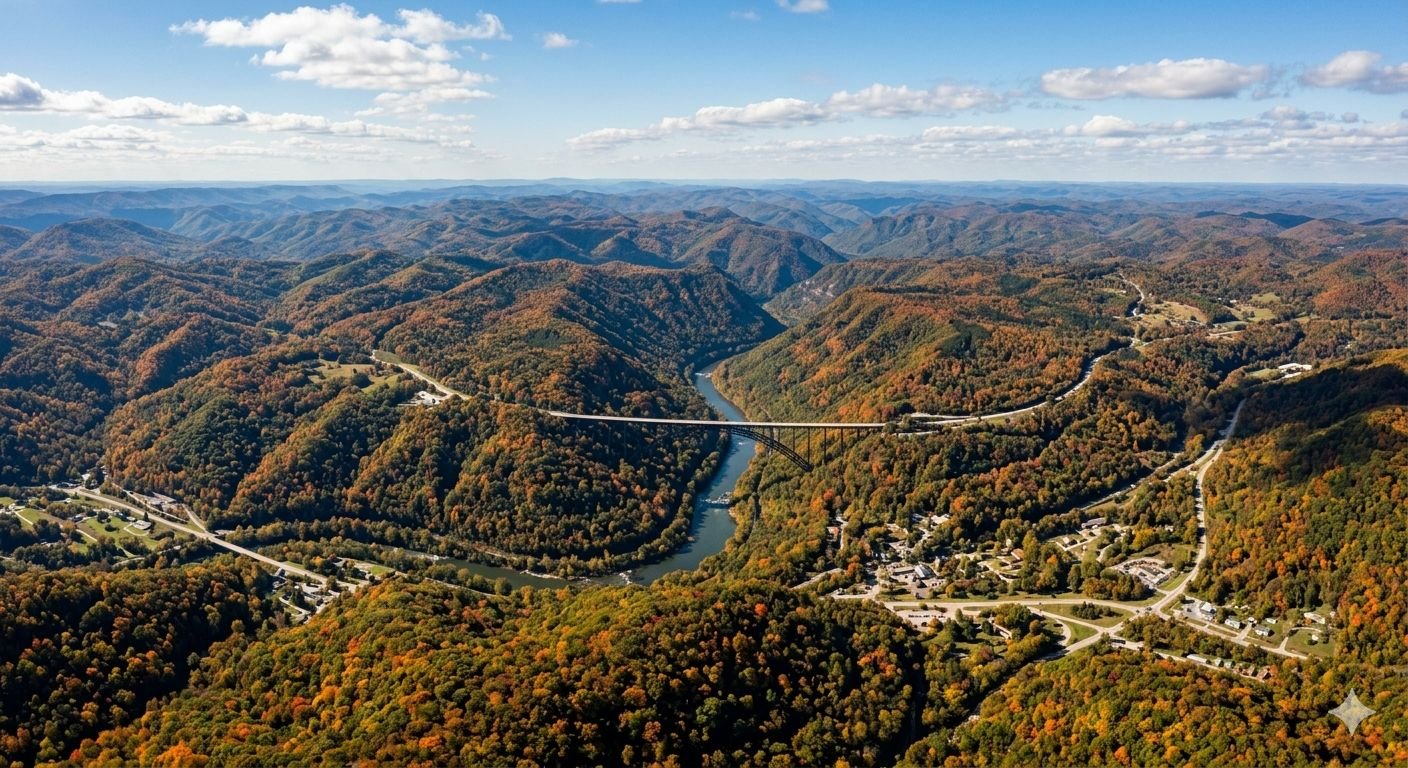
West Virginia wears its state motto — “Wild, Wonderful” — with complete justification. Tucked into the folds of the central Appalachian Mountains, this small, deeply forested state is one of the most topographically dramatic in the eastern United States, a landscape of ancient ridges, plunging river gorges, cascading waterfalls, and some of the oldest mountains on earth. It is a state of genuine contradictions: extraordinarily rich in natural beauty yet historically among the nation’s poorest in economic terms, fiercely proud of its independence yet often overlooked by the broader American travel imagination. For those willing to venture off the beaten path, West Virginia offers outdoor adventures, cultural depth, and a warmth of character that few places can match.
Geography and Character
West Virginia is the only state formed during the Civil War, breaking away from Virginia in 1863 when its largely Unionist mountain counties refused to follow Richmond into the Confederacy. That act of stubborn independence set a tone that persists to this day. West Virginians are intensely proud of their state and its distinctiveness, quick to distinguish themselves from Virginia and equally quick to point out that their mountains, rivers, and forests constitute a natural inheritance of staggering richness.
The state sits entirely within the Appalachian Mountains — the only state for which that is true — and its terrain is relentlessly vertical. There are no flat expanses here. Every road winds, every valley is narrow, and every horizon is a ridgeline. The New River, despite its name, is one of the oldest rivers in the world, predating the mountains through which it carved its gorge. The Potomac, Greenbrier, Gauley, Cheat, and Elk rivers all drain this mountainous interior, and together they have created a landscape of extraordinary recreational potential.
The climate is temperate but highly variable by elevation. Summers are cooler than surrounding lowland states, making West Virginia a traditional refuge from mid-Atlantic and southeastern heat. Fall foliage is spectacular — the state’s broad-leafed hardwood forests ignite in early to mid-October with colors that rival New England. Winters can be severe at higher elevations, with significant snowfall supporting a modest but enthusiastic ski industry. Spring brings wildflowers in extraordinary profusion, particularly the rhododendrons and mountain laurel that carpet the forest understory.
The New River Gorge: West Virginia’s Crown Jewel
In 2020, New River Gorge National Park and Preserve became the nation’s newest national park, bringing long-overdue federal recognition to what has been a world-class outdoor destination for decades. The park encompasses over 70,000 acres of rugged gorge country in southern West Virginia, centered on a 53-mile stretch of the New River as it drops through one of the deepest river gorges in the eastern United States.
The gorge is breathtaking in its scale. At points the walls drop nearly 1,000 feet from rim to river, cloaked in dense hardwood forest broken by dramatic sandstone cliffs. The New River Gorge Bridge, completed in 1977, spans the gorge at a height of 876 feet — for 26 years it was the longest steel arch bridge in the world — and the view from the Canyon Rim Visitor Center, looking out over the bridge and down into the forested gorge, is one of the iconic vistas of the Appalachians.
The park offers something for nearly every type of outdoor enthusiast. Rock climbers from across the country and beyond come specifically for the New River Gorge’s sandstone cliffs, which offer more than 1,400 established routes ranging from beginner to extremely advanced. The area around Fayetteville — the charming small city that serves as the gateway town for the park — is thick with outfitters, gear shops, and climbing guides.
Whitewater rafting on the New River and the adjacent Gauley River is among the finest in the eastern United States. The Lower New River offers Class III to V rapids in a setting of stunning gorge scenery, and dozens of rafting outfitters operate out of Fayetteville and the surrounding area. The Gauley River, which joins the New near Gauley Bridge, is considered one of the premier whitewater rivers in the world, with a series of legendary Class V rapids — Insignificant, Lost Paddle, Iron Ring, Sweet’s Falls — that draw expert paddlers from around the globe during the fall “Gauley Season,” when the Army Corps of Engineers releases water from Summersville Dam each September and October.
Hiking within the park ranges from easy rim walks to strenuous gorge descents. The Long Point Trail is a moderate favorite, ending at a sandstone outcropping with panoramic views of the bridge and gorge. The Grandview Rim Trail offers similarly dramatic views with slightly less effort. For the more ambitious, the Endless Wall Trail follows the clifftop through a stunning sequence of overhangs and viewpoints above the river.
Bridge Day, held on the third Saturday of October each year, is one of West Virginia’s most distinctive and celebrated events. The bridge is closed to traffic for a single day and opened to pedestrians, BASE jumpers, and rappellers, who leap and descend from its 876-foot deck before crowds of tens of thousands of spectators. It is a spectacle unlike anything else in Appalachia.
Harpers Ferry: Where Rivers, Mountains, and History Converge
At the northeastern tip of West Virginia, where the Shenandoah River meets the Potomac at the foot of the Blue Ridge, Harpers Ferry occupies one of the most dramatically situated towns in the eastern United States. Thomas Jefferson, visiting in 1783, called the view from the heights above the confluence worth a voyage across the Atlantic — and while that may be hyperbole, it is forgivable hyperbole.
Harpers Ferry is best known as the site of John Brown’s 1859 raid on the federal armory, an event that accelerated the nation’s slide toward Civil War. Brown and his band of abolitionists seized the armory with the intention of sparking a slave rebellion; they were quickly surrounded, captured by forces under Robert E. Lee, and Brown was tried and hanged. The raid electrified the nation and deepened the sectional crisis beyond repair. Harpers Ferry National Historical Park preserves the lower town and many of its 19th-century structures, offering an exceptionally well-interpreted window into this pivotal moment in American history.
But Harpers Ferry is far more than a Civil War site. The town changed hands eight times during the war and was witness to events spanning the full arc of that conflict. The park’s exhibits address the town’s role as an industrial center — its armory produced firearms that equipped American armies for decades — as well as its significance in African American history: Storer College, established here after the war to educate freed people, operated until 1955 and hosted a meeting of the Niagara Movement, precursor to the NAACP, in 1906.
The physical setting remains as compelling as it was in Jefferson’s day. The confluence of the two rivers, the wooded heights of Maryland Heights and Loudoun Heights rising on either side, and the Victorian commercial district of the lower town combine to make Harpers Ferry one of the most visually striking and historically resonant small towns in America.
The Appalachian Trail passes directly through Harpers Ferry, and the Appalachian Trail Conservancy maintains its national headquarters here. Hikers tackling the full trail between Georgia and Maine pass through town, and the trail’s crossing of the Potomac on the historic railroad bridge is one of the most memorable moments of the entire 2,190-mile journey.
Monongahela National Forest: The High Wilderness
Covering nearly 920,000 acres across the central and eastern highlands of West Virginia, Monongahela National Forest is the state’s largest and most ecologically significant public land. It encompasses Spruce Knob, the state’s highest point at 4,863 feet, along with the Dolly Sods Wilderness, Otter Creek Wilderness, Cranberry Glades Botanical Area, and dozens of waterfalls, trout streams, and mountain meadows.
Spruce Knob is a rewarding destination in its own right. The summit, accessible by a short walk from the parking area, is crowned by a stone observation tower and offers sweeping views in all directions — west across the folded ridges of the Allegheny highlands, east toward the Shenandoah Valley. The krummholz spruce trees near the summit, twisted and sculpted by prevailing winds into dramatic horizontal forms, are one of the forest’s signature sights.
Dolly Sods Wilderness is perhaps the most unusual landscape in West Virginia — an elevated plateau of heath barrens, bogs, and wind-flagged spruce forest that looks and feels more like the Canadian Maritimes than the mid-Atlantic. The area’s thin, rocky soils and frequent fog and wind give it a subarctic character extraordinary for its latitude. Red spruce, blueberries, and sphagnum moss dominate the vegetation, and black bears, snowshoe hares, and a remarkable diversity of migratory birds inhabit the plateau. Hiking here, especially on a cool autumn day when the barrens glow in shades of red and gold, is an experience of considerable beauty and strangeness.
Cranberry Glades, in the southern portion of the forest, is the largest boreal bog complex in the eastern United States — four open sphagnum bogs surrounded by spruce-fir forest, home to carnivorous plants including sundews and pitcher plants. A boardwalk trail crosses the fragile bog surface, and a nearby Cranberry Mountain Nature Center provides interpretive exhibits on the unique ecology of the glades.
Fishing in the Monongahela is excellent. The Cranberry River, Williams River, Shavers Fork of the Cheat, and Seneca Creek all support wild trout populations, and the forest contains hundreds of miles of streams designated as native brook trout habitat. Backcountry camping is permitted throughout much of the forest, and the solitude available in its more remote corners — particularly in the designated wilderness areas — is exceptional.
Snowshoe Mountain and Winter Recreation
West Virginia is not the first state most travelers associate with skiing, but Snowshoe Mountain Resort, perched atop Cheat Mountain in Pocahontas County, offers some of the best skiing and snowboarding in the mid-Atlantic and southeastern United States. At 4,848 feet elevation, the resort receives substantial natural snowfall supplemented by aggressive snowmaking, and its 57 trails cover a wide range of terrain from gentle beginner slopes to expert chutes.
The resort operates year-round. In summer and fall, Snowshoe transforms into a mountain biking and hiking destination, with extensive trail networks, a chairlift-served bike park, and accommodations that fill with leaf-peepers in October. The surrounding Cheat Mountain landscape — a high plateau of red spruce forest crossed by trout streams — is beautiful in every season.
Canaan Valley Resort State Park, in Tucker County, is another significant winter destination. The valley sits at around 3,200 feet elevation and receives some of the heaviest snowfall in the eastern United States, averaging over 150 inches annually. The state park operates a ski resort alongside extensive Nordic skiing and snowshoe trail networks. The valley is also a nationally significant natural area — its wetlands complex is one of the largest high-elevation freshwater wetlands in the eastern United States, supporting breeding populations of rare plants and animals and serving as a critical stopover for migratory birds.
Blackwater Falls State Park, adjacent to Canaan Valley, is one of the most visited parks in West Virginia, centered on the spectacular amber-tinted falls of the Blackwater River plunging 57 feet into a rugged gorge of hemlock and red spruce. The falls are beautiful in every season — dramatic in spring flood, surrounded by rhododendron bloom in summer, framed by brilliant foliage in fall, and encased in ice formations of remarkable complexity in winter.
The Greenbrier Valley and White Sulphur Springs
The southeastern corner of West Virginia contains some of the state’s most refined and historically significant destinations. The Greenbrier, a grand resort hotel in White Sulphur Springs, has been welcoming guests since 1778, making it one of the oldest resort destinations in the United States. Its white-columned, Georgian-style main building, surrounded by the gentle ridges of the Allegheny Mountains, exudes a grandeur that seems slightly improbable in this remote mountain setting.
The Greenbrier served as a presidential retreat for much of the 19th century and has hosted 28 sitting presidents. During World War II it was used as an internment facility for German and Japanese diplomats and later as a military hospital. Its most extraordinary secret came to light in 1992, when a journalist revealed that beneath the resort, accessible through a hidden entrance behind a service area, the United States government had constructed a massive underground bunker designed to shelter Congress in the event of nuclear war. The bunker, code-named “Project Greek Island,” is now open for tours — a surreal and fascinating attraction that combines Cold War history with the resort’s genteel surface elegance in deeply strange fashion.
The Greenbrier’s grounds include a world-class golf course — consistently ranked among the finest in the country — along with spa facilities, a casino, an extensive network of hiking and riding trails, and dining and shopping of a standard unusual for this corner of Appalachia. It is an expensive destination, but even travelers who cannot afford to stay can visit for the bunker tour or simply to walk the grounds and absorb its peculiar combination of grandeur and mountain setting.
Lewisburg, the county seat of Greenbrier County and just a few miles from The Greenbrier resort, is a delightful small city that warrants more attention than it typically receives. Its well-preserved historic downtown — a National Historic District — is lined with independent bookshops, galleries, restaurants, and cafes that punch far above their weight for a city of just 4,000 people. Carnegie Hall, the local performing arts center housed in a building funded by Andrew Carnegie in 1902, hosts concerts, theater, and cultural events year-round. The Lost World Caverns, on the edge of town, offers tours of a cathedral-sized limestone cave chamber containing spectacular stalagmite and stalactite formations.
Seneca Rocks and Spruce Knob: The Germany Valley Region
In the central highlands of Pendleton County, the landscape takes on an almost theatrical quality. Seneca Rocks — a dramatic fin of Tuscarora quartzite rising nearly 900 feet above the North Fork of the South Branch Potomac River — is one of the most recognizable natural landmarks in the Appalachians and the premier technical rock climbing destination east of the Mississippi. Its near-vertical faces, offering routes of all difficulty levels, attract climbers from across the region, while hikers can reach the summit via a steep but non-technical trail that delivers extraordinary panoramic views of the surrounding valley and ridgelines.
The small community of Seneca Rocks, clustered at the base of the formation, offers basic services — a visitors center, a couple of climbing guide services, and a handful of restaurants and lodging options — in a setting of considerable charm. The Harper’s Old Country Store, a general store operating here since 1902, is a local institution and worth a browse.
The surrounding Pendleton County region, known as the Germany Valley, is one of the most scenic rural landscapes in West Virginia — a broad, fertile valley framed by Seneca Rocks to the north and the Allegheny Front to the east, dotted with traditional farms and small communities that have changed remarkably little over the past century.
Cass Scenic Railroad
In Pocahontas County, the Cass Scenic Railroad offers one of the most unusual and rewarding excursion experiences in the eastern United States. Cass was a company logging town built by the West Virginia Pulp and Paper Company in the early 20th century to support timber operations on Cheat Mountain. The railroad that hauled logs down the mountain has been preserved as a state park, and its steep-grade Shay locomotives — powerful geared engines specifically designed for mountain logging operations — still make the climb up the mountain, carrying passengers in converted logging flatcars through magnificent spruce forest to the summit of Bald Knob, the second-highest point in West Virginia.
The trip takes most of the day and involves grades of up to 11 percent — extremely steep by railroad standards — with breathtaking views across the mountain wilderness. The Cass townsite itself, with its preserved company houses, company store, and mill buildings, offers a remarkably complete picture of early 20th-century industrial Appalachian life.
Cultural Heritage: Music, Craft, and Coal
West Virginia’s cultural identity is rooted in its Scots-Irish and English settler heritage, its African American communities, its Native American history, and the profound experience of the coal industry. Each of these threads is woven through the state’s music, crafts, food, and storytelling traditions in ways that reward the culturally curious traveler.
Appalachian old-time music — fiddle tunes, ballads, and banjo picking rooted in the British Isles but transformed by the American mountain experience — remains a living tradition in West Virginia. The Augusta Heritage Center at Davis & Elkins College in Elkins hosts one of the premier traditional music and arts programs in the country each summer, with week-long workshops in fiddle, banjo, dulcimer, and dozens of other traditional forms drawing participants from across the country and beyond. The center’s public concerts and dances during the Augusta Heritage Festival in late July and early August are among the finest showcases of Appalachian traditional music anywhere.
The Vandalia Gathering, held each Memorial Day weekend on the grounds of the state capitol in Charleston, is another essential cultural event — a celebration of West Virginia’s folk arts and traditions including music, storytelling, craft demonstrations, and dancing, organized by the West Virginia Division of Culture and History.
The coal industry’s history — its economic centrality, its brutal labor conflicts, and its human costs — is powerfully documented at several sites across the southern coalfields. The Hatfield-McCoy region, in the Mingo, Logan, and Wayne county area along the Kentucky border, is famous for the legendary 19th-century feud between the two families, and while the story has acquired an almost mythological status, it also illuminates real tensions over land, resources, and authority in the post-Civil War mountains. The area today is better known among outdoor recreation enthusiasts for the Hatfield-McCoy Trail System — more than 700 miles of off-road vehicle trails through the coalfield hills, one of the largest ATV trail systems in the country.
Charleston, the state capital, offers the surprisingly excellent West Virginia State Museum within the impressive Art Deco State Capitol complex. The capitol building itself, with its 293-foot gilded dome — taller than the dome of the United States Capitol — is worth a visit, as are the Cultural Center’s galleries and the beautiful grounds overlooking the Kanawha River.
Waterfalls
West Virginia is blessed with an extraordinary abundance of waterfalls, a consequence of its mountainous topography and substantial precipitation. Beyond Blackwater Falls, the state contains dozens of significant cascades well worth seeking out.
Elakala Falls, within Blackwater Falls State Park, is a series of four falls on Shays Run accessible by a short trail — the first falls, a dramatic 30-foot plunge into a mossy canyon, is one of the most photographed waterfalls in the state. Cucumber Falls in Ohiopyle-adjacent terrain, Sandstone Falls on the New River — the river’s widest waterfall, stretching nearly 1,500 feet across — and the twin cascades of Falls of Hills Creek in the Monongahela National Forest (including a 45-foot plunge that is among the state’s tallest) are all well worth the effort of reaching them.
Practical Travel Information
West Virginia is most conveniently reached by road. Interstate 79 runs north-south through the center of the state, connecting Charleston to Morgantown and beyond. Interstate 64 crosses the southern part of the state east-west, and Interstate 68 provides access from the north via Maryland. The primary commercial airports serving the state are Yeager Airport in Charleston and the Eastern West Virginia Regional Airport near Martinsburg, with many visitors also flying into Pittsburgh, Roanoke, or Washington Dulles and driving in.
The state is broadly affordable by eastern U.S. standards. Lodging ranges from basic but comfortable motels in small towns to the luxury of The Greenbrier and the comfortable mountain lodges within the state park system, which offers some of the better-value resort lodging in the region. Food leans toward hearty, unpretentious Appalachian cooking — pepperoni rolls (a West Virginia original), buckwheat cakes, ramp dishes in spring, and excellent country ham — though the gateway towns to major outdoor recreation areas have developed increasingly sophisticated dining scenes in recent years.
Cell service is unreliable throughout much of the state’s mountainous interior, which should be factored into navigation planning. Paper maps and downloaded offline maps are genuinely useful here, not nostalgic affectations. The flip side of this connectivity gap is the extraordinary radio silence preserved around the National Radio Astronomy Observatory in Green Bank — a federally mandated radio-quiet zone encompassing the surrounding mountains where electronic devices that emit radio waves are restricted, creating one of the truly quiet places in the modern world.
The Green Bank Observatory, home to the Robert C. Byrd Green Bank Telescope — the world’s largest fully steerable radio telescope — offers excellent public tours and a small science center explaining the extraordinary science conducted here, from the search for extraterrestrial intelligence to studies of pulsars, black holes, and the structure of the Milky Way.
Final Thoughts
West Virginia is a state that has endured more than its share of hardship — economic, environmental, and social — and its people carry that history with a dignity and dry wit that is distinctly their own. But the mountains, rivers, and forests that define this state are genuinely spectacular, and the culture that has grown from its particular history — its music, its stories, its stubbornness and pride — is one of the richest and most distinctive in America.
Come for the whitewater and the rock climbing, the fall color and the waterfalls, the hiking and the dark skies. Stay for the sense that you have found a place that has not yet been smoothed and packaged for easy consumption — a place that asks something of you, and gives back something real in return.
West Virginia, as its people will tell you without a moment’s hesitation, is almost heaven. Spend a few days here, and you may find yourself inclined to agree.
Leave a Reply
You must be logged in to post a comment.