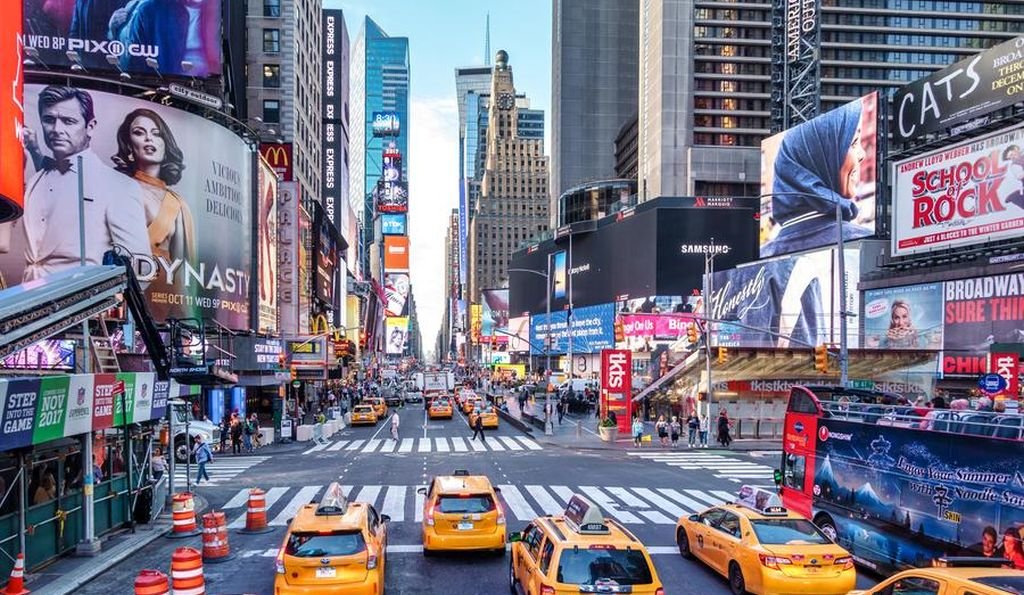
Times Square is one of the world’s most recognizable urban destinations and one of the most visited places in New York City. Famous for its enormous digital billboards, Broadway theaters, pedestrian plazas, restaurants, shops, street performers and New Year’s Eve celebration, Times Square represents the energetic, constantly changing character of Manhattan.
Often called the “Crossroads of the World,” Times Square is much more than a brightly illuminated intersection. It is a major entertainment district, transportation hub, commercial center and cultural meeting place. The district extends well beyond the famous central plaza, incorporating parts of the Theater District and the area around 42nd Street.
The Times Square Alliance defines its district as extending approximately from 40th Street to 53rd Street between Sixth and Eighth Avenues, together with the historic Restaurant Row on West 46th Street between Eighth and Ninth Avenues. The area contains dozens of theaters, hundreds of dining options and numerous hotels.
Where Is Times Square?
Times Square is located in Midtown Manhattan, at the intersection of Broadway, Seventh Avenue and 42nd Street.
The principal public space is roughly centered around:
Times Square
Manhattan, New York, NY 10036
United States
Times Square
Its location makes it exceptionally convenient for visitors exploring Manhattan. It is close to several major attractions, including:
- Broadway theaters
- Rockefeller Center
- Radio City Music Hall
- Bryant Park
- Grand Central Terminal
- Fifth Avenue
- Central Park
- Hudson Yards
- Madison Square Garden
- Empire State Building
- The Museum of Modern Art
Because so many subway lines serve the surrounding area, Times Square is also one of the easiest places from which to begin exploring New York.
The History of Times Square
From Longacre Square to Times Square
Times Square was not always called Times Square.
During the 19th century, the area was known as Longacre Square, a name associated with London’s carriage district. The neighborhood was considerably quieter and less developed than the modern entertainment district.
The arrival of electricity, public transportation and commercial development transformed the area dramatically during the late 19th and early 20th centuries. Advertising signs and electric illumination helped establish the visual identity that eventually became one of Times Square’s defining characteristics.
The New York Times Arrives
The decisive change came when newspaper publisher Adolph Ochs, owner of The New York Times, selected the area for the newspaper’s new headquarters.
The newspaper moved into the new Times Building in January 1905. The intersection was subsequently renamed Times Square.
The building became known as the Times Tower, and although The New York Times later moved elsewhere, the tower remained an architectural and symbolic centerpiece of the district.
Today the building is generally known as One Times Square.
One Times Square
The Birth of the New Year’s Eve Tradition
One of Times Square’s most famous traditions began shortly after the district received its new name.
The first Times Square New Year’s Eve celebration associated with the new headquarters of The New York Times took place in 1904. The newspaper organized a celebration to mark the opening of its new building.
The famous Ball Drop tradition followed soon afterward and eventually became an annual event.
Today, the Times Square New Year’s Eve celebration is an international television event. Hundreds of thousands of people traditionally gather in the area, while a worldwide audience watches the Ball Drop.
During World War II, the illuminated celebration was temporarily altered because New York imposed a wartime dimout. The Ball was not used in the usual manner in 1942 and 1943.
Times Square and Broadway
Perhaps the most important reason Times Square became internationally famous is its connection with Broadway theater.
The surrounding Theater District developed into one of the world’s great centers of live theatrical entertainment. By the early 20th century, many major theaters had moved into the Times Square area.
Today, Broadway is one of the principal attractions for visitors to New York.
The surrounding district contains more than 39 theaters, according to the Times Square Alliance, and offers productions ranging from huge musical productions to serious dramas and long-running theatrical classics.
For many international visitors, a trip to New York is not complete without seeing a Broadway show.
Broadway Theater Experience
Visitors can:
- Attend a major Broadway musical
- See a Broadway drama
- Purchase same-day discounted tickets
- Explore historic theaters
- Walk along Broadway before or after a performance
- Have dinner in the Theater District
- Visit Times Square after dark
The combination of theater, restaurants, hotels and nightlife makes the area particularly active in the evening.
The Bright Lights of Times Square
The enormous electronic advertising screens are probably the feature most closely associated with modern Times Square.
Buildings around the intersection are covered with giant digital displays, illuminated advertisements and constantly changing video screens.
The effect is particularly dramatic after sunset.
Unlike a conventional historic square, Times Square has an intentionally commercial and theatrical visual identity. The advertisements themselves have become part of the attraction.
Visitors commonly spend time simply walking through the pedestrian plazas, looking at the screens and photographing the illuminated buildings.
Times Square Pedestrian Plazas
One of the major changes in modern Times Square has been the transformation of sections of Broadway into pedestrian-oriented public spaces.
Broadway between approximately 42nd and 47th Streets has been closed to regular vehicle traffic, creating large areas where visitors can sit, walk and observe the activity.
The pedestrian plazas have significantly changed the experience of visiting Times Square.
Instead of viewing the district primarily from sidewalks surrounded by traffic, visitors can stand in the middle of the area and experience the buildings and screens from a much wider perspective.
Father Duffy Square
At the northern end of Times Square is Father Duffy Square, an important public space associated with the Theater District.
The square contains the statue of Father Francis Patrick Duffy, a military chaplain and former pastor of Holy Cross Church.
A statue of actor, composer and playwright George M. Cohan is also located in the area, reflecting Times Square’s long relationship with American theater.
The area is particularly recognizable because of the large red steps known as the TKTS stairs, where visitors frequently sit and watch the activity below.
TKTS and Broadway Tickets
The TKTS booth beneath the red steps at Father Duffy Square is associated with discounted same-day theater tickets.
For travelers hoping to see Broadway without paying the full standard ticket price, checking official ticket availability and discount options can be worthwhile.
Availability changes according to the individual production and day. The Times Square Alliance directs visitors to the Theater Development Fund for current ticket information.
Because Broadway shows vary considerably in popularity, visitors should not assume that every show will have discounted tickets available.
Things to Do in Times Square
There is no single way to experience Times Square. Some visitors spend only 30 minutes taking photographs, while others spend several hours combining sightseeing, shopping, dining and theater.
1. Walk Through Times Square
The simplest activity is also one of the most enjoyable.
Walk from 42nd Street toward 47th Street and explore the pedestrian plazas.
During the day, the area has a different atmosphere from nighttime, when the illuminated signs become the dominant feature.
2. Watch the Digital Billboards
The enormous electronic screens are a major part of the Times Square experience.
Take time to stand in the center and look upward. The scale of the advertising displays becomes much more impressive when viewed from the pedestrian plazas.
3. See a Broadway Show
For theater enthusiasts, Broadway is the main attraction.
Depending on the season, visitors can choose from musicals, dramas, family productions and other theatrical performances.
It is advisable to check the official production website or authorized ticketing source before purchasing.
4. Visit One Times Square
The historic Times Tower occupies the small triangular site at the center of the intersection.
The building has a particularly important place in the history of Times Square because the area received its name following the construction of The New York Times headquarters.
In recent years, One Times Square has also been redeveloped as a year-round visitor destination. New York City tourism information describes new immersive experiences connected with the history of the building, Times Square and the Ball Drop tradition.
5. Experience Times Square at Night
Times Square is spectacular after dark.
The combination of:
- Digital billboards
- Theater marquees
- Street performers
- Crowds
- Restaurants
- Taxis
- Police activity
- Illuminated skyscrapers
creates an atmosphere unlike almost anywhere else in New York City.
Nighttime is when Times Square most strongly resembles the image seen in movies, television programs and travel photography.
Times Square for Families
Times Square can be an exciting destination for families, particularly because many attractions are concentrated within walking distance.
Family-friendly activities include:
- Visiting Broadway shows suitable for children
- Exploring large toy and entertainment stores
- Watching street performers
- Photographing the billboards
- Walking through the pedestrian plazas
- Visiting nearby Central Park
- Exploring Rockefeller Center
- Dining at family-oriented restaurants
The Times Square Alliance maintains dedicated visitor information for families and accessibility resources.
Parents should remember that the area can become extremely crowded, particularly during major events and holiday periods.
Shopping in Times Square
Times Square is surrounded by major international brands, souvenir stores, fashion retailers, entertainment stores and specialty shops.
Visitors can purchase:
- New York souvenirs
- Clothing
- Toys
- Broadway merchandise
- Sports merchandise
- Gifts
- Candy
- Electronics and accessories
The district is particularly convenient for visitors who want to combine sightseeing with shopping because many stores remain open into the evening.
Restaurants and Food in Times Square
Times Square offers an enormous range of dining choices.
The Times Square Alliance reports more than 200 international dining options in the broader district.
Visitors can find restaurants serving:
- American cuisine
- Italian food
- Japanese cuisine
- Chinese food
- Korean cuisine
- Mexican food
- Indian cuisine
- Mediterranean dishes
- Burgers
- Pizza
- Steaks
- Fast food
- Desserts
Restaurant Row
One particularly important dining area is Restaurant Row, located on West 46th Street between Eighth and Ninth Avenues.
This street has a long association with the Theater District and offers restaurants convenient for visitors attending Broadway performances.
Street Performers and Characters
Street entertainment is another recognizable part of the Times Square experience.
Visitors may encounter:
- Musicians
- Dancers
- Costumed characters
- Living-statue performers
- Magicians
- Artists
- Photographers
- Promotional performers
If you choose to take a photograph with a costumed performer, it is sensible to clarify whether a payment is expected before taking the photograph.
Times Square and Public Art
Times Square is not exclusively a commercial environment.
The district also hosts public art projects and cultural programs.
Times Square Arts works with contemporary artists and cultural organizations to use the district’s public spaces and electronic screens as platforms for artistic projects.
The Times Square Alliance also organizes public programming, concerts and cultural events.
In 2026, for example, its TSQ LIVE program returned with free outdoor performances featuring musicians, DJs, dancers and other performers.
This mixture of advertising, entertainment and public art is an important part of Times Square’s modern identity.
Times Square New Year’s Eve
The Times Square New Year’s Eve Ball Drop is perhaps the most internationally famous event associated with New York City.
On December 31, enormous crowds traditionally gather around Times Square to watch the illuminated Ball descend from One Times Square shortly before midnight.
The event has been taking place in some form for more than a century.
The celebration has become a global symbol of the arrival of the New Year, with international television audiences following the event.
Visiting on New Year’s Eve
Anyone considering attending should understand that it is very different from an ordinary visit.
The area becomes exceptionally crowded, pedestrian movement is restricted, security procedures are extensive, and visitors may spend many hours outdoors.
For travelers who simply want to see Times Square, another day may provide a much more comfortable experience.
Times Square by Day vs. Night
| Feature | Daytime | Nighttime |
|---|---|---|
| Billboards | Very visible | Extremely dramatic |
| Crowds | Usually busy | Often very busy |
| Photography | Good | Excellent for illuminated scenes |
| Theater | Active | Particularly lively |
| Restaurants | Busy | Very busy |
| Atmosphere | Urban sightseeing | Entertainment and nightlife |
| Families | Convenient | Still popular |
| Walking | Easy but crowded | Busy, especially around theaters |
Both experiences are worthwhile.
However, first-time visitors who want to experience the iconic image of Times Square should include an evening visit.
Transportation to Times Square
Times Square is one of the best-connected areas in Manhattan.
The 42nd Street–Times Square subway complex connects travelers with several subway services.
Visitors can also reach Times Square by:
- Subway
- Bus
- Taxi
- Ride-hailing services
- Walking
- Bicycle
For most tourists already staying in Manhattan, public transportation or walking is generally the most practical way to reach the district.
Driving directly into the center of Times Square is usually less convenient because of congestion and pedestrian restrictions.
The Times Square Alliance provides current information about transportation, parking, accessibility and pedestrianized streets.
Hotels Near Times Square
Times Square and the surrounding Theater District contain a large concentration of hotels.
The area can be particularly convenient for visitors who want to:
- Attend Broadway shows
- Explore Midtown Manhattan
- Visit Rockefeller Center
- Walk to Fifth Avenue
- Access Central Park
- Use public transportation
- Experience Manhattan nightlife
The trade-off is that hotels in this area can be expensive, particularly during holidays, major events and peak tourist periods.
Travelers looking for lower prices can compare accommodations farther from Times Square while remaining near a subway station.
Attractions Near Times Square
One of Times Square’s greatest advantages is its central location.
Rockefeller Center
Located a short walk north of Times Square, Rockefeller Center is famous for its observation deck, NBC studios, Radio City Music Hall and seasonal Christmas tree.
Radio City Music Hall
One of New York’s most famous entertainment venues, Radio City Music Hall is located close to Times Square.
Bryant Park
Bryant Park provides a green public space just south of Times Square, behind the New York Public Library.
Fifth Avenue
The famous shopping avenue is easily accessible from Times Square.
Central Park
Central Park begins several blocks north of the Theater District.
Empire State Building
The Empire State Building is farther south but can be reached relatively easily by subway or on foot.
Grand Central Terminal
Grand Central Terminal is another major Manhattan landmark within walking distance of Times Square.
Times Square’s Transformation
Times Square has experienced dramatic changes over its history.
During the early 20th century it became a center of theater, entertainment and nightlife. Later, particularly from the Great Depression onward, parts of the district developed a reputation for adult entertainment, crime and social problems.
The situation became especially difficult during the second half of the 20th century.
By the 1970s and 1980s, Times Square had become associated with prostitution, adult theaters, drug markets and high crime. The Times Square Alliance’s historical account describes the severe deterioration of the district during this period.
Beginning in the late 20th century, major redevelopment efforts transformed the area.
The district gradually became more heavily oriented toward:
- Tourism
- Broadway theater
- Corporate offices
- Retail
- Restaurants
- Family entertainment
- Public spaces
- Large-scale advertising
The result is the Times Square that visitors recognize today.
Why Times Square Became Famous
Several factors explain its global importance.
1. Broadway
Its proximity to the world’s most famous commercial theater district established Times Square as an entertainment capital.
2. Advertising
The giant illuminated signs created a visual identity that became synonymous with modern New York.
3. Transportation
The area’s subway and transportation connections brought enormous numbers of people through the district.
4. New Year’s Eve
The annual Ball Drop turned Times Square into a global New Year’s symbol.
5. Popular Culture
Times Square has appeared extensively in films, television programs, music videos, advertisements and photographs.
6. Tourism
Its central Manhattan location makes it an easy stop for visitors exploring multiple major attractions.
Times Square in Popular Culture
Few urban locations have appeared as frequently in popular culture as Times Square.
Its distinctive combination of skyscrapers, neon signs, Broadway marquees and crowds has made it a natural setting for movies and television.
For international audiences, Times Square often functions as a visual shorthand for New York City itself.
A photograph showing the bright billboards of Times Square can immediately communicate:
New York City.
Best Time to Visit Times Square
Times Square can be visited throughout the year.
Spring
Spring brings comfortable temperatures and is a good period for walking around Midtown.
Summer
Summer generally brings large numbers of tourists and long daylight hours. Evening visits can be particularly lively.
Autumn
Fall is an excellent season for combining Times Square with walks through Midtown and Central Park.
Winter
Winter provides a completely different atmosphere, especially around Christmas and New Year’s Eve.
The holiday season is extremely popular, but temperatures can be cold and crowds can be substantial.
How Much Time Do You Need?
A quick visit can take 30–60 minutes.
However, if you want to combine Times Square with Broadway, shopping, restaurants and nearby attractions, you could easily spend half a day or an entire evening in the area.
Suggested itinerary
1 hour:
Walk through Times Square and photograph the major landmarks.
2–3 hours:
Times Square + shopping + dinner.
4–6 hours:
Times Square + Broadway + dinner + Theater District.
Full day:
Times Square + Rockefeller Center + Fifth Avenue + Bryant Park + Broadway or another evening attraction.
Practical Travel Tips
Visit both during the day and at night
The atmosphere changes dramatically after sunset.
Wear comfortable shoes
Times Square is best explored on foot.
Watch your belongings
Large crowds create opportunities for pickpocketing, as in other major tourist areas.
Be careful around traffic
Even with pedestrianized areas, Times Square remains surrounded by busy Manhattan streets.
Check Broadway schedules in advance
Popular shows can sell out, particularly during peak travel periods.
Compare restaurant prices
Restaurants in the immediate tourist core can be expensive. Walking several blocks away can provide additional choices.
Be aware of street performers
Clarify the price before accepting a photograph or service from a performer.
Use the subway
The subway provides convenient access to Times Square and other parts of Manhattan.
Don’t plan your entire New York trip around Times Square
Times Square is a major attraction, but many of New York’s most interesting neighborhoods are elsewhere. Use it as one part of a broader Manhattan itinerary.
Times Square as a Symbol of New York City
Times Square represents several aspects of New York simultaneously.
It is:
- A theater district
- A commercial center
- A tourist attraction
- A transportation hub
- A public gathering place
- An advertising landmark
- A nightlife destination
- A cultural venue
- A location for major public events
Its identity has changed repeatedly over more than a century, from Longacre Square to the newspaper-centered district of the early 1900s, through periods of decline and redevelopment, to today’s globally recognized entertainment destination.
The Times Square Alliance, established in 1992, continues to work on public safety, sanitation, arts, major events, economic development and promotion of local businesses in the district.
Times Square Visitor Summary
| Category | Information |
|---|---|
| Location | Midtown Manhattan, New York City |
| Main intersection | Broadway, Seventh Avenue & 42nd Street |
| Historic name | Longacre Square |
| Renamed | Times Square in the early 20th century |
| Most famous for | Broadway, billboards and New Year’s Eve |
| Main attraction | Times Square pedestrian plaza |
| Nearby theater district | Broadway/Theater District |
| Public transportation | Extensive subway and bus connections |
| Best experience | Daytime and after dark |
| Recommended visit | 1 hour to a full day |
| Major annual event | New Year’s Eve Ball Drop |
| Shopping | Extensive |
| Dining | International cuisine and Restaurant Row |
| Family friendly | Yes, with many nearby attractions |
| Photography | Particularly impressive after sunset |
Times Square is one of the defining landmarks of New York City. Its importance comes not from a single monument but from the combination of Broadway theater, enormous electronic advertising, public spaces, restaurants, shopping, transportation, entertainment and more than a century of history.
For a first-time visitor to New York, walking through Times Square provides an immediate introduction to the scale and energy of Manhattan. The experience is particularly memorable after dark, when thousands of lights illuminate the surrounding buildings and Broadway theaters.
At the same time, Times Square is only one part of New York City. Its central location makes it an excellent starting point for exploring the surrounding Theater District, Rockefeller Center, Fifth Avenue, Bryant Park, Central Park and other Midtown attractions.
Leave a Reply
You must be logged in to post a comment.