Category: Cities

  • Most Visited Cities in the United States

    Most Visited Cities in the United States

    This list combines international tourism, domestic travel, hotel occupancy, business travel, and entertainment tourism trends from major U.S. tourism industry reports.

    RankCityStateMain Attractions
    1New York CityNew YorkTimes Square, Broadway, Statue of Liberty
    2MiamiFloridaBeaches, nightlife, cruises
    3Los AngelesCaliforniaHollywood, Santa Monica, entertainment
    4OrlandoFloridaDisney World, Universal Studios
    5San FranciscoCaliforniaGolden Gate Bridge, Alcatraz
    6Las VegasNevadaCasinos, luxury resorts, shows
    7WashingtonDistrict of ColumbiaWhite House, Smithsonian museums
    8ChicagoIllinoisArchitecture, museums, food
    9HonoluluHawaiiWaikiki Beach, tropical tourism
    10BostonMassachusettsHistory, universities, culture
    11San DiegoCaliforniaBeaches, zoo, harbor
    12PhiladelphiaPennsylvaniaLiberty Bell, Independence Hall
    13HoustonTexasNASA, business tourism
    14New OrleansLouisianaMardi Gras, jazz, French Quarter
    15AtlantaGeorgiaAirport hub, entertainment
    16DallasTexasShopping, sports, business
    17SeattleWashingtonPike Place Market, tech culture
    18DenverColoradoRocky Mountains gateway
    19NashvilleTennesseeCountry music, nightlife
    20San AntonioTexasRiver Walk, The Alamo
    21PhoenixArizonaDesert resorts, golf
    22AustinTexasMusic scene, tech culture
    23PortlandOregonFood, coffee, nature
    24CharlestonSouth CarolinaHistoric charm, coastal tourism
    25SavannahGeorgiaHistoric district, southern culture
    26TampaFloridaGulf Coast beaches
    27Key WestFloridaIsland tourism, nightlife
    28DetroitMichiganMusic history, sports
    29MinneapolisMinnesotaLakes, arts, business
    30St. LouisMissouriGateway Arch
    31Salt Lake CityUtahSki tourism, mountain access
    32ClevelandOhioRock & Roll Hall of Fame
    33IndianapolisIndianaSports tourism
    34Kansas CityMissouriBBQ, jazz culture
    35MemphisTennesseeElvis Presley, blues music
    36SacramentoCaliforniaCalifornia history
    37RaleighNorth CarolinaTech and education
    38CharlotteNorth CarolinaFinance hub, sports
    39MilwaukeeWisconsinBreweries, lakefront
    40AnchorageAlaskaNature and wildlife tourism
    41CincinnatiOhioHistoric districts, sports
    42PittsburghPennsylvaniaBridges, museums
    43JacksonvilleFloridaBeaches, golf
    44LouisvilleKentuckyKentucky Derby
    45Santa FeNew MexicoArt and adobe architecture
    46BoulderColoradoOutdoor recreation
    47ProvidenceRhode IslandCoastal New England culture
    48Myrtle BeachSouth CarolinaBeach tourism
    49Palm SpringsCaliforniaDesert resorts
    50AspenColoradoLuxury ski tourism

    Most Popular Tourism Regions

    East Coast

    • New York City
    • Miami
    • Boston
    • Washington D.C.
    • Philadelphia

    West Coast

    • Los Angeles
    • San Francisco
    • San Diego
    • Seattle
    • Portland

    Southern USA

    • Orlando
    • New Orleans
    • Nashville
    • Austin
    • Charleston

    Mountain & Desert Tourism

    • Denver
    • Phoenix
    • Salt Lake City
    • Aspen
    • Boulder

    Most Visited for Different Reasons

    CategoryBest Cities
    BeachesMiami, San Diego, Honolulu, Key West
    NightlifeLas Vegas, Miami, Nashville, New Orleans
    Family TourismOrlando, San Diego, Anaheim
    HistoryBoston, Philadelphia, Washington D.C.
    Luxury TravelAspen, Palm Springs, New York City
    Nature & MountainsDenver, Anchorage, Boulder
    EntertainmentLos Angeles, Las Vegas, Nashville
  • Louisville, Kentucky: Where Heritage Meets the Avant-Garde

    Sitting on the southern bank of the Ohio River, Louisville is Kentucky’s largest city and one of the American South’s most compelling travel destinations. It is a city that defies simple categorization: part Southern charm, part Midwestern grit, part cosmopolitan culture hub, and entirely its own thing. Locals pronounce it “LOO-ee-vil” — and they will gently correct you if you say it wrong.

    Louisville is perhaps best known as the home of the Kentucky Derby, the world’s most famous horse race, and as the undisputed capital of American bourbon whiskey. But beyond those two celebrated claims to fame lies a city rich in African American history, Victorian architecture, independent arts, a nationally recognized food scene, and a warmth of hospitality that keeps visitors coming back year after year.

    Whether you are a first-time visitor or a returning fan, this guide covers everything you need to know to make the most of your time in one of America’s most distinctive cities.

    A BRIEF HISTORY

    Louisville was founded in 1778 by General George Rogers Clark, who used the site at the Falls of the Ohio — the only natural obstruction on the entire length of the Ohio River — as a strategic military base during the American Revolutionary War. The city grew rapidly as a river trading post, and by the mid-1800s it had become one of the most important commercial centers in the American interior.

    The city’s relationship with bourbon began early. As far back as 1783, before Kentucky had even achieved statehood, distiller Evan Williams established a distillery on the banks of the Ohio River, setting a tradition that would define the region for centuries. The river was essential to the whiskey trade, carrying barrels downriver to ports across the South and beyond.

    Louisville sits at a fascinating geographic and cultural crossroads — technically a Southern city, shaped by both plantation-era history and the legacy of the Civil War, yet deeply connected to Northern commerce and culture through its river trade. It was a Union-held city during the Civil War, and it later became a crucible of the American Civil Rights Movement, famously producing Muhammad Ali, one of the most consequential figures of the twentieth century.

    Today, Louisville is a city firmly rooted in its past but eagerly looking forward, with a booming culinary scene, a thriving arts culture, and a visitor economy that draws millions of people every year.

    WHEN TO VISIT

    Louisville enjoys four distinct seasons, each offering a different kind of travel experience.

    Spring (March through May) is arguably the most exciting time to visit. The city bursts into bloom, the weather is mild and pleasant, and the social calendar is packed. The Kentucky Derby Festival, which culminates in the first Saturday of May race at Churchill Downs, transforms Louisville into a citywide celebration for nearly two weeks. The festival includes Thunder Over Louisville — widely regarded as the largest annual fireworks display in the entire United States — along with parades, galas, steamboat races, and countless other events. If you plan to attend Derby Week, book accommodations and tickets many months in advance, as the city fills to capacity.

    Summer (June through August) brings heat and humidity, but also outdoor concerts, festivals, rooftop bars, and long evenings on the river. Waterfront Park comes alive, and the city’s many patios and beer gardens are in full swing.

    Fall (September through November) is beautiful and often underrated. The foliage is stunning, the weather is comfortable, and bourbon tourism reaches its peak, as many whiskey enthusiasts consider autumn the ideal season for distillery tours. The Louder Than Life music festival, one of the country’s largest rock festivals, takes place each September.

    Winter (December through February) is quiet by comparison, but offers an intimate look at the city without the crowds. The holiday season brings festive lights and events, and bourbon bars are wonderfully cozy when the temperature drops.

    GETTING THERE AND GETTING AROUND

    Louisville Muhammad Ali International Airport (SDF) serves the city with direct flights to dozens of major U.S. cities. The airport is compact and easy to navigate, located just a few miles south of downtown.

    By car, Louisville sits at the intersection of Interstates 64, 65, and 71, making it easily accessible from Cincinnati (about 100 miles northeast), Nashville (about 175 miles south), Lexington (about 80 miles east), and Indianapolis (about 115 miles north).

    Within the city, a car is helpful but not strictly necessary if you plan to focus on downtown and nearby neighborhoods. Louisville has a city bus system (TARC), rideshare services, and a growing network of bike lanes and rental options. The Big Four Bridge, a former railroad bridge converted into a pedestrian and cycling path, connects downtown Louisville to Jeffersonville, Indiana across the Ohio River — and it is one of the most scenic and pleasant walks in the city.

    Downtown Louisville is quite walkable. Most of the major attractions along Museum Row, Whiskey Row, and the waterfront are within comfortable walking distance of one another.

    THE KENTUCKY DERBY AND CHURCHILL DOWNS

    No visit to Louisville is complete without engaging with horse racing culture, and Churchill Downs is the beating heart of it. Located about three miles south of downtown on Central Avenue, Churchill Downs has hosted the Kentucky Derby every year since 1875 — a 150-year-plus tradition that makes it one of the longest-running sporting events in American history.

    The Kentucky Derby itself takes place on the first Saturday of May and lasts roughly two minutes, but it is surrounded by weeks of pageantry, fashion, and celebration. Infield tickets are raucous and festive; grandstand seats and box seats offer a more refined experience. The race’s official drink is the Mint Julep — a simple, refreshing blend of bourbon, fresh mint, simple syrup, and crushed ice — and it is consumed in enormous quantities on Derby Day.

    Even outside of Derby season, Churchill Downs is worth visiting. The track hosts live racing in the spring and fall, and the Kentucky Derby Museum, located on the grounds, is an engaging and well-curated attraction that tells the full story of the race, its horses, its jockeys, and its cultural significance. The museum’s centerpiece is a 360-degree film that puts visitors right in the middle of Derby Day — complete with the roar of 150,000 people singing “My Old Kentucky Home.” The Barn and Backside Tour gives visitors a rare behind-the-scenes look at how racehorses and their teams prepare day to day.

    BOURBON: THE SOUL OF THE CITY

    Kentucky produces approximately 95 percent of the world’s bourbon supply, and Louisville is the unofficial capital of that industry. The city is home to more than two dozen bourbon experiences — distilleries, tasting rooms, and dedicated bourbon bars — making it possible to spend several days exploring nothing but whiskey and still feel like you have barely scratched the surface.

    The Kentucky Bourbon Trail is a formal tourism program that connects distilleries across the state, and Louisville serves as its gateway. The Frazier History Museum on Museum Row houses the Kentucky Bourbon Trail Welcome Center, which is the official starting point for the trail and a wonderful place to begin your bourbon education. The museum’s permanent exhibit, The Spirit of Kentucky, tells the full story of America’s native spirit.

    On Whiskey Row — a stretch of Main Street in downtown Louisville — distilleries and bourbon businesses have reclaimed a historic district that was once the commercial center of the American whiskey industry in the nineteenth century. Today, visitors can tour the Evan Williams Bourbon Experience, one of the city’s most popular distillery attractions and an official stop on the Kentucky Bourbon Trail. Old Forester Distilling Co., the brand that introduced bourbon in sealed bottles to ensure quality, also anchors Whiskey Row with a beautiful, modern distillery experience.

    The Michter’s Fort Nelson Distillery, housed in a landmark building on Main Street, offers impressive tours and a cocktail bar that showcases the craft and history of one of America’s oldest whiskey brands. Stitzel-Weller Distillery, located just outside downtown in the Shively neighborhood, offers a deep historical dive into bourbon heritage.

    For those who prefer to sip rather than tour, the Urban Bourbon Trail is a curated collection of bars and restaurants across the city, each offering at least 60 different bourbons on their menu. Standout stops include the Old Seelbach Bar, one of the most elegant and historically significant cocktail rooms in the country, located inside the legendary Seelbach Hotel. Bourbons Bistro on Frankfort Avenue helped spark the modern bourbon renaissance and remains one of the city’s top destinations for serious whiskey enthusiasts. Neat Bourbon Bar & Bottle Shop on Bardstown Road specializes in rare “dusties” — vintage, hard-to-find bottles — and lets enthusiasts taste bourbon history by the pour.

    If you are new to bourbon, a few basic things to know: all bourbon is whiskey, but not all whiskey is bourbon. To be labeled bourbon, the spirit must be made in the United States, from a grain mixture that is at least 51 percent corn, aged in new charred oak barrels, and distilled to no more than 160 proof. Kentucky’s unique limestone-filtered water, combined with the state’s dramatic temperature swings between summer and winter, creates ideal conditions for aging bourbon, which expands into the barrel wood in summer and contracts in winter, developing its color, flavor, and complexity over years or decades.

    MUSEUM ROW AND DOWNTOWN ATTRACTIONS

    Louisville’s Museum Row on West Main Street is one of the finest concentrations of museums and cultural attractions in any American city of Louisville’s size. It deserves at least a full day of exploration.

    The Louisville Slugger Museum & Factory is one of the most beloved and photogenic attractions in the city. Visitors cannot miss it — a 120-foot-tall steel baseball bat leans against the side of the building, making it one of the most distinctive landmarks in downtown Louisville. Inside, the museum tells the story of the Louisville Slugger wooden bat, which has been the choice of professional baseball players since the 1880s. Factory tours show visitors the full manufacturing process, from raw billets of ash or maple wood to finished bats ready for the Major Leagues, and every tour includes a free miniature bat to take home.

    The Muhammad Ali Center is one of the most moving and thoughtfully designed museums in the American South. Located near the Ohio River, the center is dedicated to the life, legacy, and humanitarian work of Louisville’s most famous son. Cassius Clay, who would become Muhammad Ali, was born in Louisville in 1942 and grew up in the city before becoming heavyweight champion of the world, a conscientious objector during the Vietnam War, and one of the most globally recognized human beings of the twentieth century. The museum does not shy away from the complexity of his life — his faith, his politics, his relationships, and his courage — and it inspires visitors of all backgrounds.

    The Frazier History Museum covers a broad sweep of American and world history, with a particular focus on the American West and Kentucky’s role in it. It is also home, as noted above, to the Kentucky Bourbon Trail Welcome Center.

    The Kentucky Science Center is a wonderful choice for families with children, offering hands-on exhibits covering science, technology, and natural history. The 21c Museum Hotel, an innovative boutique hotel concept that doubles as a contemporary art museum, keeps its gallery spaces open to the public 24 hours a day, seven days a week, free of charge — making it one of the most accessible art experiences in the city.

    The Roots 101 African-American Museum, also on Museum Row, tells the story of African American history from the Middle Passage through the Civil Rights era to the present day with depth, honesty, and power. It is one of the most important cultural institutions in Louisville and should not be missed.

    Flame Run Glass Studio and Gallery is a unique and mesmerizing experience, where visitors can watch master glassblowers create works of art in real time. The studio also offers hands-on glassblowing classes for those who want to try their own hand at the craft.

    OLD LOUISVILLE: A VICTORIAN TREASURE

    Just south of downtown lies one of the most architecturally stunning residential neighborhoods in the entire United States. Old Louisville is home to the largest collection of restored Victorian homes in the country and stands as the third-largest Historic Preservation District in America.

    Built primarily in the 1870s and 1880s as an upscale suburb connected to downtown by streetcar, Old Louisville encompasses more than 40 city blocks of elaborate, mansion-esque Victorian and Richardsonian Romanesque architecture. The homes are enormous, ornate, and beautifully preserved — many have since been converted into bed-and-breakfasts and inns, making it one of the most atmospheric places to stay in the city.

    Walking through Old Louisville is like stepping into a different century. The neighborhood’s tree-canopied streets, lined with mature magnolias and oaks, are particularly lovely in spring when the magnolias are in bloom. St. James Court, a private street at the heart of the neighborhood, is especially beautiful and hosts the nationally renowned St. James Court Art Show each October.

    The Conrad-Caldwell House Museum, a Romanesque Revival mansion built in 1895, opens its doors to visitors and offers a remarkable window into the lifestyle of Louisville’s wealthy elite during the Gilded Age.

    Old Louisville is also home to an unusually high concentration of stained-glass windows in its residential buildings — a feature that makes the neighborhood glow with color in afternoon light.

    NULU: NEW LOUISVILLE’S CREATIVE HUB

    The East Market District, universally known as NuLu (short for New Louisville), has emerged over the past fifteen years as one of the most vibrant and creative urban neighborhoods in the American South. Thrillist has named it one of the best food neighborhoods in America, and the accolade is well deserved.

    NuLu is centered on East Market Street east of downtown and is characterized by converted warehouses, independent galleries, specialty boutiques, and an exceptionally strong dining scene. The neighborhood is walkable, colorful, and filled with murals — it has become the center of Louisville’s visual arts community.

    For food, NuLu is a destination in its own right. The neighborhood is home to a rotating cast of inventive, locally owned restaurants that have put Louisville on the national culinary map. Visitors should plan at least one meal here. The area is particularly strong for brunch, with several restaurants competing for the title of best morning meal in the city.

    Beyond restaurants, NuLu offers excellent independent shopping, from vintage clothing to handmade crafts to locally produced goods. The Saturday NuLu Farmers Market is a neighborhood institution that draws both locals and visitors for fresh produce, artisan foods, and live music on weekend mornings.

    THE HIGHLANDS: MUSIC, NIGHTLIFE, AND BOHEMIAN SPIRIT

    South of downtown along Bardstown Road lies The Highlands, Louisville’s most eclectic and energetic neighborhood. Often compared to Brooklyn’s more bohemian districts, the Highlands is home to Louisville’s original “Restaurant Row” and offers an unmatched density of bars, coffee shops, music venues, bookstores, and locally owned boutiques.

    The Highlands is where Louisville lets its hair down. Live music spills out of venues on weekend nights, sidewalk cafes are packed with regulars, and the street-level energy is palpable at almost any hour. The neighborhood attracts a diverse, creative crowd and has a well-earned reputation for being one of the most socially progressive and welcoming communities in the city.

    For nightlife specifically, the Highlands is the city’s premier destination. Dozens of bars line Bardstown Road, ranging from quiet craft beer pubs to lively dance floors to intimate cocktail lounges. The neighborhood is also home to several of Louisville’s best live music venues, keeping the city’s robust music scene alive and thriving.

    WEST LOUISVILLE: HISTORY AND HERITAGE

    West Louisville encompasses nearly a dozen neighborhoods along the western side of the city, bordering the Ohio River. The area carries a deep and significant African American heritage and is an essential part of understanding Louisville’s full story.

    Muhammad Ali’s boyhood home is located in the West End neighborhood of Louisville, in the area where Cassius Clay grew up before becoming one of the world’s most iconic figures. The Kentucky Center for African American Heritage celebrates and preserves the cultural contributions of African Americans to Kentucky and the nation. Simmons College of Kentucky, a historically Black institution with roots going back to 1879, remains an anchor of the community.

    West Louisville’s culinary scene is centered on soul food traditions. Big Momma’s Soul Kitchen in the Parkland neighborhood has earned rave reviews for its fried chicken, pork chops, and hearty sides. Blak Koffee, with locations in the Russell and Parkland neighborhoods, serves a full breakfast and lunch menu and is a beloved neighborhood gathering place.

    BUTCHERTOWN AND THE WATERFRONT

    Butchertown, nestled just east of downtown near the Ohio River, is one of Louisville’s oldest neighborhoods and takes its name from the meatpacking industry that once dominated the area. Today, it is a fashionable district of converted industrial buildings, inventive restaurants, and an exclusive nightlife scene.

    Among Butchertown’s most fascinating landmarks is the Thomas Edison House, where the famous inventor lived briefly as a young telegraph operator in 1866 — a reminder of Louisville’s long history as a city that attracted ambitious young Americans seeking their fortune.

    Copper & Kings American Brandy Company operates one of the most distinctively styled distilleries in Louisville from a Butchertown warehouse. The rooftop bar offers sweeping views of the city skyline and the Ohio River, and the distillery produces American brandy aged to music — literally, speakers mounted throughout the aging warehouse are said to create vibrations that accelerate the maturation process.

    Louisville’s Waterfront Park is an 85-acre municipal park hugging the Ohio River just west of Butchertown and adjacent to downtown. The park offers wide green lawns, playgrounds, an extensive trail network, spectacular river views, and the Big Four Bridge pedestrian walkway. On summer evenings, the waterfront fills with families, joggers, cyclists, and people simply enjoying the river breeze. Free outdoor concerts and festivals are held here throughout the warm months.

    FOOD AND DINING

    Louisville has developed one of the most celebrated food scenes of any mid-sized American city. The culinary renaissance that began in the early 2000s has produced a dining culture that blends Southern traditions with global influences and serious culinary ambition.

    Every visitor to Louisville should try the Hot Brown — a Louisville original invented at the Brown Hotel in 1926. The Hot Brown is an open-faced turkey sandwich smothered in Mornay sauce (a creamy cheese sauce), topped with crispy bacon, and broiled until golden and bubbling. It is rich, indulgent, and deeply satisfying. The Brown Hotel still serves the definitive version, and the dining room under its hand-painted ceilings is an experience in itself. Many other Louisville restaurants have created their own interpretations of this beloved dish.

    Beyond the Hot Brown, Louisville’s food scene spans a remarkable range. Chef Edward Lee, who owns multiple restaurants in Louisville, has made a national name for himself blending Korean and Southern culinary traditions into something entirely new. His restaurants represent the innovative, boundary-pushing spirit that defines the best of Louisville dining.

    Feast BBQ in NuLu is a local favorite for barbecue, with pork cakes (a signature dish) and creative takes on smoked meats that draw both locals and visitors. Merle’s Whiskey Kitchen in the Highlands is beloved for its hot chicken and bourbon cocktails — a combination that captures the city’s dual culinary identity perfectly.

    For a sweet experience with deep local roots, Schimpff’s Confectionery in Jeffersonville, Indiana (just across the river from downtown Louisville) has been making handcrafted candy using nineteenth-century methods since 1891. It is one of the oldest candy stores in the United States and a charming piece of living history.

    The Louisville food scene also has a strong brunch culture, particularly in NuLu and the Highlands, where weekend mornings bring long lines outside the most popular spots. Plan accordingly and arrive early, or make a reservation when possible.

    Bourbon is not just for drinking in Louisville — it is a cooking ingredient woven throughout the city’s menus. From bourbon-glazed salmon to bourbon-spiked desserts to bourbon-infused chocolate truffles at Art Eatables (a bourbon chocolatier and must-stop on the Urban Bourbon Trail), the city’s chefs have embraced the local spirit as a pantry staple.

    OUTDOOR ACTIVITIES AND PARKS

    Louisville offers more outdoor recreation than many visitors expect. Beyond Waterfront Park, the city’s park system — largely designed in the late nineteenth century by Frederick Law Olmsted, the legendary landscape architect who also designed New York’s Central Park — is one of the finest urban park networks in America.

    Cherokee Park, Iroquois Park, and Seneca Park are the three largest of Olmsted’s Louisville parks, each offering trails, open meadows, scenic overlooks, and places for picnicking. Cherokee Park in the Highlands neighborhood is particularly popular for hiking and trail running.

    The Louisville Mega Cavern, located just south of downtown, is one of the city’s most unusual attractions. Created from a limestone quarry beneath Louisville, the cavern spans 100 acres underground and offers a range of activities including bicycle ziplines, tram tours, and even a subterranean holiday lights display in winter. It consistently ranks among Louisville’s top attractions for families and adventure seekers.

    The Big Four Bridge, already mentioned for its connection to Indiana, deserves special note as a recreational destination in its own right. The converted railroad bridge is now a smooth, wide pedestrian and cycling path that arches gracefully over the Ohio River, offering some of the best views of the Louisville skyline available anywhere. Watching the sunset from the midpoint of the bridge is a memorable Louisville experience.

    For families with children, Kentucky Kingdom Theme and Water Park is a major draw. The park spans 67 acres and combines thrill rides, classic carnival attractions, and a full water park, making it an easy full-day outing.

    The Louisville Zoo, set in a wooded park west of the Highlands, is home to more than 1,700 animals representing around 130 species. The zoo is particularly well regarded for its gorilla exhibit and its landscaped habitats.

    ARTS AND CULTURE

    Louisville has a robust and diverse arts ecosystem that extends well beyond its museums. The Kentucky Center for the Performing Arts is the city’s premier venue for Broadway touring productions, orchestra performances, and major theatrical events. The Louisville Orchestra, founded in 1937, is one of the country’s oldest and most respected regional orchestras.

    Actors Theatre of Louisville is nationally significant in American theater. Founded in 1964, it produces the Humana Festival of New American Plays each spring — a festival that has launched many of the most important plays in contemporary American theater, including works that have gone on to Broadway and international productions.

    The Louisville Ballet, Louisville Visual Art, and a constellation of independent galleries and studio spaces round out a creative scene that is vibrant relative to the city’s size.

    The 21c Museum Hotel model — combining a boutique hotel with a serious contemporary art museum — has become a Louisville success story that has been replicated in cities across the country. The original Louisville location remains a landmark and features rotating exhibitions of international contemporary art, all free and always open.

    PRACTICAL TIPS FOR VISITORS

    Currency and Costs: Louisville is generally affordable by American standards, particularly compared to coastal cities. Budget-minded visitors will find comfortable accommodations, good meals, and many free attractions. Derby Week and major festival periods are the exception, when hotel prices can spike dramatically.

    Tipping: Standard American tipping customs apply. Tip 18-20 percent at restaurants, $1-2 per drink at bars, and a few dollars per night for hotel housekeeping.

    Safety: Louisville, like all American cities, has neighborhoods that are safer and less safe. Downtown, NuLu, the Highlands, Old Louisville, and Butchertown are all popular visitor areas and generally safe, particularly during daytime and early evening hours. Exercise standard urban awareness after dark.

    Getting Around: As mentioned, a car gives you the most flexibility, but downtown Louisville is genuinely walkable. The rideshare economy is active in Louisville, and taxis are available as well.

    Bourbon Etiquette: When visiting distilleries or bourbon bars, it is perfectly acceptable to ask questions — bartenders and distillery guides in Louisville are passionate and knowledgeable, and they love talking about bourbon. Do not feel pressured to drink more than you are comfortable with; tasting pours are small, and pacing yourself is both accepted and encouraged.

    Reservations: For popular restaurants, particularly in NuLu and the Highlands, reservations are strongly recommended on weekends. During Derby Week and major festivals, book everything — hotels, restaurants, tours — as far in advance as possible.

    Language and Accent: Louisville’s accent is a distinctive blend of Southern and Midwestern American English. You may encounter the expression “y’all” (second-person plural, universally used), and the local enthusiasm for bourbon, horse racing, and University of Louisville or University of Kentucky basketball (a passionate rivalry) will quickly become apparent.

    WHERE TO STAY

    Louisville offers accommodations across every category.

    For historic grandeur, the Seelbach Hilton is a Louisville institution. The hotel opened in 1905 and its Rathskeller bar is one of the most ornate and historically significant rooms in the American South. F. Scott Fitzgerald mentioned the Seelbach in “The Great Gatsby,” and the hotel embraces its literary history with pride.

    The Brown Hotel, opened in 1923 and located in the heart of downtown, is elegant, beautifully restored, and the birthplace of the Hot Brown. Staying here puts you in the center of Louisville’s cultural and culinary heritage.

    The 21c Museum Hotel, for those who want contemporary design and immersive art, is the boutique option of choice — with rooms that feel more like gallery spaces than standard hotel rooms.

    Old Louisville’s bed-and-breakfasts offer an intimate and atmospheric alternative to downtown hotels. Several historic mansions have been converted into thoughtfully managed inns, and staying in one puts you inside the Victorian architecture rather than simply admiring it from the street.

    For those seeking bourbon-themed accommodations, several properties across the city have embraced the theme with barrel-inspired décor, in-room bourbon selections, and partnerships with local distilleries.

    DAY TRIPS FROM LOUISVILLE

    Louisville’s central location makes it an excellent base for exploring broader Kentucky.

    Bardstown, about 40 miles south of Louisville, is often called “the Bourbon Capital of the World” and is home to some of the state’s most historic distilleries, including Maker’s Mark and Heaven Hill. The town itself is charming and compact, with a historic district full of antebellum architecture.

    Mammoth Cave National Park, about 90 miles south of Louisville, is one of the world’s great natural wonders — a cave system so vast that explorers have mapped more than 400 miles of passages and still have not reached the end. Guided tours range from leisurely walks to challenging spelunking adventures.

    Lexington, Kentucky’s second city, is about 80 miles east and offers the famous Keeneland Race Course, the Kentucky Horse Park, bourbon distilleries, and the rolling green pastures of the Bluegrass Region. A day trip combining Lexington’s horse farms and a distillery or two makes for an excellent excursion.

    The Ark Encounter, a full-scale timber replica of Noah’s Ark based on the biblical account, is located in Williamstown, about 45 miles northeast of Louisville. It is one of the most visited attractions in Kentucky.

    CONCLUSION: WHY LOUISVILLE DESERVES YOUR TIME

    Louisville is the kind of city that tends to exceed expectations. Visitors who arrive thinking they will spend a day or two at Churchill Downs and a distillery or two often find themselves extending their stay, drawn into the city’s neighborhoods, its food, its music, and its people.

    It is a city with a complicated history — of slavery, of segregation, of the Civil Rights struggle — that it does not hide or prettify. The Roots 101 museum, the Muhammad Ali Center, and the Kentucky Center for African American Heritage all confront that history with honesty and respect. This willingness to engage honestly with the past, alongside a genuine civic pride in what Louisville has become, gives the city a moral seriousness that elevates it beyond a simple tourist destination.

    Louisville is also, fundamentally, a city that knows how to have a good time. The bourbon flows freely, the food is deeply satisfying, the live music is real and rooted, the horse races are genuinely thrilling, and the people are, by and large, exactly as friendly as their reputation suggests.

    Come for the Kentucky Derby, stay for the bourbon, leave utterly charmed by everything in between.

    QUICK REFERENCE: TOP THINGS TO DO IN LOUISVILLE

    1. Visit Churchill Downs and the Kentucky Derby Museum
    2. Tour the distilleries on Whiskey Row (Evan Williams, Old Forester, Michter’s Fort Nelson)
    3. Walk Museum Row: Louisville Slugger Museum, Muhammad Ali Center, Frazier History Museum
    4. Explore Old Louisville’s Victorian neighborhoods on foot
    5. Eat and drink your way through NuLu (East Market District)
    6. Experience the Urban Bourbon Trail at the Old Seelbach Bar, Bourbons Bistro, and Neat Bourbon Bar
    7. Try a Hot Brown at the Brown Hotel
    8. Walk or cycle across the Big Four Bridge at sunset
    9. Visit the Roots 101 African-American Museum
    10. Stroll Waterfront Park along the Ohio River
    11. Explore the Highlands neighborhood’s bars, music venues, and bookstores
    12. Descend into the Louisville Mega Cavern for underground adventure
    13. Visit West Louisville and Muhammad Ali’s boyhood home
    14. Catch a live performance at Actors Theatre of Louisville
    15. Plan a day trip to Bardstown or Mammoth Cave National Park
  • Santa Fe, New Mexico: Where Art And History Come Alive

    There is no city quite like Santa Fe. Perched at 7,000 feet above sea level in the high desert of northern New Mexico, the capital of the Land of Enchantment has earned its official nickname — “The City Different” — through sheer force of character. It is one of the oldest continuously inhabited cities in the United States, a place where Native American, Spanish colonial, Mexican, and Anglo-American cultures have layered upon one another for centuries, producing something genuinely unlike anywhere else in the country.

    Santa Fe’s adobe architecture glows warm amber in the afternoon light. Its sky is a shade of blue that painters have been chasing for over a century. Its streets are scented with pinon wood smoke in winter and the wild fragrance of high desert sage in summer. Its art scene is internationally significant. Its food is an education in itself. And its pace — unhurried, contemplative, and quietly confident — is an antidote to the frenetic energy of most American cities.

    Whether you come for art, history, hiking, food, indigenous culture, spiritual renewal, or simply the incomparable quality of the light, Santa Fe is the kind of place that changes people. Visitors who expect a quaint Southwestern town discover a city of genuine cultural depth and unexpected sophistication. Those who plan a long weekend often end up extending their stay. Many never fully leave.

    This guide covers everything you need to know to experience Santa Fe at its finest.

    A BRIEF HISTORY

    The story of Santa Fe is one of the oldest and most layered in North America. Long before the Spanish arrived, this high desert valley was home to indigenous Pueblo peoples. The area around present-day Santa Fe was inhabited by the ancestors of today’s Pueblo communities for centuries — the nearby Ogha Po’oge, a Tewa-speaking pueblo, was occupied well before European contact.

    In 1609 and 1610, the Spanish governor Pedro de Peralta established Santa Fe as the capital of the province of Nuevo Mexico, making it the oldest state capital in the United States. The Palace of the Governors, constructed at that time, is the oldest continuously occupied government building in the country — a remarkable distinction that is still tangible today when you stand in front of its long portal.

    The Spanish colonial period was neither peaceful nor uncomplicated. In 1680, the Pueblo peoples of New Mexico launched the Pueblo Revolt, a coordinated uprising that successfully drove the Spanish out of Santa Fe for twelve years — one of the most decisive indigenous resistance movements in North American history. The Spanish returned in 1692, and the colonial period continued until Mexican independence in 1821, when Santa Fe became part of the new republic of Mexico.

    American control came in 1846, during the Mexican-American War, and New Mexico was eventually admitted to the United States as a state in 1912. The arrival of the railroad in 1880 brought new economic life and waves of new arrivals, including artists who were captivated by the light, the landscape, and the ancient cultures they found there. By the early twentieth century, Santa Fe had established itself as one of the most significant art colonies in the world — a reputation it has never relinquished.

    Today, Santa Fe is a city of roughly 85,000 permanent residents, swelled considerably each year by millions of visitors drawn to its extraordinary combination of history, culture, cuisine, and natural beauty.

    WHEN TO VISIT

    Santa Fe’s elevation gives it a climate that surprises many visitors. Despite its desert location, the city experiences genuine seasons, and the altitude means temperatures are noticeably cooler than in Albuquerque or Phoenix, even in midsummer.

    Spring (March through May) is beautiful but unpredictable. Temperatures are mild and the desert begins to bloom, but late-season snowstorms are possible even in April. Spring is an excellent time to visit for those who prefer smaller crowds, more affordable accommodations, and the fresh energy of a city shaking off winter. The Santa Fe Farmers Market reopens and the gallery scene is active.

    Summer (June through August) is the high tourist season and the most festive time to visit. Days are warm and sunny — typically in the low 80s Fahrenheit (mid-20s Celsius) — but the altitude keeps conditions comfortable compared to lower-elevation desert cities. Afternoon thunderstorms, part of the summer monsoon season, arrive reliably and dramatically most afternoons in July and August, cooling temperatures and illuminating the sky in spectacular fashion. The Santa Fe Opera season runs through the summer, and the city’s major festivals cluster in this period. Book well in advance for summer visits.

    The Spanish Market and the Santa Fe Indian Market — two of the most important indigenous and Hispanic arts markets in the country — take place in July and August respectively, drawing serious collectors, artists, and art lovers from around the world. The Indian Market, held on the Plaza in August, is considered one of the premier events in the Native American art world and has been held annually for over a century.

    Fall (September through November) is many regular visitors’ favorite season. The weather is ideal — warm days and cool nights, with the aspens in the surrounding mountains turning brilliant gold in late September and October. The Balloon Fiesta takes place in nearby Albuquerque in early October. Crowds thin noticeably after Labor Day, prices moderate, and the city takes on a quiet, golden quality that is deeply appealing.

    Winter (December through February) is magical. Snow dusts the mountains and occasionally the city itself. Canyon Road hosts its legendary Christmas Eve Farolito Walk, when thousands of farolitos — small paper lanterns traditionally lit with candles — line the entire length of the street, creating one of the most beautiful and atmospheric experiences in the American Southwest. The Santa Fe ski area, just 16 miles from downtown, opens in late November or December and attracts skiers and snowboarders through the spring. Winter lodging rates are generally the most affordable of any season.

    A note on altitude: at 7,000 feet (2,134 meters), Santa Fe’s elevation is significant enough to affect visitors who are not acclimatized. Common effects include mild headache, fatigue, shortness of breath with exertion, and disrupted sleep, particularly in the first day or two. Drink water generously, reduce alcohol consumption initially, and take it easy on your first day. Most people adapt quickly.

    GETTING THERE AND GETTING AROUND

    Santa Fe Regional Airport (SAF) is a small airport with limited direct service, primarily to Dallas and Denver. Most visitors fly into Albuquerque International Sunport (ABQ), about 65 miles south of Santa Fe via Interstate 25 — roughly an hour’s drive. Shuttle services run between Albuquerque’s airport and Santa Fe, and renting a car in Albuquerque is a common and practical choice that gives you flexibility for day trips.

    By car, Santa Fe sits on Interstate 25, making it accessible from Albuquerque to the south, Colorado to the north, and beyond. The drive from Denver is approximately six hours; from Phoenix, approximately seven. The Turquoise Trail (State Road 14) is a scenic alternative route between Albuquerque and Santa Fe that winds through old mining towns and high desert landscapes and is worth taking at least one way.

    Within Santa Fe, the historic downtown core — centered on the Plaza — is compact and eminently walkable. Most of the major museums, galleries, historic sites, and restaurants within the city center can be reached on foot. Canyon Road is an easy fifteen-minute walk from the Plaza.

    For attractions farther afield — Museum Hill, Meow Wolf, and Ten Thousand Waves — a car, taxi, or rideshare is necessary. Rideshare services operate in Santa Fe but can be slow during peak times. The Santa Fe Trails public bus system is inexpensive and covers much of the city, though service is less frequent than in larger cities.

    THE PLAZA: HEART OF THE CITY

    Every visit to Santa Fe begins at the Plaza. Established in 1610 as the central gathering place of the new Spanish colonial capital, the Plaza has served as the social, commercial, and ceremonial heart of Santa Fe for over four hundred years. It is surrounded by some of the city’s most significant buildings and is framed by strings of chile ristras — dried red chiles — hanging from the lampposts.

    The Plaza itself is a pleasant public square with benches, trees, and a central gazebo where free summer concerts take place on many evenings. It is always animated, with locals and visitors mingling in roughly equal measure, vendors selling roasted corn and other street foods from carts, and the general pleasant buzz of a genuinely public space.

    On the north side of the Plaza stands the Palace of the Governors, completed around 1610 and the oldest continuously occupied government building in the United States. Under the Palace’s long, shaded portal, Native American artisans from New Mexico’s 22 pueblos and tribes lay out their handmade jewelry, pottery, and crafts on blankets each day, as they have for generations. This is one of the best places in the world to purchase authentic, handcrafted Native American art directly from the makers. The artists are vetted by the state, ensuring that everything sold is genuinely handmade by members of New Mexico’s pueblo and tribal communities. Take time to speak with the artists — they are often generous with information about their traditions, their materials, and their communities.

    The Palace of the Governors now serves as part of the New Mexico History Museum, whose entrance is adjacent to the Palace and which houses extensive exhibits on New Mexico’s history from its ancient indigenous past through the twentieth century.

    Just a short walk east of the Plaza, the Cathedral Basilica of Saint Francis of Assisi is one of the most striking buildings in Santa Fe. Constructed between 1869 and 1886 by Archbishop Jean-Baptiste Lamy (the historical model for the protagonist of Willa Cather’s novel “Death Comes for the Archbishop”), the Romanesque Revival cathedral feels almost incongruous amid the low adobe buildings around it — a deliberate assertion of European Catholic authority in a city that had its own deep religious traditions. The interior is serene and beautiful, and the cathedral welcomes visitors respectfully throughout the day.

    A few blocks south of the Plaza, the Loretto Chapel is famous for its mysterious “miraculous staircase” — a circular wooden staircase with no visible means of central support, built in the 1870s by an unknown craftsman. Whatever its structural secrets, the staircase is an engineering marvel and an object of enduring fascination.

    CANYON ROAD: THE WORLD’S GREATEST ART STREET

    If the Plaza is the historic heart of Santa Fe, Canyon Road is its creative soul. This half-mile, tree-lined street southeast of the Plaza contains the highest density of art galleries in the United States — well over one hundred galleries, studios, boutiques, and restaurants packed into a stretch of charming adobe buildings that were once private homes and agricultural properties.

    Canyon Road’s origins stretch back to the thirteenth century, when it was a trail leading from a Tewa pueblo in the area of present-day Santa Fe up into the mountains. After the Spanish founded the city in 1610, settlers built homes, gardens, and an irrigation ditch — the Acequia Madre — along the trail. Artists began moving into the neighborhood in the early twentieth century, and by the 1960s, when the area was rezoned for commercial use, Canyon Road had transformed into the gallery district it is today.

    The art on Canyon Road spans an extraordinary range — from traditional Pueblo pottery and Navajo weaving to nineteenth-century landscape paintings, contemporary abstract sculpture, photography, glass art, and work by emerging artists from across New Mexico and the world. Galleries like Zaplin Lampert feature early Santa Fe Art Colony painters alongside contemporary Native American artists. Other galleries specialize in Western art, Spanish colonial religious pieces, or cutting-edge contemporary work. Many of the galleries have established relationships with major collectors and appear regularly at top art fairs and museum exhibitions across the country.

    Canyon Road is best explored on foot and at a leisurely pace. Most galleries are open daily from roughly 10 AM to 5 PM. Do not feel obligated to buy — gallery staff are generally welcoming to browsers, and simply walking through the spaces and engaging with the art is its own reward. On Friday evenings throughout the summer, many galleries open late and host receptions with wine and light refreshments, turning Canyon Road into one long, informal open-air art party. These Friday evening openings are free to attend and are among the most enjoyable social events in Santa Fe.

    At the upper end of Canyon Road, the street transitions into Upper Canyon Road, where the galleries thin out and the environment becomes quieter, more residential, and greener. The Randall Davey Audubon Center and Sanctuary, set in a historic mill house surrounded by wooded trails, offers a peaceful nature escape within walking distance of the gallery district.

    For food on Canyon Road, The Compound Restaurant is one of Santa Fe’s finest dining destinations, housed in a beautifully restored adobe building that was once the centerpiece of a private family compound. The Teahouse, toward the upper end of Canyon Road, is a beloved local institution offering more than 150 varieties of tea along with breakfast, lunch, and dinner in a cozy, art-filled interior. El Farol, one of Santa Fe’s oldest bars and restaurants, is the place to stop for Spanish tapas and live music in an atmosphere thick with history and character.

    THE GEORGIA O’KEEFFE MUSEUM

    No cultural institution in Santa Fe better captures the city’s artistic identity than the Georgia O’Keeffe Museum, located a short walk from the Plaza on Johnson Street. Dedicated to the life and work of America’s most celebrated female artist, the museum houses the largest collection of O’Keeffe’s art in the world — more than 3,000 works spanning the full arc of her career.

    Georgia O’Keeffe first visited New Mexico in 1929 and was immediately and permanently transformed by the landscape. She returned every summer, eventually settling permanently in the village of Abiquiu, about an hour north of Santa Fe, in 1949. The New Mexico desert — its bleached bones, its sculptural cliffs, its overwhelming sky — became the central subject of her mature work, producing the iconic flower paintings, skull-and-sky compositions, and abstract landscape studies that remain among the most recognizable images in American art.

    The museum presents O’Keeffe’s work with scholarly depth and visual intelligence, contextualizing each period of her career and tracing the evolution of her singular vision. The building itself, a converted adobe, is sympathetic to both the art and the city. Special exhibitions rotate regularly and often bring in significant related works and archival materials.

    Tours of O’Keeffe’s home and studio in Abiquiu are offered by advance reservation only and are extremely popular — book months ahead if you wish to visit. The home has been preserved largely as it was during her lifetime, and spending time there, surrounded by the landscape she painted for decades, is one of the most affecting artistic pilgrimages in the American Southwest.

    MUSEUM HILL

    A short drive or a pleasant uphill walk southeast of the Plaza, Museum Hill is one of the finest concentrations of museums in any American city of Santa Fe’s size. Four world-class institutions cluster around a central plaza with sweeping views of the Sangre de Cristo Mountains.

    The Museum of International Folk Art is a revelation. Its permanent collection holds more than 135,000 objects from over 100 countries — an astonishing accumulation of handmade objects, textiles, toys, religious art, and everyday functional items from cultures around the world. The main gallery presents thousands of objects together in dense, kaleidoscopic installations that are simultaneously overwhelming and joyful. For those interested in how people make things with their hands across cultures and centuries, there is no better museum in the American Southwest.

    The Museum of Indian Arts and Culture presents the artistic and cultural heritage of the Native peoples of the American Southwest, with particularly strong holdings in pottery, textiles, jewelry, and contemporary Native American art. The permanent exhibition “Here, Now and Always” provides a comprehensive introduction to Pueblo, Navajo, and Apache cultures and is one of the most respectful and thoughtfully curated presentations of indigenous culture in American museology.

    The Wheelwright Museum of the American Indian was founded in 1937 in collaboration with Navajo ceremonial leaders and has evolved into one of the country’s finest institutions for contemporary and historical Native American art. Its building is modeled after a traditional Navajo hogan.

    The Museum of Spanish Colonial Art focuses on the art, culture, and heritage of the Spanish colonial period in New Mexico, from the sixteenth century to the present. Its collection of santos (religious figures), textiles, furniture, and devotional objects is unparalleled.

    Between and around the museums, the sculpture garden on Museum Hill offers impressive outdoor works and panoramic views of the mountains that are worth the trip on their own.

    MEOW WOLF: IMMERSIVE ART FOR THE 21ST CENTURY

    No description of Santa Fe’s art scene would be complete without Meow Wolf, which has become one of the city’s most visited and most talked-about attractions since its permanent installation opened in 2016. Located inside a converted bowling alley in the Sanbusco Market area south of downtown, Meow Wolf’s House of Eternal Return is a 20,000-square-foot immersive, interactive art installation unlike anything else in the world.

    The premise involves a mysterious house that has experienced some kind of reality-fracturing event, leaving its rooms connected to portals leading to bizarre and beautiful alternate dimensions. Visitors explore freely, crawling through refrigerators and fireplaces that open into entirely different worlds, climbing through tunnels, discovering hidden passages, and encountering a constantly surprising sequence of elaborately designed rooms, each created by different artists from the collective.

    The experience is simultaneously playful and genuinely strange, filled with glow-in-the-dark environments, interactive sound and light installations, cryptic narrative clues, and a level of artistic and craft detail that rewards repeated visits. It is equally engaging for children and adults, though for very different reasons. Children experience it as a wild, sensory adventure; adults find it philosophically provocative and visually stunning.

    Meow Wolf was co-founded with support from Santa Fe resident George R.R. Martin, author of the Game of Thrones series, who helped the collective acquire and renovate the bowling alley building. The Santa Fe installation’s success spawned locations in Denver and Las Vegas, but the original remains a pilgrimage site for fans and a point of local pride. Book timed-entry tickets in advance, particularly on weekends and during summer, as it sells out regularly.

    THE RAILYARD DISTRICT

    South of the Plaza, the Railyard District has emerged as one of Santa Fe’s most dynamic and contemporary neighborhoods. Centered on a reclaimed rail yard that once served the Atchison, Topeka and Santa Fe Railway, the area has been thoughtfully redeveloped into a mixed-use district with parks, galleries, restaurants, shops, and cultural venues.

    Railyard Park itself is a beautifully designed public space with native plantings, seating areas, walking paths, and mountain views. On Tuesday mornings and Saturday mornings, the Santa Fe Farmers Market takes place in the Railyard, offering locally grown produce, herbs and spices, prepared foods, artisan goods, and live music. The market is one of the best in the American Southwest and a wonderful way to engage with the local food culture.

    SITE Santa Fe, located in the Railyard District, is one of the premier contemporary art spaces in the American Southwest, presenting ambitious exhibitions by nationally and internationally significant artists in a large, flexible gallery building. A satellite of the New Mexico Museum of Art also opened in the district in recent years. The Railyard Arts District complements Canyon Road’s more traditional gallery scene with a commitment to contemporary and experimental work.

    The Railyard is also home to some of Santa Fe’s best and most innovative restaurants, reflecting the neighborhood’s younger, more experimental spirit. The area is particularly active on weekend afternoons and evenings.

    NATIVE AMERICAN CULTURE AND HERITAGE

    Understanding Santa Fe requires engaging with the Native American cultures that shaped it long before European contact and that remain a living, vital presence in the city and the surrounding region today. New Mexico is home to 23 federally recognized tribes and pueblos, and the influence of Pueblo, Navajo, and Apache cultures is woven into virtually every aspect of Santa Fe’s art, food, architecture, and civic life.

    The Palace of the Governors portal, where indigenous artisans sell their work daily, is the most visible expression of this presence in the heart of the city. The experience of meeting the artists, learning about their traditions, and purchasing directly from them is one that visitors consistently describe as among their most meaningful in Santa Fe.

    The Indian Pueblo Cultural Center in Albuquerque (about an hour south) offers the most comprehensive introduction to the nineteen Pueblos of New Mexico — their history, governance, art, and contemporary life — and is an excellent starting point for visitors who want a deeper understanding of Pueblo culture before visiting the pueblos themselves.

    Several of New Mexico’s pueblos welcome visitors, though opening days, hours, and policies vary. Tesuque Pueblo is just a few minutes north of Santa Fe. San Ildefonso Pueblo, about 25 miles north of the city, was the home of Maria Martinez, the legendary potter who revived the ancient black-on-black pottery tradition in the twentieth century — a tradition her descendants continue today. The San Ildefonso Pueblo Museum presents the history of the community and the evolution of its distinctive pottery tradition.

    Visitors should approach pueblo communities with respect. Photography policies vary by pueblo and should be strictly observed. Many pueblos are not open to visitors on certain religious feast days, and private or sacred areas are clearly marked and must be respected. When in doubt, ask — pueblo staff and community members are generally welcoming to respectful visitors.

    NEW MEXICAN CUISINE: A FOOD TRADITION UNLIKE ANY OTHER

    New Mexican cuisine is not Mexican food, not Tex-Mex, and not Southwestern fusion. It is its own tradition — ancient, specific, and deeply rooted in the agricultural and cultural history of the region. At its core are three elements: beans, corn, and chile. But it is the chile that defines everything.

    New Mexico’s red and green chiles, grown primarily in the Hatch Valley to the south, are unlike any other chile in the world — distinct in flavor, heat, and culinary versatility. Green chile is picked fresh and has a bright, herbaceous heat. Red chile comes from dried, ripened green chile and has a deeper, earthier, more complex flavor. When you order New Mexican food, you will invariably be asked “red or green?” — the most important question in the state. “Christmas” is the answer you can give when you want both, and many visitors quickly discover that “Christmas” is the correct answer.

    The classic New Mexican dishes that every visitor should try include:

    Red and Green Chile Enchiladas: corn tortillas, cheese or meat, smothered in one or both chiles. Humble, perfect, irreplaceable.

    Sopapillas: light, puffy fried dough pillows served with honey, traditionally at the end of a New Mexican meal. Sopapillas are simultaneously bread, dessert, and a vehicle for the honey that soothes the chile heat.

    Posole: a hominy and pork stew seasoned with red chile and topped with oregano, cabbage, and lime — warming, complex, and deeply satisfying.

    Tamales: masa (corn dough) stuffed with pork, cheese, or chile and wrapped in corn husks. New Mexican tamales tend toward the spare and flavorful.

    Fry Bread: a staple of Pueblo and Navajo cuisine, fry bread is a flat, golden disc of fried dough that can be served sweet (with powdered sugar or honey) or savory as a Fry Bread Taco (also called an Indian Taco), topped with beans, meat, cheese, and chile.

    The Green Chile Cheeseburger has achieved something approaching religious significance in New Mexico. The state takes it seriously enough to have an official Green Chile Cheeseburger Trail spanning dozens of locations statewide, each claiming the definitive version.

    For dining in Santa Fe, the range of options spans the full spectrum from casual to world-class.

    The Shed, located in a 300-year-old hacienda between the Plaza and the Cathedral, is one of the definitive addresses for traditional Santa Fe cuisine. It almost always has a wait, but the red chile here is considered by many to be among the best in the city.

    Cafe Pasqual’s, a few steps from the Plaza, has been a Santa Fe institution for decades. It serves bold, globally influenced New Mexican cooking in a colorful, mural-covered dining room. Breakfast and brunch are particularly celebrated, and the line often forms before the doors open. Reservations are recommended.

    The Compound Restaurant on Canyon Road represents Santa Fe’s fine dining at its most accomplished — sophisticated contemporary cuisine in an adobe setting of quiet elegance.

    Jambo Cafe, a local favorite in the Railyard neighborhood, brings African and Caribbean flavors to the Santa Fe table in ways that feel both surprising and perfectly at home in this multicultural city. The goat stew is legendary.

    Izanami at Ten Thousand Waves serves Japanese small plates in an atmosphere of mountain-resort serenity, making dinner there an experience as much as a meal.

    The Santa Fe Margarita Trail connects visitors to more than 40 restaurants, bars, and local hangouts across the city, each serving creative takes on the classic cocktail. Some lean traditional with fresh lime and tequila; others incorporate local ingredients like chile, lavender, or prickly pear cactus. The trail can be followed via a downloadable app or a paper passport. It is worth noting that Santa Fe has a historically significant relationship with tequila — the city is reportedly the first place in the New World to import the spirit from Mexico.

    The Chocolate Trail is a related program connecting visitors with local chocolatiers, pastry chefs, and cafes producing artisan chocolate confections with New Mexican flavors and ingredients.

    The Santa Fe Brewing Company, founded in 1988, is New Mexico’s oldest and largest craft brewery and a good stop for those interested in local beer.

    TEN THOUSAND WAVES: MOUNTAIN SPA SANCTUARY

    About three miles up the mountain from downtown Santa Fe, Ten Thousand Waves is one of the most distinctive and beloved hospitality experiences in the American Southwest. Inspired by the traditional Japanese mountain hot spring resorts (onsen), Ten Thousand Waves offers private and communal outdoor soaking tubs, a full spa menu, Japanese-style lodging, and the Izanami restaurant, all set against a backdrop of wooded mountain terrain.

    The soaking tubs — filled with hot mineral water and surrounded by pine and juniper — are available in private configurations for couples or groups and in communal arrangements open to all guests. Women’s-only communal tubs, saunas, and cold plunges are also available. The combination of mountain air, hot water, pine scent, and mountain views produces a state of relaxation that visitors consistently describe as transformative.

    The lodging at Ten Thousand Waves consists of Japanese-inspired casitas and suites on the hillside, each with private hot tub access and mountain views. Staying overnight is a particular luxury in the winter, when snow dusts the trees and the hot tubs steam against the cold air.

    Book well in advance for any visit to Ten Thousand Waves, especially on weekends and during summer. It is one of Santa Fe’s most popular experiences and regularly sells out.

    For those seeking additional spa and hot spring experiences in the region, Ojo Caliente Mineral Springs Resort and Spa, about an hour north of Santa Fe, offers natural mineral-fed soaking pools in a stunning desert landscape. Multiple distinct pools contain different mineral compositions — iron, arsenic, soda, and lithia — each with reputed therapeutic properties. The resort also offers lodging, dining, and full spa services.

    OUTDOOR ACTIVITIES AND HIKING

    Santa Fe sits at the foot of the Sangre de Cristo Mountains, part of the southern Rocky Mountains, and the outdoor recreation available within a short drive of the city is exceptional.

    The Santa Fe National Forest begins immediately east of the city and offers hundreds of miles of trails for hiking, mountain biking, and, in winter, cross-country skiing and snowshoeing. The Winsor Trail in the Pecos Wilderness is one of the most popular day hikes, climbing through aspen and spruce forest to alpine meadows with sweeping views. The Dale Ball Trail System, with more than 22 miles of interconnected trails beginning near the edge of the city, is easily accessible for visitors without a car and offers beautiful high-desert hiking with mountain views.

    The Ski Santa Fe resort, located just 16 miles from downtown via the Ski Basin Road, sits at a summit elevation of 12,075 feet (3,680 meters) and offers excellent skiing and snowboarding from late November through early April, depending on snowfall. The drive up the Ski Basin Road is itself one of the most scenic routes in New Mexico, particularly in autumn when the aspens turn golden.

    Hyde Memorial State Park, on the way to the ski area, offers camping, picnicking, and access to the trail network at a more relaxed pace.

    The Randall Davey Audubon Center and Sanctuary, on Upper Canyon Road, protects 135 acres of riparian and upland habitat along the Santa Fe River and offers gentle nature trails and excellent birdwatching within walking distance of the gallery district.

    BANDELIER NATIONAL MONUMENT AND BEYOND

    Santa Fe’s position in northern New Mexico places it within easy reach of some of the most significant archaeological and natural landscapes in North America.

    Bandelier National Monument, about 45 miles west of Santa Fe, is one of the most compelling and accessible archaeological sites in the American Southwest. The monument preserves the ancestral homeland of the Pueblo peoples who lived in the canyons of the Pajarito Plateau for thousands of years. Visitors walk through Frijoles Canyon to reach remarkable cliff dwellings carved directly into the soft volcanic tuff — rooms, kivas, and ceremonial spaces accessible via wooden ladders that allow visitors to climb into spaces where people lived six hundred or more years ago. The landscape, where canyon walls glow pink and orange in the afternoon light, is as striking as the archaeology.

    The Manhattan Project National Historical Park in Los Alamos, adjacent to Bandelier, preserves and interprets the history of the secret wartime laboratory where the atomic bomb was designed and built between 1943 and 1945. The Los Alamos National Laboratory remains one of the country’s premier scientific research facilities, and the history museum offers a nuanced and thought-provoking account of one of the most consequential scientific projects in human history.

    Taos, about 70 miles north of Santa Fe, is one of the great day trips or overnight extensions for Santa Fe visitors. Taos Pueblo, continuously inhabited for more than a thousand years and designated a UNESCO World Heritage Site, is the most significant indigenous architectural monument in North America. The multi-story adobe buildings of the North and South Houses rise against the Taos Mountain, virtually unchanged in appearance for centuries. The pueblo’s community welcomes visitors on most days, and guided tours led by community members provide an intimate and respectful introduction to Taos Pueblo life.

    The town of Taos itself has its own vibrant art scene, its own historic Plaza, and the Harwood Museum of Art, which houses an important collection of work by the Taos Society of Artists — the early twentieth-century painting movement that, alongside the Santa Fe Art Colony, helped introduce the landscapes and peoples of northern New Mexico to the world.

    The High Road to Taos is one of the most scenic drives in the American Southwest, winding through mountain villages, apple orchards, and piñon forests, with stops at the weaving village of Chimayo (home of El Santuario de Chimayo, one of the most sacred pilgrimage sites in North America) and the art colony of Truchas along the way.

    Abiquiu, about an hour northwest of Santa Fe, is where Georgia O’Keeffe made her home and where the landscape she painted for decades surrounds the visitor on all sides. The multicolored cliffs and mesas of the Piedra Lumbre — red, ochre, white, and grey rock forms rising from the high desert — are as extraordinary in person as they appear in her canvases. Ghost Ranch, a conference and retreat center on the road to Abiquiu, offers trail rides, hiking, and paleontological tours of badlands rich with dinosaur fossils.

    THE SANTA FE OPERA

    The Santa Fe Opera is one of the great opera companies in North America and one of the most beloved summer traditions in the American Southwest. Founded in 1957, the company performs in an architecturally stunning, partially open-air amphitheater in the foothills just north of the city, with the mountains visible behind the stage and the desert sky overhead.

    The open-air design means that performances often occur against a backdrop of sunset light fading to stars — an experience that has no parallel in the opera world. The company produces five operas each summer season (typically July and August), a mixture of standard repertoire and rarities, presented in the original language with supertitles.

    Tailgate picnics before performances are a beloved Santa Fe Opera tradition. Visitors arrive early, spread blankets and folding chairs on the hillside, and enjoy elaborate picnics that have evolved over decades into something of a competitive sport. The opera’s parking lot on a summer evening, filled with candlelit tables and picnic spreads, is a scene entirely its own.

    Tickets range from affordable spots in the uppermost sections to premium seating in the center orchestra. Advance booking is strongly recommended, particularly for popular productions.

    ARTS EVENTS AND FESTIVALS

    Santa Fe’s festival calendar is rich and worth planning around.

    The Santa Fe Indian Market, held annually in August on and around the Plaza, is the largest and most prestigious Native American art market in the world. For over a hundred years, artists from more than 200 indigenous nations have gathered to sell their work — pottery, jewelry, textiles, sculpture, paintings, and more — directly to collectors and the general public. The quality of work is exceptional, and the event draws serious collectors from across the country and around the world. Arrive early on the first morning for the best selection.

    The Spanish Market, held in July, celebrates the living traditions of Spanish colonial art in New Mexico — woodcarving, tinwork, weaving, embroidery, and the religious folk art forms that have been practiced in northern New Mexico for centuries.

    The Santa Fe Fiesta, held in September, is the oldest community celebration in the United States, marking the Spanish reconquest of Santa Fe in 1692 with parades, religious ceremonies, music, and dancing. It is a living expression of the city’s complex cultural identity.

    The International Folk Art Market, held in July on Museum Hill, brings master folk artists from dozens of countries to sell their work directly to visitors — an extraordinary opportunity to purchase exceptional handmade objects from cultures around the world.

    The Christmas season in Santa Fe is magical, culminating in the Canyon Road Farolito Walk on Christmas Eve, when thousands of farolitos light the entire length of Canyon Road and carolers sing in the streets.

    SHOPPING AND MARKETS

    Santa Fe is one of the finest shopping destinations in the American West, with an emphasis on art, craft, jewelry, and handmade goods over mass-market retail.

    Turquoise jewelry is the defining Santa Fe purchase for many visitors, and buying it well requires a little knowledge. The finest turquoise in the American Southwest comes from mines in New Mexico, Arizona, Nevada, and Colorado, each producing stones with distinct color and matrix characteristics. Authentic Navajo, Zuni, and Hopi silverwork is distinguished from mass-produced imitations by the quality of the silverwork itself, the quality and authenticity of the stones, and the hallmark of the artist. The Native American artisans selling under the Palace of the Governors portal offer some of the most reliably authentic work in the city, backed by state vetting requirements.

    On Museum Hill, Canyon Road, the Railyard District, and the streets around the Plaza, visitors will find galleries, boutiques, and shops selling art, textiles, furniture, ceramics, clothing, and artisan food products. Seret and Sons, near the Plaza, is a remarkable store specializing in Central Asian hand-carved furniture, antique textiles, and architectural salvage elements.

    The Santa Fe Farmers Market, held in the Railyard on Tuesday and Saturday mornings, is the best place to buy local produce, heirloom chile, artisan cheeses, and prepared foods made from traditional New Mexican recipes.

    WHERE TO STAY

    Santa Fe’s accommodations reflect the city’s character: adobe-wrapped, art-filled, and often surprising in their quality and individuality.

    La Fonda on the Plaza is the grande dame of Santa Fe hotels. Located on the corner of the Plaza and San Francisco Street, an inn has occupied this site since the early seventeenth century. The current building dates primarily from the 1920s, and its public spaces — the lobby, the La Plazuela restaurant, the bar — are among the most beautiful interiors in the city. Staying here is staying at the literal center of four centuries of Santa Fe history.

    The Inn of the Five Graces, a Relais and Chateaux property just off the Plaza, is one of the most extraordinary boutique hotels in North America. Its interiors are decorated with antique textiles, intricate tile mosaics, and furnishings imported from Afghanistan, India, Morocco, and other cultures — an aesthetic that somehow feels deeply appropriate to Santa Fe’s layered cultural identity. The spa added in 2021 has been warmly received.

    Inn and Spa at Loretto, adjacent to the Loretto Chapel, occupies a beautifully maintained building modeled on the Taos Pueblo architecture. Its spa and courtyard are popular, and its location puts guests within easy walking distance of the Plaza.

    El Farolito and Four Kachinas are charming, smaller bed-and-breakfast properties near Canyon Road that offer intimate, personalized hospitality and a genuine sense of place.

    For those seeking a spa resort experience in a more secluded setting, Encantado Resort, a Auberge property in the foothills above the city, offers stunning mountain views, a full spa, and a level of luxury that complements Santa Fe’s own particular brand of refinement.

    Ten Thousand Waves, as described above, offers mountain-retreat lodging for those who want to make the spa experience the center of their stay.

    PRACTICAL TIPS FOR VISITORS

    Sun and Altitude: The combination of high altitude and New Mexico’s intense sunshine requires more sun protection than most visitors anticipate. Wear broad-spectrum sunscreen, carry sunglasses, and stay hydrated. The UV index at 7,000 feet is significantly higher than at sea level.

    Dress in Layers: Temperature swings between day and night are pronounced, particularly in spring and fall, when afternoons can be warm and evenings quite cool. A light jacket is useful year-round.

    Water: Drink more water than you think you need. The dry desert air accelerates dehydration, and the altitude compounds its effects. Many visitors mistake the fatigue of dehydration for altitude sickness.

    Tipping: Standard American conventions apply. Plan on 18-20 percent at restaurants.

    Art Purchases: Santa Fe is one of the best places in the country to purchase fine art, indigenous jewelry and craft, and folk art. Take your time, ask questions, and buy from artists and galleries you trust. If authenticity matters — and it should, particularly for Native American work — purchase from verified sources.

    Photography: Ask before photographing people, particularly Native American artisans at the Palace of the Governors portal. Many are happy to be photographed but appreciate being asked. In pueblo communities, photography policies are strictly enforced — respect them always.

    Reservations: Book restaurant reservations, hotel rooms, and tickets to the Santa Fe Opera and Meow Wolf well in advance, especially in summer. Popular breakfast and brunch spots can have long waits on weekends.

    Day Trips: Build at least one day trip into any visit of four days or more. Taos, Bandelier, Abiquiu, and the High Road to Taos are all exceptional and add enormous depth to a Santa Fe itinerary.

    CONCLUSION: WHY SANTA FE ENDURES

    Santa Fe has been described as a “museum of living cultures,” and while that phrase might suggest something static or preserved behind glass, the reality is far more dynamic. The cultures that make Santa Fe extraordinary — Pueblo, Navajo, Spanish colonial, Hispanic New Mexican, and Anglo American — are all actively alive here, in tension and conversation with one another, producing art, food, architecture, and ceremony that evolve continuously while remaining rooted in centuries of tradition.

    There is a spiritual quality to Santa Fe that even the most secular visitor tends to notice. It may be the quality of the light, which painters have been documenting as something extraordinary since the early twentieth century. It may be the altitude, which creates a sense of physical closeness to sky and mountains that is literally true. It may be the accumulated weight of human habitation going back thousands of years — the sense that this high desert valley has been the site of human searching, ceremony, and creativity for an almost incomprehensible span of time.

    Whatever its source, that quality is real and it is why Santa Fe occupies a place in the American imagination that no city of its modest size has any right to hold. Come prepared to be surprised by depth where you expected mere scenery, moved by history where you expected museums, and utterly seduced by a city that has been enchanting strangers for four hundred years and shows no sign of stopping.

    QUICK REFERENCE: TOP THINGS TO DO IN SANTA FE

    1. Walk the Santa Fe Plaza and meet the artisans under the Palace of the Governors portal
    2. Spend a morning on Canyon Road visiting galleries and studios
    3. Visit the Georgia O’Keeffe Museum
    4. Explore Museum Hill: Museum of International Folk Art, Museum of Indian Arts and Culture, Wheelwright Museum
    5. Attend Meow Wolf’s House of Eternal Return (book tickets in advance)
    6. Soak in the mountain tubs at Ten Thousand Waves
    7. Try a complete New Mexican meal — red and green chile enchiladas, sopapillas, posole
    8. Visit the Cathedral Basilica of St. Francis of Assisi and Loretto Chapel
    9. Attend the Friday evening gallery openings on Canyon Road (summer)
    10. Shop the Santa Fe Farmers Market in the Railyard on Saturday morning
    11. Attend a performance at the Santa Fe Opera (summer season)
    12. Take a day trip to Bandelier National Monument
    13. Drive the High Road to Taos, stopping in Chimayo and Truchas
    14. Walk the Canyon Road Farolito Walk on Christmas Eve (December)
    15. Plan a day in Taos, including Taos Pueblo

    ESSENTIAL FESTIVALS AND EVENTS:

    August: Santa Fe Indian Market (world’s premier Native American art market)
    July: Spanish Market / International Folk Art Market
    July-Aug: Santa Fe Opera summer season
    September: Santa Fe Fiesta (oldest community celebration in the U.S.)
    December: Canyon Road Christmas Eve Farolito Walk
    Year-round: Friday evening gallery openings on Canyon Road (May-October)
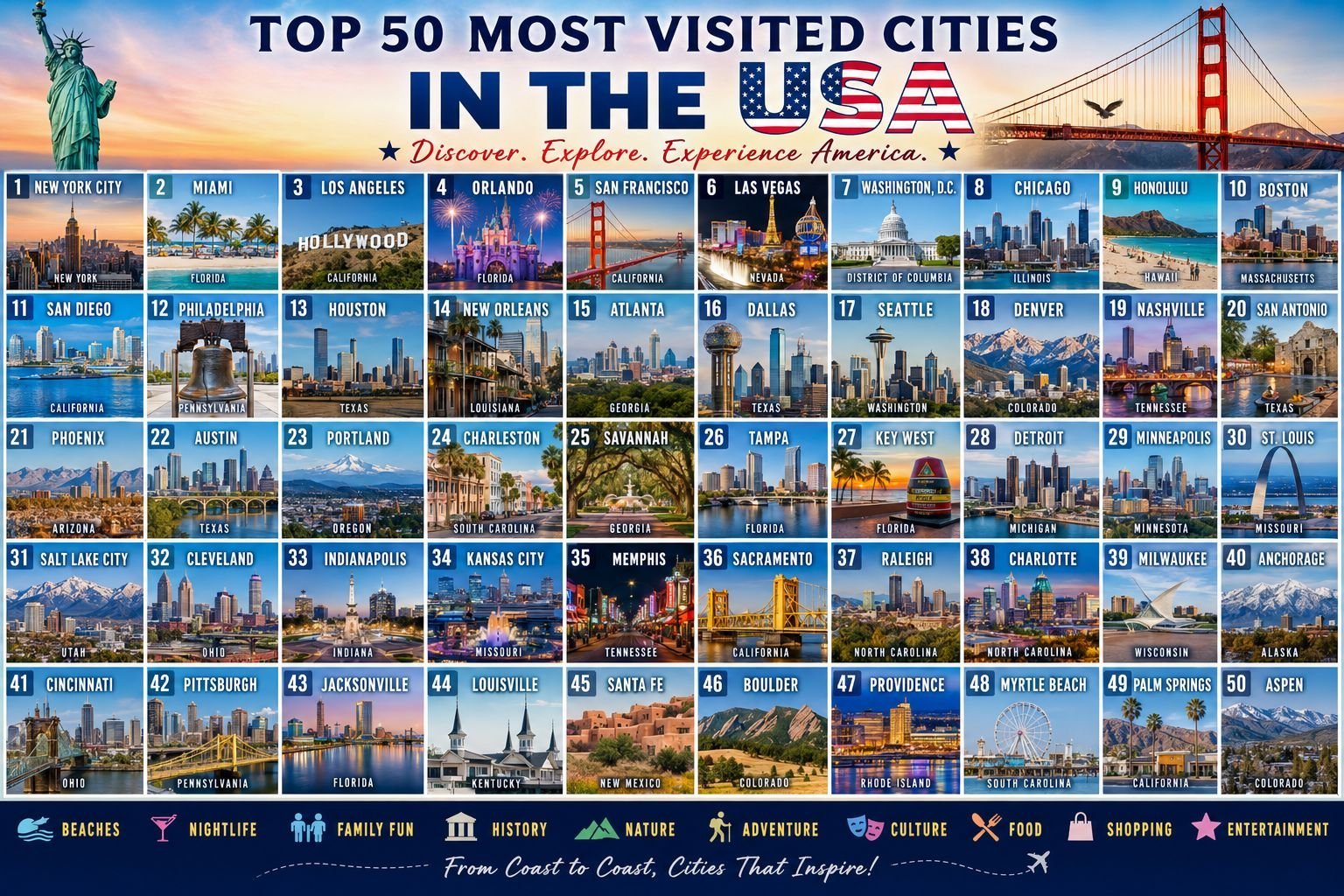
  • Honolulu, Hawaii: Where Nature Nurtures and Island Hospitality Heals

    Honolulu is paradise made real. Situated on the southern shore of Oahu, the third largest of the Hawaiian Islands and the most populous, Honolulu is the capital and largest city of Hawaii and one of the most beautiful, culturally rich, and geographically extraordinary urban destinations in the world. It is a city where the Pacific Ocean laps at the edges of a dense and cosmopolitan metropolis, where volcanic mountains rise dramatically behind downtown skyscrapers, where ancient Hawaiian culture coexists with the most diverse Asian-Pacific demographic mix of any American city, and where the quality of light, the warmth of the air, the color of the water, and the fragrance of tropical flowers combine to create an atmosphere that has been drawing visitors from the mainland United States and from around the world for well over a century.

    Honolulu is frequently reduced in the popular imagination to Waikiki, the famous beachfront resort strip that occupies a narrow peninsula of reclaimed land between the Pacific and the Ala Wai Canal, and while Waikiki is genuinely beautiful and worthy of its reputation, it represents only a small fraction of what Honolulu offers. The city proper encompasses a sprawling arc of neighborhoods from the working waterfront of Kakaako through the historic streets of downtown and Chinatown, through the residential valleys of Nuuanu and Manoa, out to the university district of Moiliili and the local shopping corridors of Kaimuki and Kapahulu. Beyond the city limits, Oahu’s extraordinary variety of landscapes, beaches, hiking trails, surf breaks, botanical gardens, and historical sites provides a depth of experience that rewards visitors who stay long enough to venture beyond the resort corridor.

    Hawaii occupies a unique position in American life, the only state entirely surrounded by ocean, the only state located in the tropics, the only state with a majority Asian-American population, and the only state that was once an independent kingdom with its own monarchy, its own language, its own spiritual traditions, and its own sophisticated culture that predated Western contact by over a thousand years. That history, and the complex and sometimes painful story of how Hawaii became part of the United States, is present throughout Honolulu in its museums, its cultural institutions, its street names and place names, its political life, and the faces and lives of its people. Engaging with that history honestly and respectfully is part of what it means to truly visit Honolulu rather than merely to pass through it on the way to the beach.

    The beach, of course, is extraordinary. Waikiki’s famous crescent of soft white sand, the legendary surf breaks of the North Shore accessible on day trips from the city, the dramatic black sand beaches of the eastern coast, and the green and gold sand beaches tucked into hidden coves around the island all represent a range and quality of ocean experience that is genuinely world-class. The warm, clear, tropical Pacific waters offer some of the finest swimming, snorkeling, surfing, diving, and ocean recreation available anywhere in the world. The weather, with its near-perfect year-round temperatures moderated by the trade winds that blow reliably across the island, makes outdoor activity comfortable and pleasurable in every season.
    Honolulu is also a city of genuine urban sophistication, with outstanding restaurants, a vibrant arts and cultural scene, excellent shopping from luxury boutiques to local farmers markets, and a nightlife that ranges from beachside tiki bars to serious live music venues.

    It is a city that takes food seriously, as befits a place sitting at the intersection of Native Hawaiian, Japanese, Chinese, Korean, Filipino, Portuguese, and American culinary traditions, producing a local cuisine of extraordinary depth and distinctiveness. It is a city of music, where the steel guitar and the ukulele are not tourist props but living instruments embedded in a musical culture of genuine beauty. And it is a city of extraordinary natural beauty, where the mountains and the ocean and the light and the flowers create a setting so consistently lovely that visitors find themselves stopping mid-sentence to simply look around and absorb it.
    Come to Honolulu for the beach. Stay for everything else.

    Getting There
    Honolulu Daniel K. Inouye International Airport, named for the late and beloved Hawaii senator who served for nearly five decades as one of the most respected figures in the United States Congress, is the primary gateway to Hawaii and one of the major aviation hubs of the Pacific. It is located approximately four miles west of downtown Honolulu and about nine miles from Waikiki, and it handles an enormous volume of traffic from the mainland United States, Japan, Korea, Australia, Canada, and other Pacific destinations.

    From the US mainland, direct flights to Honolulu are available from a large number of cities, with particularly strong service from Los Angeles, San Francisco, Seattle, Phoenix, Denver, Dallas, and other western hubs. The flight from Los Angeles is approximately five and a half hours. From the East Coast, direct flights from New York, Boston, Chicago, and other major cities are available, typically running nine to eleven hours. Hawaiian Airlines, the state’s flagship carrier, operates an extensive network of mainland routes alongside its interisland service and transpacific connections. United, American, Delta, Southwest, Alaska, and several international carriers also serve Honolulu.

    Japanese visitors constitute one of the largest international visitor groups to Hawaii, and Japan Airlines, All Nippon Airways, and other carriers operate frequent direct flights from Tokyo, Osaka, Nagoya, and other Japanese cities. Korean Air and Asiana Airlines serve Honolulu from Seoul. Qantas and Jetstar connect from Sydney and other Australian cities. Air Canada operates seasonal service from the Canadian mainland.

    Ground transportation from the airport to Waikiki and central Honolulu is available by taxi, rideshare, and the TheBus public transit system. Taxis and rideshares are the most convenient option for most visitors with luggage. TheBus Route 20 connects the airport to Waikiki and downtown at a fraction of the cost, though it requires patience with luggage. Rental cars are available at the airport and are the most practical option for visitors planning to explore Oahu beyond the Waikiki and downtown corridor. Traffic on the H-1 freeway between the airport and Waikiki can be significant during morning and evening rush hours.

    There is no commercial ferry service from the mainland United States to Hawaii, though cruise ships from various California ports call at Honolulu as part of Pacific itineraries, and the Norwegian Cruise Line operates interisland cruises within Hawaii that include Honolulu as a port of call.

    Getting Around
    Oahu and Honolulu are most efficiently explored by rental car, particularly for visitors who plan to visit beaches and attractions beyond walking distance of Waikiki. The island’s road network is well-maintained and signage is generally clear, though traffic on major highways can be heavy, particularly on the H-1 between Pearl City and downtown during commuting hours and on the Pali Highway and Likelike Highway during peak periods. Parking is available at most major attractions and beaches, though it can be limited and costly at popular destinations on weekends.

    TheBus, operated by the City and County of Honolulu, is one of the best public bus systems in the United States and connects virtually every neighborhood, beach, and major attraction on Oahu. A single-ride fare covers unlimited transfers within two and a half hours, and monthly passes are available. The bus system is used extensively by local residents as well as visitors and provides a genuine window into the daily life of the island beyond the resort bubble. The number 8 bus runs along Kuhio Avenue through Waikiki and is one of the most useful routes for visitors.

    The Skyline rail system, a new elevated rail line currently in operation and continuing to expand, connects East Kapolei in the west to Aloha Stadium and will eventually extend to downtown Honolulu and the University of Hawaii. As it completes its extension, it will provide a useful transit option for visitors in certain corridors.

    Within Waikiki itself, walking is the most practical mode of transportation for most purposes. The area is compact and pedestrian-friendly, with the beach, the main shopping streets, and most hotels and restaurants within comfortable walking distance of one another. The Waikiki Trolley operates narrated loop services connecting Waikiki to various shopping, dining, and cultural destinations around the Honolulu area and is a pleasant and convenient option for visitors who prefer guided transportation.

    Cycling has become increasingly viable in Honolulu, with bike lanes on several major streets and a Biki bike share system operating with stations throughout Waikiki, downtown, and surrounding neighborhoods. The waterfront promenade along Ala Moana Beach Park and the path around Diamond Head offer excellent cycling in a beautiful setting.

    Waikiki
    Waikiki is the beating heart of Honolulu tourism and one of the most famous resort destinations in the world, a narrow strip of hotels, restaurants, shops, and beach that somehow manages to accommodate millions of visitors annually while retaining a genuine beauty and vitality that makes it much more than merely a tourist trap. The famous crescent of white sand beach, about a mile and a half long, runs along the southern edge of the peninsula with Diamond Head volcano rising magnificently in the background, framing every view toward the east with one of the most iconic vistas in the Pacific.

    The beach itself is the great democratic pleasure of Waikiki, public and free and accessible to everyone regardless of where they are staying or how much money they are spending. The water is warm, calm near the shore, and extraordinarily clear and beautiful in the particular deep aquamarine color of tropical Pacific water. Outrigger canoes, operated by several beach concession stands, take visitors through the surf in the traditional Hawaiian manner, providing an active and joyful ocean experience. Surfing lessons are available from numerous operators along the beach, and Waikiki’s gentle, consistent waves make it one of the finest places in the world for beginner surfers to learn.

    The Duke Kahanamoku Statue on the beach is one of the most important public monuments in Honolulu, honoring the great Native Hawaiian swimmer, surfer, and Olympic gold medalist who is credited with spreading the sport of surfing to the world in the early twentieth century. Duke, as he is universally known, was born in Honolulu in 1890 and became one of the most beloved figures in Hawaiian history, and the bronze statue depicting him with arms outstretched is perpetually adorned with fresh flower leis placed by admirers.

    Kalakaua Avenue, the main commercial boulevard running parallel to the beach, is lined with luxury hotels, high-end retail boutiques, restaurants of every description, and the constant flow of visitors that gives Waikiki its particular energy. The Royal Hawaiian Hotel, the Pink Palace of the Pacific, opened in 1927 and remains one of the most beloved and distinctive hotels in Hawaii, its Spanish-Moorish pink architecture standing out beautifully against the blue sky and the surrounding towers. The Moana Surfrider, opened in 1901 and the oldest hotel in Waikiki, retains its Victorian elegance and its famous banyan tree courtyard where live Hawaiian music is performed most evenings.

    The International Market Place, the historic outdoor market that occupied a beloved spot in the heart of Waikiki for decades under a great banyan tree, has been replaced by a modern shopping center retaining the name and the banyan tree, now surrounded by upscale retail. The stretch of Kuhio Avenue parallel to Kalakaua one block mauka, meaning toward the mountains, has a slightly more local character with smaller restaurants, convenience stores, and the beach park where local residents gather.

    Kapiolani Park, at the Diamond Head end of Waikiki, is a large and beautiful green space bordering the beach that hosts regular events, the Honolulu Marathon finish line, tennis courts, and the peaceful atmosphere of a park beloved by residents for jogging, picnicking, and weekend relaxation. The Waikiki Shell, an open-air performance venue within the park, hosts concerts with Diamond Head as its backdrop.

    Diamond Head
    Diamond Head, the ancient volcanic tuff crater rising 760 feet above sea level at the eastern edge of Waikiki, is the most iconic natural landmark in Honolulu and one of the most recognized geographical features in the Pacific. Known to Hawaiians as Leahi, meaning brow of the tuna, the crater was formed in a single volcanic eruption approximately 300,000 years ago and has been the defining visual element of the Waikiki skyline ever since. The name Diamond Head was given by British sailors in the nineteenth century who mistook calcite crystals on its slopes for diamonds.

    The Diamond Head State Monument encompasses the crater and its rim and is the site of one of the finest and most rewarding short hikes accessible from any major resort area in the world. The trail from the crater floor to the summit follows a well-maintained path that climbs through a tunnel, up a spiral staircase through a former military lookout, and emerges at a series of bunkers and observation platforms on the rim with panoramic views stretching across Waikiki, the Honolulu skyline, the Pacific Ocean, and the Koolau Mountains behind. The hike is approximately one and a half miles round trip with about 560 feet of elevation gain, manageable for most reasonably fit visitors in an hour to an hour and a half. The summit views at sunrise are particularly magnificent, and early morning visits offer the additional benefits of cooler temperatures and fewer crowds. Advance reservations are required and parking is limited.

    Downtown Honolulu and Chinatown
    Downtown Honolulu, a short drive or bus ride west of Waikiki along Ala Moana Boulevard, is the historic and governmental heart of the city and contains some of the most significant and evocative sites in all of Hawaii. The neighborhoods of downtown and adjacent Chinatown reward deep exploration and provide an experience of Honolulu that is entirely different from the resort atmosphere of Waikiki.

    Iolani Palace, completed in 1882 during the reign of King Kalakaua, is the only royal palace on American soil and one of the most historically poignant sites in Hawaii. It served as the official residence of the Hawaiian monarchy until the illegal overthrow of Queen Liliuokalani in 1893 by a group of American businessmen and sugar planters backed by US Marines, an event that led directly to the annexation of Hawaii by the United States in 1898. The palace was subsequently used as the territorial and then state capitol for many decades before being restored and opened as a museum. Guided and audio tours of the palace interior reveal the sophisticated and cosmopolitan life of the Hawaiian court, the beautiful throne room, the royal apartments, and the basement prison where Queen Liliuokalani was held under house arrest following a failed counter-revolution in 1895. Visiting Iolani Palace is one of the most moving and important historical experiences available in Honolulu.

    The Hawaii State Capitol, immediately behind the palace, is an extraordinary work of architecture completed in 1969 and designed to evoke the natural world of Hawaii. Its columns represent palm trees, its legislative chambers are shaped like volcanic craters open to the sky, and it is surrounded by reflecting pools representing the ocean. The design is distinctive and controversial in equal measure but genuinely fascinating as an architectural statement about place and identity.
    Kawaiahao Church, completed in 1842 from 14,000 coral slabs cut from offshore reefs, is the oldest Christian church in Hawaii and the historic church of the Hawaiian royal family. Its architecture combines New England Congregationalist traditions with the physical materials of Hawaii in a way that speaks eloquently to the complex cultural encounters of the nineteenth century. Services are still held in both English and Hawaiian.

    The Hawaii State Art Museum occupies the magnificent No. 1 Capitol District Building, a Spanish Mission-style structure from 1928, and presents an excellent collection of art by Hawaii artists spanning traditional and contemporary forms. Admission is free.

    Chinatown, immediately west of downtown along Hotel Street and Nuuanu Avenue, is one of the oldest Chinatown districts in the United States and one of the most vibrant and interesting urban neighborhoods in Honolulu. The neighborhood has been successively home to Chinese, Japanese, Korean, Filipino, Vietnamese, and other Asian immigrant communities, and its current character reflects that layered history in its mix of traditional herb shops, lei sellers, food markets, noodle restaurants, art galleries, bars, and nightclubs.

    The Chinatown Cultural Plaza and the Oahu Market are excellent destinations for exploring the neighborhood’s commercial life. The lei stands along Maunakea Street, operated by Filipino families who have maintained this tradition for generations, sell freshly made flower leis of extraordinary beauty and fragrance at prices that reflect genuine craft rather than tourist markup. Purchasing a lei here and wearing it through the neighborhood is one of the most sensory and authentic of all Honolulu experiences.

    The Honolulu Museum of Art, located at the edge of Chinatown on Beretania Street, is one of the finest art museums in the Pacific, with a collection of over 50,000 works spanning Asian, European, American, African, and Pacific art across a beautifully designed complex of galleries surrounding garden courtyards. The Asian art collection is particularly outstanding, reflecting the cultural demographics of Hawaii and the museum’s position as a bridge between East and West. The Doris Duke Theatre within the museum is an important venue for independent and international cinema.

    The Nuuanu Pali Lookout, accessible by car via the Pali Highway climbing through the Koolau Mountains behind downtown, is one of the most spectacular viewpoints in Hawaii, with panoramic views of the windward coast, the green valleys below, and the dramatic vertical cliffs of the Koolau Range. The winds at the lookout can be ferocious, funneling through the pass with remarkable force. The site was the location of the Battle of Nuuanu in 1795, when King Kamehameha I drove the warriors of Oahu over the precipice in the battle that unified the Hawaiian Islands under his rule.

    Pearl Harbor
    Pearl Harbor, located about ten miles west of downtown Honolulu, is one of the most significant historical sites in the United States and a place of profound meaning for American, Japanese, and Hawaiian history. The Japanese attack on the US Naval Base at Pearl Harbor on the morning of December 7, 1941, which drew the United States into World War Two, killed 2,403 Americans, wounded nearly 1,200 more, and destroyed or damaged 19 naval vessels and 328 aircraft in two hours of devastating aerial assault. The sites commemorating that attack, and the broader story of the Pacific War, are among the most visited and most moving historical destinations in the country.

    The USS Arizona Memorial, administered by the National Park Service, is the most sacred of the Pearl Harbor sites, a white marble structure spanning the sunken hull of the battleship USS Arizona, which sank in less than nine minutes after a bomb ignited its forward ammunition magazine, killing 1,177 of its crew. The ship remains on the harbor floor, and oil still seeps slowly from its fuel tanks, the so-called black tears of the Arizona visible on the water’s surface decades after the attack. A boat shuttle operated by the National Park Service takes visitors from the Pearl Harbor Visitor Center to the memorial, where the ship’s bell, the names of the dead inscribed on a marble wall, and the view through the openings in the memorial floor down to the sunken hull below create an experience of immense solemnity and emotion. Tickets for the boat shuttle require advance reservation and are frequently fully booked weeks ahead during peak season.

    The Battleship Missouri Memorial is anchored nearby, and the juxtaposition of the Arizona, where America entered the war, and the Missouri, on whose deck the Japanese surrender was signed on September 2, 1945, ending the war, gives the Pearl Harbor site a historical completeness that is extraordinary. Tours of the Missouri’s decks, bridge, and interior spaces are excellent, and standing on the spot where the surrender document was signed is one of the most historically charged moments available to visitors anywhere in the Pacific.
    The Pacific Aviation Museum on Ford Island presents an outstanding collection of aircraft from the Pacific War theater, with several original aircraft from the December 7 attack displayed in authentic hangars that still bear the bullet holes of that morning. The museum’s exhibits on the broader Pacific air war, from Midway to the atomic bomb missions, are thoughtful and comprehensive.

    The USS Bowfin Submarine Museum and Park, adjacent to the visitor center, allows visitors to board and explore the interior of a World War Two submarine that sank 44 enemy vessels during the war, earning it the nickname Pearl Harbor Avenger. The claustrophobic reality of life aboard a submarine at war is vividly conveyed by the experience of squeezing through its hatches and compartments.
    Visiting Pearl Harbor requires careful planning. Demand for the Arizona Memorial boat shuttle far exceeds availability, and advance online reservation is strongly recommended. The Pearl Harbor Historic Sites complex encompasses all four attractions described above, and a full visit to all of them realistically requires a full day.

    The Bishop Museum
    The Bernice Pauahi Bishop Museum in the Kalihi neighborhood is the most important museum in Hawaii and one of the greatest natural history and cultural museums in the Pacific world. Founded in 1889 by the estate of Princess Bernice Pauahi Bishop, the last descendant of King Kamehameha I, the museum holds the largest collection of natural history and cultural artifacts from Hawaii and the Pacific in the world, encompassing over 25 million specimens and objects spanning geology, biology, anthropology, and Hawaiian cultural heritage.

    The Hawaiian Hall, housed in a magnificent Victorian building of basalt and coral from 1889, contains the museum’s core collection of Hawaiian cultural objects, including feather cloaks worn by Hawaiian ali’i, or royalty, carved wooden temple images, navigational instruments, traditional weapons, musical instruments, and thousands of other objects that provide the most comprehensive available window into traditional Hawaiian culture and material life. The collection of royal feather cloaks, made from hundreds of thousands of tiny bird feathers in brilliant yellow and red, is one of the most extraordinary museum collections in the world.

    The Science Adventure Center presents interactive natural history and science programming. The Planetarium presents shows on Hawaiian navigation and the night sky. The museum’s hula performances, cultural demonstrations, and educational programming make it a living institution rather than merely a repository of objects. Visiting the Bishop Museum is one of the most important and rewarding cultural experiences available in Honolulu and provides essential context for understanding everything else the city and island offer.

    Beaches Beyond Waikiki
    Oahu’s coastline encompasses beaches of extraordinary variety, from the calm turquoise waters of protected bays on the south and west shores to the powerful winter swells of the legendary North Shore, from the black volcanic rock of the eastern coast to the broad white sand expanses of the Windward Shore. Most of the finest beaches on the island are within an hour’s drive of Waikiki.

    Hanauma Bay Nature Preserve, about ten miles east of Waikiki on the southern coast, is one of the finest snorkeling destinations in Hawaii and one of the most protected and carefully managed marine environments on the island. The bay occupies an ancient volcanic crater whose southern wall collapsed into the sea, creating a sheltered, shallow lagoon of extraordinary clarity and marine abundance. The coral reef within the bay supports a remarkable diversity of tropical fish, sea turtles, and other marine life that are remarkably comfortable with human presence after decades of careful management. Access requires advance online reservation for a timed entry permit, and visitors must view an educational video about reef protection before entering the water. The efforts are well worth it, as the snorkeling experience at Hanauma Bay is among the finest accessible to non-divers anywhere in Hawaii.

    Lanikai Beach on the Windward Shore, accessible from the town of Kailua about thirty minutes over the Pali Highway from Honolulu, is consistently rated among the most beautiful beaches in the world, a narrow strip of powdery white sand fringed with coconut palms and fronting the extraordinarily calm, clear, and impossibly turquoise water of a protected bay. The view across the water to the twin Mokulua Islands offshore is one of the most photographed in Hawaii. Parking is limited and requires using street parking in the residential neighborhood behind the beach, but the beauty of the destination rewards the effort completely.

    Kailua Beach Park, adjacent to Lanikai, is a longer and somewhat more accessible stretch of equally beautiful sand and water and is popular with windsurfers, kitesurfers, kayakers, and paddleboarders taking advantage of the reliable trade winds. The town of Kailua itself has excellent independent restaurants, coffee shops, and boutiques and is one of the most pleasant day trip destinations from Honolulu.

    Waimea Bay on the North Shore, about an hour’s drive from Honolulu, is one of the most famous surf breaks in the world, the site of the legendary Eddie Aikau Big Wave Invitational surf contest that takes place only when wave heights reach thirty feet or more, an event that occurs only a handful of times per decade. In summer, when the north swells subside, Waimea Bay becomes a calm and beautiful swimming beach with crystalline water and a large rock from which the brave and the foolish leap into the bay below. In winter, the transformation of the same beach into one of the most powerful and dramatic surf environments on Earth is one of the great spectacles of the natural world and can be observed safely from the beach.

    The Seven Mile Miracle, the stretch of North Shore coastline between Haleiwa and Sunset Beach encompassing Waimea Bay, the Banzai Pipeline, Sunset Beach, and dozens of other legendary surf breaks, is the spiritual home of professional surfing and the site of the Vans Triple Crown of Surfing competition held each November and December. The Pipeline, where waves pitch over an extremely shallow reef to create perfectly barreling hollow waves of enormous power and beauty, is the most photogenic and most dangerous surf break on the North Shore. During contest season and large swells, the beaches are packed with spectators watching among the world’s best surfers ride waves that most people would only watch from shore.

    Makua Beach on the Waianae Coast and Yokohama Bay at the western tip of the island offer relatively uncrowded and wild beaches in a dramatic setting where the Waianae Mountains meet the sea. The communities of the Waianae Coast are among the most Native Hawaiian in character on Oahu and deserve respectful and humble engagement from visitors.

    Hiking and Outdoor Activities
    Oahu’s interior mountain ranges, the ancient Koolau and Waianae mountains carved by millions of years of volcanic activity and erosion, provide some of the finest hiking accessible from a major resort destination anywhere in the world. The trails range from easy walks through botanical gardens to strenuous ridge hikes requiring significant fitness and a head for heights.
    The Manoa Falls Trail, about four miles from Waikiki in the cool, green Manoa Valley, is one of the most accessible and rewarding short hikes on the island, a gentle forty-five-minute walk through lush tropical forest to a beautiful waterfall dropping 150 feet into a moss-covered amphitheater. The Lyon Arboretum at the head of Manoa Valley, operated by the University of Hawaii, is a magnificent botanical garden of five acres encompassing thousands of tropical plant species in a gorgeously lush setting.

    The Koko Head Crater Trail is a strenuous workout disguised as a hike, climbing the steep outer flank of an ancient volcanic crater via 1,048 railroad ties set into the slope by the military during World War Two. The climb typically takes thirty to forty-five minutes of sustained effort and rewards with panoramic views of the southeastern coast, Diamond Head, and the Koolau Range. It is a beloved early morning exercise destination for local residents and a memorable experience for visiting hikers who enjoy a genuine physical challenge.
    The Makapu’u Lighthouse Trail on the eastern tip of the island is an easy paved path winding up the cliff face to a historic lighthouse with panoramic views of the windward coast, the offshore islands of Rabbit Island and Flat Island, and the Pacific stretching to the horizon. From January through May, the offshore waters are a prime humpback whale watching area, and the elevated viewpoint makes whale spotting particularly productive.

    The Pillbox Hike above Lanikai Beach follows a red dirt trail up a steep ridge to a series of World War Two military observation pillboxes with one of the finest panoramic views on Oahu, encompassing Lanikai Beach, the Mokulua Islands, the windward coast, and the Koolau Mountains. The hike is steep but short, taking about thirty minutes each way, and it is particularly popular at sunrise.

    The Aiea Loop Trail in Keaiwa Heiau State Recreation Area winds through a forest of eucalyptus, Norfolk Island pine, and native Hawaiian plants on a ridge above Pearl Harbor, with excellent views of the harbor, the Ewa Plain, and the mountains. The trailhead is an easy drive from downtown Honolulu.
    Ocean activities available from Honolulu and around the island include world-class surfing and surf lessons, stand-up paddleboarding, outrigger canoe paddling, snorkeling, scuba diving, deep sea sport fishing, whale watching cruises from January through March, sunset sailing and catamaran cruises along the Waikiki coast, and kayaking to the Mokulua Islands off Lanikai Beach.

    Food and Dining
    Honolulu’s food culture is one of the most distinctive and rewarding in the United States, a reflection of the extraordinary diversity of the islands’ population and the unique culinary traditions that have evolved over generations of cultural exchange between Native Hawaiian, Japanese, Chinese, Korean, Filipino, Portuguese, Puerto Rican, and American food ways.
    The plate lunch is the quintessential local meal, a generous tray of rice, macaroni salad, and a protein, which might be kalua pork, teriyaki chicken, lau lau, chicken katsu, or any number of other options. It is the food of working people, filling and flavorful and deeply embedded in the daily food culture of the islands. Rainbow Drive-In in Kapahulu, operating since 1961, is the most beloved plate lunch institution in Honolulu and a genuinely important cultural landmark.

    Shave ice is Hawaii’s most beloved sweet treat and is entirely distinct from the snow cones sold elsewhere in the United States. Properly made Hawaiian shave ice is made by pressing a block of ice against a rotating blade to produce an extraordinarily fine, soft, almost powdery shave that absorbs the colorful flavored syrups poured over it rather than merely coating them. Matsumoto Shave Ice in Haleiwa on the North Shore is the most famous purveyor, a pilgrimage site that draws lines of devoted customers, but excellent shave ice is available throughout Honolulu. Adding a scoop of ice cream underneath and azuki beans on top elevates the experience further.

    Spam musubi is another beloved local food, a block of seasoned rice topped with a slice of fried Spam and wrapped in nori seaweed in the manner of Japanese onigiri. Hawaii’s cultural embrace of Spam, a canned meat introduced to the islands during World War Two when fresh meat was scarce, has become a point of cultural pride, and the product appears on menus from convenience stores to hotel restaurants throughout the islands. Spam musubi, purchased from a convenience store, is the perfect walking-around snack.
    Poke, the Hawaiian preparation of cubed raw fish seasoned with soy sauce, sesame oil, limu seaweed, and Hawaiian sea salt, is perhaps the most globally influential Hawaiian culinary export of recent decades, though the poke available in Honolulu bears relatively little resemblance to the oversauced, trend-driven versions proliferating in mainland cities. Ono Seafood in Kapahulu and Tamura’s Fine Wine and Liquors in multiple locations are among the most beloved traditional poke destinations in Honolulu.

    Loco moco, another Hawaiian original, is a bowl of rice topped with a hamburger patty, a fried egg, and generous ladles of brown gravy, a combination that sounds unlikely and tastes magnificent, particularly after a morning of surfing or hiking. Cafe 100 in Hilo on the Big Island claims to have invented it, but it is ubiquitous throughout Oahu.
    Traditional Hawaiian food, rooted in the pre-contact indigenous cuisine, centers on kalua pork roasted in an underground imu oven, poi made from steamed and pounded taro root, lomi lomi salmon, haupia coconut pudding, and lau lau of pork or fish wrapped and steamed in taro leaves. The best opportunity to experience traditional Hawaiian food in its proper cultural context is at a luau, and Honolulu and Oahu offer several luau experiences ranging from intimate and culturally authentic to large and tourist-oriented spectacles.

    The restaurant scene in Honolulu has matured dramatically and now encompasses genuine culinary ambition alongside its extraordinary local food traditions. MW Restaurant by husband and wife chefs Wade Ueoka and Michelle Karr-Ueoka is one of the most celebrated fine dining destinations in Honolulu, presenting a menu of contemporary Hawaii Regional Cuisine that draws on the island’s multicultural food heritage with exceptional skill and creativity. Senia in Chinatown is another outstanding destination for creative contemporary cuisine. Vintage Cave Club is an extraordinary ultra-fine dining experience in a dramatic underground setting. The sheer density of outstanding Japanese restaurants, reflecting the enormous Japanese-American population of the islands, is remarkable, with excellent sushi, ramen, izakaya, and Japanese comfort food available throughout the city.

    The Ala Moana Center food court and the nearby Ward Village area have excellent food hall and restaurant options. The KCC Farmers Market at Kapiolani Community College on Saturday mornings is one of the finest farmers markets in Hawaii, with local vendors selling freshly made food, tropical produce, local honey, coffee, macadamia nuts, and handmade goods in the shadow of Diamond Head.

    Arts, Culture, and Entertainment
    Honolulu has a vibrant and sophisticated arts and cultural scene that is frequently underestimated by visitors focused on the beach and the major tourist attractions.
    The Hawaii Theatre Center in Chinatown is a magnificently restored 1922 vaudeville palace, now presenting a full calendar of live music, dance, comedy, film, and theater productions in one of the finest historic theater interiors in the Pacific. The Blaisdell Center, a large convention and performance complex in the Moiliili neighborhood, houses the Neal S. Blaisdell Concert Hall and Arena, which host the Hawaii Symphony Orchestra, touring Broadway productions, major concert acts, and sporting events.

    The Honolulu Museum of Art, as described above, is the premier visual arts institution in the city. The Contemporary Museum in Makiki Heights, housed in a 1925 estate with spectacular gardens and panoramic city views, is an excellent venue for contemporary art in an unusually beautiful setting. The First Fridays Honolulu monthly event in the Chinatown arts district draws thousands of residents and visitors to gallery openings, street performances, food trucks, and the general festive atmosphere of the neighborhood’s creative community.

    Hawaiian music is a living and evolving tradition of genuine beauty, combining the mele or traditional chant of ancient Hawaii with the steel guitar, ukulele, and vocal harmonies that developed through the nineteenth and early twentieth centuries in contact with Portuguese, Mexican, and American musical traditions. The slack-key guitar, or ki hoalu, a style of fingerpicking guitar developed in Hawaii in which the strings are tuned to open chord positions, is one of the most distinctive and beautiful guitar traditions in the world. The Masters of Hawaiian Music Concert Series, the Hawaii International Film Festival, and the Hawaiian falsetto contest at the Merrie Monarch Festival are among the most significant cultural events celebrating Hawaiian musical heritage.

    Hula is the living embodiment of Hawaiian cultural knowledge, a form of movement and chant that encodes in its gestures and lyrics the history, mythology, genealogy, and natural world of Hawaii. The Merrie Monarch Festival, held each year in Hilo on the Big Island in the week following Easter, is the most prestigious hula competition in the world, but hula performances are available throughout Honolulu at luaus, cultural centers, and venues including the Bishop Museum and the Royal Hawaiian Center.

    The Polynesian Cultural Center in Laie on the windward coast, about an hour from Honolulu, is the largest tourist attraction in Hawaii and presents the cultures of Polynesia, including Hawaii, Samoa, Tonga, Fiji, Aotearoa New Zealand, and Tahiti, through village environments, craft demonstrations, cultural performances, and an evening luau and show. It is operated by the Church of Jesus Christ of Latter-day Saints and staffed largely by students from the adjacent Brigham Young University Hawaii, and while its commercial tourism orientation is evident, the quality of the cultural programming and performance is genuinely excellent.

    Shopping
    Shopping in Honolulu ranges from the extraordinary concentration of luxury retail at the Ala Moana Center to the local farmers markets, artisan shops, and cultural vendors that offer the most authentic and meaningful souvenirs of the islands.

    The Ala Moana Center, the largest open-air shopping mall in the world with over 350 stores on four levels, sits between Waikiki and downtown Honolulu and anchors the retail life of the city. Its tenant mix includes department stores, luxury boutiques from Chanel, Louis Vuitton, Tiffany, and Burberry, and a comprehensive range of mainstream and specialty retail. The Ala Moana Center is the shopping destination of choice for both residents and visitors and is essentially unavoidable for anyone spending more than a day or two in Honolulu.
    The Royal Hawaiian Center on Kalakaua Avenue in Waikiki is a dedicated shopping complex with an emphasis on luxury brands and a significant cultural programming component, including free hula lessons and cultural demonstrations. The DFS Galleria Waikiki, operated by the duty-free shopping giant, is particularly popular with international visitors eligible for tax-free purchases.

    For more local and authentic shopping experiences, the Honolulu Museum of Art Shop carries an excellent selection of art books, prints, and locally made gifts. Na Mea Hawaii in Ward Village is the finest Hawaiian cultural and arts gift shop in the city, specializing in authentic Hawaiian-made products, traditional crafts, books about Hawaii, and locally produced music. The Chinatown neighborhood offers lei stands, herb shops, local food products, and artisan goods that reflect the community’s cultural character rather than the tourist retail of the resort area.
    Macadamia nuts, Kona coffee, Hawaiian sea salt, locally made chocolate from Oahu and other islands, and handmade Hawaiian quilts are among the most meaningful and authentically local souvenirs available.

    Luaus
    The luau is one of the most enduring and beloved traditions of Hawaiian hospitality, a feast combining traditional food, music, dance, and storytelling that has roots in the pre-contact Hawaiian feast tradition known as aha aina. Contemporary luaus range from small, intimate cultural experiences to large commercial productions serving hundreds of guests, and the quality and cultural authenticity of the experience varies considerably between operators.

    The Paradise Cove Luau on the Ko Olina coast and the Polynesian Cultural Center’s Ali’i Luau are among the largest and most elaborate commercial luau experiences on Oahu, featuring full buffet dinners of traditional and local Hawaiian food, open bars, craft demonstrations, and extended evening entertainment programs featuring hula, Samoan fire knife dancing, and Hawaiian music. The Chief’s Luau at Sea Life Park on the windward coast offers a more intimate experience in a beautiful setting. The Royal Hawaiian Hotel luau in Waikiki, held in the hotel’s ocean-front Mai Tai Bar, combines the beautiful setting of the Pink Palace’s beachfront with a curated luau experience.

    For visitors seeking the most authentic and culturally grounded luau experience, smaller operations and those recommended by knowledgeable local sources are generally preferable to the largest commercial productions, though the latter are professionally executed and provide a pleasant introduction to Hawaiian food and performance traditions.

    Day Trips and Neighboring Islands
    Oahu is the most convenient base for exploring the other Hawaiian Islands, with excellent interisland air service connecting Honolulu to Maui, the Big Island of Hawaii, Kauai, Molokai, and Lanai multiple times daily.
    Maui, about thirty minutes by air
    , is the second most visited Hawaiian Island and offers extraordinary natural diversity including the massive Haleakala volcano, the Road to Hana coastal drive, world-class whale watching in the Auau Channel from January through March, and the beautiful beaches of the Kaanapali and Wailea coasts.
    The Big Island of Hawaii, also about thirty minutes by air from Honolulu, is the largest island by land area and one of the most geologically active places on Earth, with Kilauea volcano in Hawaii Volcanoes National Park producing the only place in the world where visitors can regularly observe active lava flows. The island’s extraordinary diversity of climate zones, from tropical rainforest to alpine desert, and its magnificent Mauna Kea summit with world-class astronomical observatories make it one of the most scientifically remarkable places accessible to ordinary visitors.

    Kauai, known as the Garden Isle, is the oldest and most geologically eroded of the main Hawaiian Islands, its ancient volcanic surfaces having been carved by rain and rivers into the dramatic cliffs and valleys of the Na Pali Coast and the extraordinary Waimea Canyon, often called the Grand Canyon of the Pacific. It is the most rural and least developed of the main islands and the most purely natural in its appeal.

    Practical Information
    Climate: Honolulu’s climate is one of the most consistently pleasant in the world. Temperatures vary relatively little throughout the year, averaging in the high seventies to low eighties Fahrenheit year-round, moderated by the reliable northeast trade winds that blow across the island for much of the year and keep humidity at comfortable levels. The summer months from May through September tend to be warmer and drier, while the winter months from October through April are marginally cooler and wetter, with occasional heavy rainfall particularly on the windward side of the island and in the mountain valleys. The south-facing beaches of Waikiki are generally sunny and pleasant throughout the year.

    Hurricane season in the central Pacific runs from June through November, and while direct hurricane hits on Hawaii are relatively rare, tropical storms and their associated rainfall can affect the islands during this period.
    Water Safety: The ocean around Oahu is beautiful but deserves respect and should not be underestimated. Ocean currents, shore break, and waves can be powerful even at beaches that appear calm, and the surf conditions can change rapidly. Warning flags at beaches should always be observed, and swimming at unguarded beaches requires caution and awareness. The North Shore during winter swells is an extremely dangerous swimming environment for all but expert ocean swimmers. Rip currents are present at many beaches and knowing how to respond to one, by swimming parallel to shore rather than against it, is important knowledge for all ocean swimmers.

    Cultural Respect: Hawaii has a living indigenous culture that deserves respect and genuine engagement rather than superficial appropriation. The aloha spirit that characterizes Hawaiian hospitality is genuine and beautiful, but it exists alongside a history of cultural suppression, land dispossession, and political subjugation that remains deeply relevant to the lives of Native Hawaiian people today. Engaging with Hawaiian culture respectfully means learning something of its history, supporting Native Hawaiian cultural institutions and businesses, following protocols at sacred sites, and approaching the experience of being a guest in these islands with humility and gratitude.

    Best Time to Visit: Honolulu is an excellent destination year-round, but the winter months from December through March offer the additional attraction of humpback whale watching in Hawaiian waters. Summer brings the largest crowds and highest hotel rates but also the calmest ocean conditions for swimming at most beaches. The shoulder periods of April through May and September through October offer a good balance of pleasant weather, manageable crowds, and somewhat lower costs.

    Costs: Hawaii is one of the more expensive domestic travel destinations for Americans, reflecting the cost of transporting virtually everything the islands consume across thousands of miles of ocean. Hotel rates in Waikiki range from budget to ultra-luxury, and advance booking is advisable for the best rates. Restaurant prices are generally higher than mainland equivalents at comparable quality levels, though the plate lunch and other local food traditions offer excellent value. The state of Hawaii levies a transient accommodations tax in addition to the general excise tax on goods and services, and visitors should factor these into their budgeting.

    Conclusion
    Honolulu is a city that gives generously and asks relatively little in return except the willingness to be present, to look up from the guidebook and the phone and the curated Instagram moment and simply be in one of the most beautiful places on Earth. The ocean is there every morning, the same improbable color it was the morning before and the morning before that, and the mountains are there behind the city, green and steep and ancient, and the flowers are blooming and the trade winds are moving through the palms and the whole magnificent Pacific is laid out before you with a generosity that feels almost personal.

    But Honolulu gives more than beauty. It gives history, complex and important and still unresolved, that demands engagement. It gives food of extraordinary depth and originality, music of genuine loveliness, cultural traditions of a sophistication and elegance that predate Western contact by centuries and continue to evolve and flourish in the present. It gives the particular warmth of a city that has always been a crossroads, a meeting point of cultures and peoples who have learned, imperfectly but genuinely, to live alongside one another in a place that everyone who comes to love it claims as their own.

    The aloha spirit is real. It is not a slogan or a marketing concept. It is the distillation of something true about human possibility in a particular place, the possibility of generosity, of welcome, of genuine care for the stranger and the visitor and the neighbor alike. Honolulu offers it freely, and the best thing a visitor can do is receive it with the gratitude and the grace it deserves.
    Mahalo. Thank you for coming. Come back soon.

  • Oklahoma City: Where The Wind Comes Sweeping Down The Plain

    Oklahoma sits at the geographic and cultural crossroads of America, a state that defies easy categorization and rewards curious travelers with experiences they rarely anticipate. Wedged between the South, the Midwest, and the West, Oklahoma draws from all three traditions, blending cowboy heritage with Native American culture, neon-lit roadside Americana with rugged wilderness, and down-home hospitality with a quietly sophisticated arts scene. It is a state that has been underestimated for generations, and that is precisely what makes it such a compelling destination today.

    Known as the Sooner State, Oklahoma earned its nickname from the settlers who cheated in the great Land Runs of the late 1880s and early 1890s, sneaking into the territory sooner than the rules allowed. That spirit of bold, impatient energy never quite left. Today it shows up in a food scene that refuses to stand still, in museums that punch far above their weight, in festivals that fill the calendar year-round, and in landscapes that shift from dense forests and rolling hills in the east to dramatic mesas and canyon country in the west, with tallgrass prairies and red-dirt farmland in between.

    Whether you are driving the original Route 66 through the heart of the state, paddling the Illinois River, exploring the galleries of Tulsa’s Gilcrease Museum, or watching a thunderstorm roll across the open plains at sunset, Oklahoma has a way of getting under your skin. This guide will walk you through everything you need to know to make the most of your time here.

    GETTING TO OKLAHOMA
    Oklahoma City’s Will Rogers World Airport is the state’s primary gateway, served by major domestic carriers including American, Southwest, Delta, United, and Spirit. Tulsa International Airport provides a strong alternative entry point, particularly for travelers heading to the northeastern part of the state. Both airports have seen significant upgrades in recent years and offer car rental facilities from all major providers.

    By road, Oklahoma is remarkably well connected. Interstate 40 crosses the state east to west along roughly the same corridor as the original Route 66, connecting it to Amarillo to the west and Fort Smith to the east. Interstate 35 runs north to south through Oklahoma City, linking Wichita to Dallas. Interstate 44 cuts diagonally across the state through Tulsa. Amtrak’s Heartland Flyer connects Oklahoma City to Fort Worth, Texas, daily, though rail connections beyond that are limited. Most visitors find that having a car is essential for exploring Oklahoma properly.

    OKLAHOMA CITY
    The capital and largest city of Oklahoma has undergone one of the more remarkable urban transformations of any American city over the past two decades. Stung by the 1995 bombing of the Alfred P. Murrah Federal Building and battered by the broader economic struggles of the oil patch, Oklahoma City made a deliberate and sustained choice to reinvent itself. The results are impressive.

    Downtown Oklahoma City is genuinely lively today, anchored by the Bricktown entertainment district, a former warehouse neighborhood now filled with restaurants, bars, music venues, and the Chickasaw Bricktown Ballpark. The Bricktown Canal winds through the district, and water taxis and paddle boats are available for leisurely rides. A stroll along the canal on a warm evening, with the lights of the ballpark glowing across the water, is one of the more pleasant urban experiences in the region.

    The Oklahoma City National Memorial and Museum is the city’s most emotionally significant attraction and deserves an unhurried visit. The outdoor memorial, with its 168 empty chairs representing each victim of the 1995 bombing, is open around the clock and is especially affecting at night. The adjacent museum tells the full story of that day and its aftermath with exceptional care and depth.

    Bricktown is far from the only neighborhood worth exploring. Midtown, just north of downtown, has become a hub for independent restaurants, coffee shops, and boutiques. The Film Row district along Sheridan Avenue preserves a cluster of handsome early-20th-century buildings and hosts a growing creative community. Deep Deuce, historically the heart of Oklahoma City’s African American community and a center of jazz culture in the early 20th century, has been revitalized with apartments, restaurants, and bars while working to honor its heritage.

    The Oklahoma City Museum of Art houses an impressive collection with particular strengths in American art and one of the world’s finest collections of Dale Chihuly glass. The Museum of Osteology, dedicated entirely to animal skeletons and bone specimens, is unusual and surprisingly fascinating, especially for younger visitors. The Science Museum Oklahoma, housed in a building topped by an actual Cessna airplane, offers hands-on exhibits and an IMAX theater.

    For sports fans, Oklahoma City punches well above its size. The Oklahoma City Thunder NBA franchise has been a consistent playoff contender and plays its home games at Paycom Center downtown. The energy on a game night is electric, and tickets are generally easier to obtain and less expensive than in larger markets. The city also has a rich rodeo tradition; the annual Stockyards City district, with its working cattle auction and old-fashioned steakhouses, gives visitors a vivid taste of the cowboy economy that still quietly underpins much of the state.

    No visit to Oklahoma City is complete without eating at one of the great steakhouses in or around Stockyards City. Cattlemen’s Steakhouse, which has been operating since 1910 and famously changed hands in a card game in 1945, is the most historic. The beef here is serious, the portions generous, and the atmosphere unlike anything you will find in a chain restaurant. Breakfast at Cattlemen’s, featuring a lamb fry that has startled and delighted visitors for generations, is a rite of passage.

    TULSA
    Oklahoma’s second city is, in many respects, its most architecturally distinguished. Tulsa experienced an extraordinary oil boom in the early 20th century, and the wealth generated during that period was poured into buildings of genuine grandeur. The result is the largest concentration of Art Deco architecture in the United States outside of Miami. Walking through downtown Tulsa today, particularly along Fifth Street and Boston Avenue, is like moving through a living museum of the style. The Philtower Building, the Philcade, the Exchange National Bank Building, and above all the Boston Avenue United Methodist Church, with its stunning terracotta ornamentation, are masterpieces of the form. Several organizations offer guided Art Deco walking tours, and they are well worth taking.

    The Gilcrease Museum holds what is widely considered the world’s most comprehensive collection of art and artifacts relating to the American West and Native American cultures. Thomas Gilcrease, himself of Creek Nation descent, assembled this extraordinary collection over decades, and the museum that bears his name does it justice. Paintings by Frederic Remington, Charles Russell, and Albert Bierstadt hang alongside pre-Columbian artifacts, historical documents, and Native American art spanning centuries. The museum sits on a hill overlooking the city, surrounded by beautifully maintained gardens.

    The Philbrook Museum of Art occupies an Italian Renaissance villa built in 1927 as the private home of oil magnate Waite Phillips, who later donated the property to the city. The collection is eclectic and strong, ranging from Renaissance paintings and Native American pottery to contemporary works. The formal gardens surrounding the villa are among the most beautiful in the region and make for a wonderful late-afternoon visit. Philbrook also operates a downtown satellite location in a historic building that shows rotating contemporary exhibitions.

    The Woody Guthrie Center celebrates the life and work of the folk singer and songwriter born in Okemah, Oklahoma, who wrote “This Land Is Your Land” and influenced generations of American musicians. The center holds the world’s largest archive of Guthrie’s work, including original manuscripts, letters, drawings, and recordings, and presents them in a deeply engaging exhibit. Bob Dylan and Pete Seeger are among those who have praised the center as a fitting tribute to one of the great voices in American musical history.

    Tulsa’s Greenwood District carries one of the heaviest and most important histories in the state. Known in the early 20th century as “Black Wall Street” for the extraordinary concentration of Black-owned businesses and professional life that flourished there, Greenwood was destroyed in the Race Massacre of 1921, one of the worst incidents of racial violence in American history. For decades the massacre was barely discussed; today it is the subject of serious scholarly attention, public memorials, and an excellent museum, the Greenwood Cultural Center, that tells the full story. A visit here is sobering and essential.

    The Brady Arts District and the adjacent Blue Dome District have become Tulsa’s creative and nightlife center, filled with galleries, live music venues, breweries, and restaurants. The Cain’s Ballroom, a historic dance hall that has hosted everyone from Bob Wills and the Texas Playboys to the Sex Pistols, remains one of the great live music rooms in America. Its spring-loaded wooden dance floor is legendary.

    ROUTE 66: THE MOTHER ROAD THROUGH OKLAHOMA
    Oklahoma claims more original miles of Historic Route 66 than any other state, and the road remains alive here in a way that goes beyond nostalgia. From the Kansas border near Baxter Springs to the Texas line at Texola, the route covers roughly 400 miles of two-lane highway, small towns, vintage motels, neon signs, and Americana that has been gradually disappearing everywhere else.

    The road enters the state through Commerce, birthplace of Mickey Mantle, and passes through Miami (pronounced my-AM-uh by locals, and woe to the visitor who gets it wrong) before reaching Claremore, the hometown of Will Rogers. The Will Rogers Memorial Museum here is one of the better small museums in the state, devoted to the cowboy philosopher and humorist who was the most popular entertainer in America in the 1920s and 30s. His wit still resonates; his observation that “I never met a man I didn’t like” has outlasted nearly everything else from his era.

    Catoosa is home to the Blue Whale, a smiling whale sculpture built by Hugh Davis as an anniversary present for his wife in the early 1970s. It sits beside a pond and remains one of the most photographed quirky roadside attractions in America. Nearby, the Coleman Theater in Miami is a stunning 1929 vaudeville and movie palace that has been meticulously restored to its original opulence, complete with gilded interiors and a Wurlitzer organ.

    Passing through Tulsa, Route 66 hits Sapulpa and then enters the stretch through Stroud, Chandler, and Arcadia. The Round Barn in Arcadia, built in 1898 and restored by community effort in the 1990s, is a remarkable piece of vernacular architecture. POPS, a restaurant and gas station just north of Arcadia, is a contemporary Route 66 landmark featuring a 66-foot illuminated soda bottle sculpture out front and an inventory of more than 700 varieties of bottled soda inside.

    Oklahoma City sits roughly at the midpoint of the state’s Route 66 stretch, and the historic road winds through several of the city’s older neighborhoods before heading west through Yukon, El Reno, and Clinton. The Oklahoma Route 66 Museum in Clinton provides the most thorough overview of the road’s history and culture in the state. Elk City, farther west, has a well-regarded Route 66 museum complex of its own and a friendly small-town atmosphere that makes for a pleasant overnight stop. The road ends its Oklahoma run at the tiny ghost town of Texola, where a handful of abandoned buildings and a hand-painted sign mark the state line.

    NATURAL ATTRACTIONS AND OUTDOOR RECREATION
    Oklahoma’s landscapes are more varied and more dramatic than most people outside the state realize, and outdoor recreation is among the state’s strongest suits.

    The Ouachita National Forest covers the southeastern corner of Oklahoma and extends into Arkansas, encompassing more than 1.8 million acres of forested mountain terrain. The Talimena National Scenic Byway, running along the ridge crest of the Ouachita Mountains between Talihina, Oklahoma, and Mena, Arkansas, offers some of the finest fall foliage drives in the region, typically peaking in mid-to-late October. Hiking trails range from short nature walks to challenging backcountry routes. Beavers Bend State Park, near Broken Bow, sits in the heart of this forest country and is one of the most popular state parks in Oklahoma, with trout fishing on the Mountain Fork River, canoe and kayak rentals, a nature center, and an excellent lodge.

    The Illinois River in northeastern Oklahoma is one of the most beautiful and heavily used float streams in the south-central United States. Canoe and kayak outfitters operate along the river near Tahlequah, the capital of the Cherokee Nation, offering trips ranging from a few hours to multiple days. The river runs clear and cool, lined with canopies of sycamore and cottonwood, and the float from Peyton’s Place to Tenkiller Lake is among the finest day trips in the state.

    Winding Stair Mountain in the Ouachita National Forest presents some of Oklahoma’s most rugged hiking. The Ouachita National Recreation Trail extends more than 220 miles from Talimena State Park in Oklahoma to Pinnacle Mountain State Park near Little Rock, Arkansas, offering serious backpackers a genuine multi-day wilderness experience.

    The Tallgrass Prairie Preserve near Pawhuska in Osage County is one of the largest protected expanses of tallgrass prairie remaining in the world, covering more than 39,000 acres. The Nature Conservancy manages the preserve, and a herd of roughly 2,500 bison roams free across the rolling hills. Driving or hiking through the preserve and encountering bison at close range is one of the most genuinely wild experiences available anywhere in the region. The nearby town of Pawhuska gained unexpected national fame as the home base of Ree Drummond, the Pioneer Woman, whose Mercantile store and restaurant draws visitors from across the country.

    Black Mesa, in the extreme northwestern corner of the state in the Oklahoma Panhandle, is Oklahoma’s highest point at 4,973 feet. The mesa rises dramatically from the surrounding high plains, and the hike to the summit, while not technically difficult, covers about 8.4 miles round-trip through terrain that feels genuinely remote and otherworldly. The area receives far fewer visitors than it deserves and offers outstanding stargazing.

    The Wichita Mountains Wildlife Refuge near Lawton covers 59,020 acres of granite mountains, mixed-grass prairie, and wetlands in southwestern Oklahoma. The refuge is home to free-roaming bison, longhorn cattle, elk, and white-tailed deer, and offers excellent wildlife viewing and hiking. Mount Scott, accessible by paved road, provides panoramic views of the surrounding plains and makes for a fine sunset stop. The refuge also contains the Holy City of the Wichitas, an outdoor Easter pageant site that has been staging its Passion Play since 1926.

    Oklahoma’s lakes deserve special mention. The state has more miles of shoreline than the Atlantic and Gulf coasts of the United States combined, a remarkable statistic that reflects the enormous number of reservoirs created by Army Corps of Engineers projects throughout the 20th century. Lake Texoma on the Oklahoma-Texas border is one of the largest lakes in the country and a major destination for fishing, particularly for striped bass. Grand Lake o’ the Cherokees in the northeastern corner of the state is ringed with resorts, marinas, and vacation homes and is among the most developed recreational lakes in the region. Lake Tenkiller in the Cherokee Hills is prized for its clear, blue-green water and excellent scuba diving and snorkeling.

    The Red River forms Oklahoma’s southern border with Texas, and the red sandstone bluffs and canyons along its drainage are among the most visually striking landscapes in the state. Red Rock Canyon State Park near Hinton offers excellent rock climbing, rappelling, and hiking, with brilliant red and orange canyon walls that glow in the morning and evening light.

    Alabaster Caverns State Park near Freedom in northwestern Oklahoma contains the largest natural gypsum cave open to the public in the country. Guided tours wind through chambers filled with alabaster, selenite, and other gypsum formations. The surrounding woodlands harbor bat colonies that make for spectacular viewing at dusk during summer months.

    NATIVE AMERICAN CULTURE AND HERITAGE
    Oklahoma has the largest Native American population of any state in the contiguous United States, with 39 federally recognized tribal nations headquartered within its borders. This is not background history; it is living culture, and it shapes Oklahoma’s identity, cuisine, art, governance, and daily life in ways that are visible throughout the state.

    The Cherokee Nation, with its capital at Tahlequah, is the largest tribe in the United States by citizenship. The Cherokee Heritage Center outside Tahlequah offers an excellent introduction to Cherokee history and culture, including a reconstructed ancient village and an 1800s era village, along with galleries showcasing traditional and contemporary Cherokee art. The Cherokee National History Museum nearby tells the full story of the Trail of Tears, the forced removal of the Cherokee people from their southeastern homelands in the 1830s, and the rebuilding of Cherokee society in Indian Territory.

    The Chickasaw Cultural Center near Sulphur is one of the finest tribal cultural centers in the country. Set on 184 acres, it includes an extensive museum, a reconstructed Chickasaw village, a living history program, a theater, and beautifully landscaped grounds. The center presents Chickasaw history and contemporary culture with sophistication and pride, and a visit here will deepen any traveler’s understanding of Oklahoma’s complex history.

    The Five Civilized Tribes Museum in Muskogee is dedicated to the Cherokee, Choctaw, Chickasaw, Creek, and Seminole nations. The building itself, a handsome Victorian-era structure that served as the Union Indian Agency, is worth seeing, and the collection of traditional arts and artifacts is strong.

    Powwows are held throughout Oklahoma on nearly every weekend from spring through fall, and many are open to the public. The Red Earth Festival in Oklahoma City, typically held in June, is one of the largest and most celebrated Native American cultural events in the country, drawing participants and dancers from tribes across North America. The Gathering of Nations in Albuquerque is larger, but Red Earth has a warmth and accessibility that makes it particularly welcoming to first-time visitors.

    The Osage Nation’s relationship with its homeland in northeastern Oklahoma took on new international attention with David Grann’s book “Killers of the Flower Moon” and its subsequent film adaptation. The Osage Tribal Museum in Pawhuska, the oldest continuously operating tribal museum in the country, tells the full story of the Osage people, including the Reign of Terror of the 1920s in which Osage citizens were systematically murdered for their oil headrights. Visiting the museum and the surrounding Osage Hills gives genuine weight and meaning to a story that touched the world.

    OKLAHOMA’S FOOD SCENE
    Oklahoma food culture has always been defined by generosity of portion and unpretentiousness of presentation, but the state’s culinary landscape has grown considerably more sophisticated in recent years, particularly in Oklahoma City and Tulsa.

    The chicken-fried steak is Oklahoma’s most iconic dish, a beef cutlet pounded thin, breaded, and fried, then covered in white cream gravy. Every town in the state has a diner or cafe serving its own version, and debates about whose is best are conducted with genuine passion. The Hammett House in Claremore, the established classic, and Cattlemen’s Steakhouse in Oklahoma City are among the most celebrated, but some of the best are found in tiny cafes with hand-lettered signs and booths that have not been reupholstered since the Carter administration.

    Oklahoma barbecue draws from multiple traditions. The state sits at the confluence of Texas brisket country, Kansas City-style rib culture, and its own distinctive traditions. Iron Star Urban Barbeque in Oklahoma City and Burn Co. in Tulsa represent the contemporary end of the spectrum, while older institutions like Leo’s Barbecue in Oklahoma City carry on traditions stretching back generations. Oklahoma-style onion burgers, developed in El Reno during the Great Depression when cooks stretched their meat by smashing onions into the patties, are a distinct and beloved regional variation. Sid’s Diner in El Reno and Robert’s Grill nearby are the undisputed masters.

    Fry bread, a flatbread descended from the foods Native people were forced to make with commodity rations during the reservation era, appears at powwows and festivals throughout the state, often serving as the base for Indian tacos piled high with meat, beans, cheese, lettuce, and tomato. It is comfort food with complicated history, and eating it while understanding its origins makes the experience more meaningful.

    The Mexican food in Oklahoma benefits from the state’s proximity to Texas and a long tradition of Mexican American communities, particularly in the southwest. Tex-Mex, New Mexico-style green chile cooking, and traditional interior Mexican flavors all find expression here. Oklahoma City in particular has seen an explosion of outstanding Mexican and Latin American restaurants in recent years.

    Tulsa and Oklahoma City both have excellent farm-to-table restaurants, craft breweries, and ambitious chefs doing serious work. Ludivine in Oklahoma City, with its commitment to Oklahoma-grown ingredients and thoughtful, seasonal menus, exemplifies the ambition of the new Oklahoma dining scene. Juniper in Tulsa operates at a similarly high level. The craft beer scene has expanded dramatically, with notable breweries including Stonecloud and Prairie Artisan Ales in Oklahoma City and Marshall Brewing Company in Tulsa.

    ARTS, CULTURE, AND FESTIVALS
    Oklahoma has a richer arts and cultural life than its national reputation might suggest, and visitors who dig into it are reliably rewarded.

    The deadCenter Film Festival, held each June in Oklahoma City, is one of the finest independent film festivals in the American interior. The Woody Guthrie Folk Festival in Okemah each July celebrates the folk music tradition with performances, workshops, and jam sessions. The Blue Dome Arts Festival in Tulsa, held each May in the Blue Dome District, brings together visual artists, musicians, and food vendors for one of the most lively street festivals in the region.

    The Oklahoma City Philharmonic performs a full season at the Civic Center Music Hall, a beautifully restored Art Deco theater that is itself worth a visit. The Tulsa Performing Arts Center hosts opera, ballet, theater, and classical music throughout the year. Theatre Tulsa and Lyric Theatre of Oklahoma are the major regional theater companies, both capable of producing work of genuine quality.

    The National Cowboy and Western Heritage Museum in Oklahoma City is one of the finest museums in the country devoted to the art and culture of the American West. The Prosperity Junction exhibit, a recreated Western frontier town, is alone worth the price of admission, and the Rodeo Hall of Fame and Western Performers Gallery are fascinating. The collection of Western art, including works by Russell, Remington, and Albert Bierstadt, is extraordinary.

    The Oklahoma History Center, also in Oklahoma City, is an architecturally striking building housing comprehensive exhibits on Oklahoma history from prehistoric times through the 20th century. The oil derrick out front and the extensive collections inside make it one of the best state history museums in the country.

    PRACTICAL TRAVEL INFORMATION
    The best time to visit Oklahoma is generally spring (April through May) and fall (September through October). Spring brings wildflowers, mild temperatures, and the beginning of outdoor festival season, along with the possibility of dramatic thunderstorms that can be spectacular to watch from a safe distance. Fall brings cooler weather, fall foliage in the eastern mountains, and a full calendar of festivals and events. Summer is hot, often intensely so, with temperatures regularly exceeding 100 degrees Fahrenheit in July and August, though it is also rodeo season and the time when lakes and rivers are most heavily used. Winters are generally mild but unpredictable; ice storms can occasionally make driving treacherous.

    Oklahoma has no state income tax on Social Security benefits and generally low costs of living, which means that the tourist infrastructure tends to offer good value. Hotels in Oklahoma City and Tulsa are consistently less expensive than comparable properties in larger cities. Restaurant meals, even at upscale establishments, are moderately priced by national standards.

    The state is generally safe for travelers. Tornado season runs roughly from April through June, and Oklahoma sits squarely in Tornado Alley. Most tornadoes give sufficient warning, and following local weather broadcasts and having a weather alert app on your phone are sensible precautions. Many hotels and public buildings have designated storm shelters. Oklahomans take severe weather seriously and are experienced at responding to it.

    Driving is the dominant mode of transportation, and visitors should be prepared to cover significant distances between attractions. The state is large, and public transit between cities is extremely limited. Renting a car at the airport is the practical choice for most travelers.

    Oklahomans are, in the experience of virtually every traveler who has spent meaningful time in the state, among the friendliest and most genuinely hospitable people in the country. Striking up conversations with strangers, asking locals for restaurant recommendations, or stopping to ask directions are not just practical strategies; they are often the beginning of memorable interactions. The state’s reputation for warmth is well earned.

    SUGGESTED ITINERARIES
    Three Days: Spend your first day in Oklahoma City, visiting the National Memorial and Museum, walking through Bricktown, and having dinner at Cattlemen’s Steakhouse. On the second day, drive to Tulsa via the historic Route 66 corridor, stopping at the Blue Whale in Catoosa. Spend the afternoon exploring the Philbrook Museum and the Art Deco architecture of downtown Tulsa. On the third day, visit the Gilcrease Museum in the morning and the Greenwood Cultural Center in the afternoon before heading home.

    Five Days: Add a day at Beavers Bend State Park for hiking and canoeing on the Mountain Fork River, and a day exploring the Cherokee Heritage Center in Tahlequah and floating the Illinois River.

    One Week: Incorporate a drive through the Tallgrass Prairie Preserve near Pawhuska, a visit to the Chickasaw Cultural Center near Sulphur, and a full day devoted to driving a long stretch of Route 66 from end to end within the state, stopping at museums, diners, and roadside attractions along the way.

    CONCLUSION
    Oklahoma defies the dismissive attitude that outsiders sometimes bring to the Great Plains states. It is a place of genuine depth, natural beauty, cultural complexity, and human warmth, a state still in the process of coming to terms with its own layered history while building something new on that foundation. It rewards the traveler who arrives with an open mind and a willingness to go a little off the well-worn path. The wind does indeed come sweeping down the plain here, and it carries with it the smell of cedar and red dirt and possibility. Come and find out what Oklahoma is for yourself.