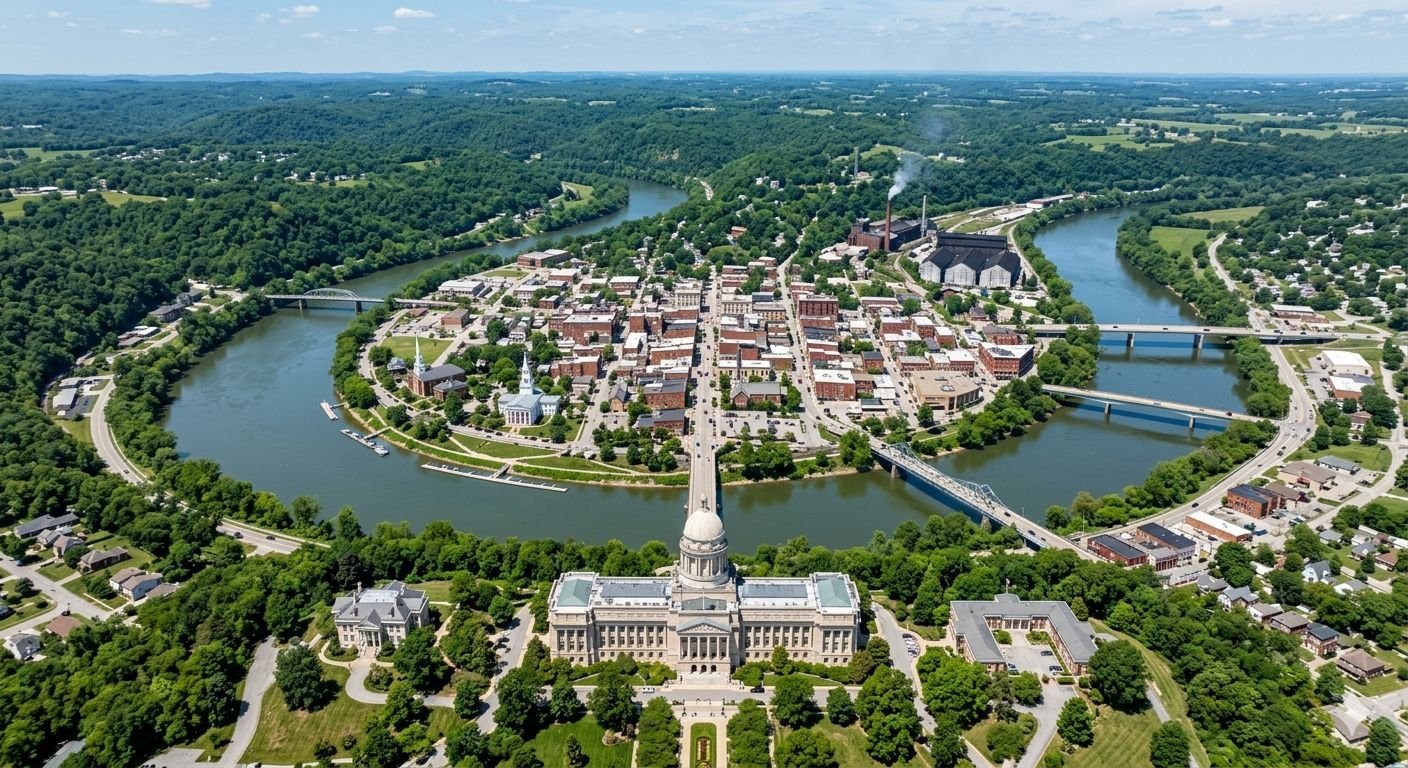
Nestled in the heart of the American South and Midwest, Kentucky is a state that rewards every kind of traveler. Whether you are drawn by the thunder of hooves at Churchill Downs, the amber glow of a bourbon distillery, the mist rolling over ancient caves, or the haunting beauty of Appalachian hollows, Kentucky offers a richness that few states can match. It is a place where history is not kept behind museum glass but lived and breathed in small towns, on rolling farmland, and along winding rivers. Come for the whiskey, stay for the people, and leave with stories that last a lifetime.
Louisville: The Gateway City
Most journeys into Kentucky begin in Louisville, the state’s largest city, sitting on the southern bank of the Ohio River. Louisville is a city with enormous energy and character, blending Southern hospitality with a surprisingly cosmopolitan arts and food scene.
The city’s crown jewel is Churchill Downs, the legendary horse racing venue that has hosted the Kentucky Derby every May since 1875. Even outside of Derby season, a visit to Churchill Downs is worthwhile. The Kentucky Derby Museum on the grounds offers an immersive look at the history of “the most exciting two minutes in sports,” complete with films, exhibits, and a 360-degree panoramic theater that puts you right in the middle of the action. On race days from spring through fall, you can watch live thoroughbred racing from the grandstands.
Downtown Louisville’s NuLu neighborhood — short for New Louisville — is a vibrant stretch of East Market Street packed with galleries, farm-to-table restaurants, boutique shops, and craft cocktail bars. The Louisville Slugger Museum and Factory is another must-see, where you can walk through the process of making the famous baseball bats and hold a mini replica to take home. The Muhammad Ali Center, a stunning museum and cultural complex dedicated to the life and legacy of the Louisville-born boxing legend, is both inspiring and deeply moving.
The Louisville Waterfront Park, stretching for miles along the Ohio River, is perfect for a morning run, a picnic, or simply watching a sunset over the water. The Big Four Bridge, a converted railroad bridge now open only to pedestrians and cyclists, offers one of the finest views of both Louisville and the Indiana shoreline.
The Bourbon Trail
No trip to Kentucky would be complete without exploring its bourbon heritage. Kentucky produces roughly 95 percent of the world’s bourbon supply, and the state takes tremendous pride in that fact. The Kentucky Bourbon Trail is a self-guided tour that winds through some of the most scenic countryside in America, connecting dozens of working distilleries where visitors can learn the craft, nose and taste expressions at every age and mash bill, and soak in the atmosphere of rickhouses stacked floor to ceiling with aging barrels.
In Bardstown, often called the Bourbon Capital of the World, you will find Heaven Hill’s Bourbon Heritage Center, Willett Distillery, and the remarkable Oscar Getz Museum of Whiskey History. Bardstown itself is a charming small town with antebellum architecture, a lively downtown square, and an annual Kentucky Bourbon Festival each September that draws visitors from around the world.
Further afield, the town of Loretto is home to Maker’s Mark, one of the most picturesque distilleries anywhere. Set on a National Historic Landmark property, its red shutters and black-trimmed buildings feel like stepping into a Victorian painting. Visitors can dip their own bottle of Maker’s in the signature red wax, a hands-on experience that makes for an unforgettable souvenir.
Buffalo Trace Distillery in Frankfort, the state capital, is one of the oldest continuously operating distilleries in the United States and produces some of the most sought-after bourbons in the world, including Pappy Van Winkle. Tours here are informative and atmospheric, and the grounds have a genuine sense of history that is hard to replicate.
Wild Turkey in Lawrenceburg, Four Roses in Lawrenceburg and Cox’s Creek, Jim Beam in Clermont, and Woodford Reserve in the scenic Bluegrass near Versailles all round out a trail that could keep a bourbon lover busy for a full week.
The Bluegrass Region
Central Kentucky’s Bluegrass region is one of the most visually striking agricultural landscapes in the world. Gently rolling hills, white plank fences, black four-board fences, and vast horse farms stretch in every direction under wide open skies. The region gets its name from the bluegrass that grows in abundance here, which turns a faint blue-purple when it flowers in spring.
Lexington is the region’s hub, a college town anchored by the University of Kentucky but with a sophisticated food scene, a strong arts community, and an unmistakable equine identity. The Kentucky Horse Park, just north of the city, is a working horse farm and living museum dedicated to the horse’s relationship with humanity. You can see breeds from around the world, watch daily shows, visit the International Museum of the Horse, and even take trail rides. The graves of Man o’ War and other legendary racehorses are on the grounds, and the atmosphere is one of quiet reverence for these magnificent animals.
Keeneland Race Course, just west of Lexington, is widely considered the most beautiful thoroughbred racing facility in the world. Racing takes place only in April and October, but the track is open for morning workouts year-round. Watching horses gallop in the early morning mist with a cup of coffee in hand is one of those simple, perfect experiences that Kentucky offers freely.
The Kentucky Horse Park, Keeneland, and the dozens of stud farms that open for tours — including the famous Three Chimneys and WinStar Farm — make the Bluegrass region essential for any horse enthusiast. But even those with no particular interest in equestrian life will be charmed by the beauty of the countryside.
Mammoth Cave National Park
In south-central Kentucky, the earth opens up into one of the natural wonders of the world. Mammoth Cave is the longest known cave system on the planet, with more than 400 mapped miles of passageways stretching beneath the surface — and explorers are still finding more. The cave has been used by humans for at least 4,000 years, first by Native Americans who mined its minerals, and later by settlers who used it for saltpeter production during the War of 1812.
Today, Mammoth Cave National Park offers a wide range of tours for all fitness levels and interests. The Historic Tour takes visitors through enormous chambers with nineteenth-century signatures scratched into the cave walls. The Frozen Niagara Tour showcases the cave’s most dramatic flowstone formations. For the adventurous, the Wild Cave Tour is a full-day crawl through tight passages and muddy corridors that gives you a genuine sense of what cave exploration feels like.
Above ground, the park’s 53,000 acres of forests, rivers, and ridges offer excellent hiking, cycling, canoeing on the Green River, and wildlife watching. White-tailed deer, wild turkey, and river otters are commonly seen. The park is a dark-sky-friendly area, and stargazing on a clear night is spectacular.
The Red River Gorge and Eastern Kentucky
Eastern Kentucky is a land of dramatic geology and deep cultural roots. The Red River Gorge Geological Area, part of the Daniel Boone National Forest, is a hiker’s paradise of sandstone arches, towering cliffs, narrow gorges, and waterfalls. Natural Bridge State Resort Park sits at the heart of the gorge and features a massive sandstone arch accessible by trail or sky lift. Rock climbers from across the country flock here for some of the best sport climbing in the eastern United States.
The small town of Slade serves as a base for gorge exploration, and the Miguel’s Pizza restaurant near the park entrance has become something of a legendary gathering spot for climbers. Camping throughout the gorge ranges from developed sites to backcountry dispersed camping for those willing to hike in.
Further east, the Cumberland Gap National Historical Park straddles the meeting point of Kentucky, Virginia, and Tennessee, marking the passage through the Appalachian Mountains that Daniel Boone helped to blaze and through which hundreds of thousands of pioneers passed on their way west. The views from the Pinnacle Overlook on a clear day are breathtaking, and the park’s trails wind through both natural beauty and layers of American history.
The small towns of Harlan, Pikeville, and Whitesburg carry the culture of Appalachia — music traditions, quilting, storytelling, and a cuisine all their own. The Appalshop arts and education center in Whitesburg has spent decades documenting and celebrating the culture of the region through film, radio, and theater.
Western Kentucky and the Land Between the Lakes
Western Kentucky is quieter and less visited than the central and eastern parts of the state, but it holds its own remarkable attractions. The Land Between the Lakes National Recreation Area occupies a narrow peninsula between Kentucky Lake and Lake Barkley, two enormous reservoirs formed by dams on the Tennessee and Cumberland Rivers. This 170,000-acre area of forests and wetlands is one of the largest inland peninsulas in the United States and offers outstanding fishing, boating, camping, hiking, and wildlife viewing.
The Elk and Bison Prairie at Land Between the Lakes is a 700-acre enclosed range where visitors can drive through and observe free-roaming elk and American bison up close — an experience that feels genuinely wild and unexpected in this part of the country.
Nearby, the town of Paducah at the confluence of the Tennessee and Ohio Rivers is a small city with an outsized reputation in the quilting world. Paducah hosts the American Quilters Society Quilt Show each April, drawing thousands of visitors and displaying some of the finest textile art anywhere. The National Quilt Museum in downtown Paducah is a stunning gallery dedicated to this traditional American craft. Paducah’s Lowertown Arts District is a charming neighborhood of restored Victorian homes that have been converted into artist studios and galleries.
Kentucky’s Food Culture
Kentucky’s culinary identity is as distinctive as its bourbon. The Hot Brown, invented at the Brown Hotel in Louisville in the 1920s, is an open-faced turkey sandwich smothered in Mornay sauce and topped with crispy bacon, then broiled until bubbling. It is rich, indulgent, and completely satisfying. The Brown Hotel still serves the original, and it is essential eating.
Burgoo is a thick, slow-cooked stew of meats and vegetables that dates back to frontier days and remains a staple at Derby parties and community gatherings across the state. Benedictine spread — a cool, pale green mixture of cream cheese, cucumber, and dill — is a Louisville specialty that appears on sandwiches and canapés throughout the city. Country ham, cured and aged in the old tradition, is a salt-forward delicacy that divides outsiders but is beloved by Kentuckians.
Modjeska candies, named after a nineteenth-century Polish actress who visited Louisville, are soft caramels wrapped around a center of marshmallow and remain a local confection worth seeking out. Derby Pie, a chocolate and walnut tart baked in a pastry shell and trademarked by Louisville’s Kern’s Kitchen, is the definitive Derby season dessert.
Music and Arts
Kentucky has a deep musical heritage rooted in old-time Appalachian music, bluegrass, gospel, and country. Bill Monroe, the father of bluegrass music, was born in Rosine, in western Kentucky, and his hometown holds a small festival in his honor each year. The International Bluegrass Music Museum in Owensboro celebrates the genre with instruments, recordings, photographs, and interactive exhibits. The ROMP Bluegrass Festival, also in Owensboro, is one of the finest outdoor music events in the region each June.
Louisville has a thriving independent music and arts scene. The Louisville Orchestra is nationally respected, the Kentucky Center for the Performing Arts hosts touring Broadway productions and major concerts, and the Speed Art Museum — the state’s largest and oldest art museum — recently underwent a major renovation and is a genuine cultural gem.
Practical Travel Information
The best times to visit Kentucky are spring and fall, when the weather is mild and the landscape is at its most dramatic. Spring brings the Kentucky Derby, blooming wildflowers in the gorge, and peak bourbon festival season. Fall colors in the eastern mountains and the Red River Gorge are spectacular, typically peaking in mid-October.
Summers can be hot and humid, but the caves offer natural cool air relief, and the lakes and rivers are ideal for water recreation. Winters are generally mild by northern standards, with occasional snow that can make the horse farm countryside look particularly magical.
Louisville’s Muhammad Ali International Airport is the main gateway, with Lexington’s Blue Grass Airport serving as a convenient alternative for those focused on the Bluegrass and bourbon regions. Car rental is essential for most of the state, as public transportation outside Louisville is limited.
Kentucky is generally an affordable destination. Distillery tours range from free to around forty dollars for premium experiences. State parks offer excellent value lodging in resort-style lodges and cabins. The people are famously warm and welcoming to visitors, and the pace of life invites slowing down and savoring the moment.
Conclusion
Kentucky is a state that surprises people. Visitors expecting only horse races and bourbon often find themselves drawn in by the landscape, the history, the music, and the food in ways they did not anticipate. It is a state with enormous range — from the urban sophistication of Louisville to the wilderness silence of the Red River Gorge, from the polished elegance of a top distillery to the rough beauty of a Cumberland Mountain trail. Whatever kind of journey you are looking for, Kentucky has a version of it, and it will almost certainly send you home already planning your return.
Leave a Reply
You must be logged in to post a comment.